This article was automatically translated from the original Turkish version.
+1 More
Dimension(s) | 122.9 × 82.6 cm | ||||||||
|---|---|---|---|---|---|---|---|---|---|
Color Usage | Dominance of blue and cool tones | ||||||||
Composition | Single-figure simplified composition | ||||||||
Art Period | Blue Period | ||||||||
Type of Work | Figurative painting | ||||||||
Technique | Oil on canvas | ||||||||
Year of Production | Between 1903 and 1904 | ||||||||
Artist | Pablo Picasso | ||||||||
Location | Art Institute of Chicago United States of America | ||||||||
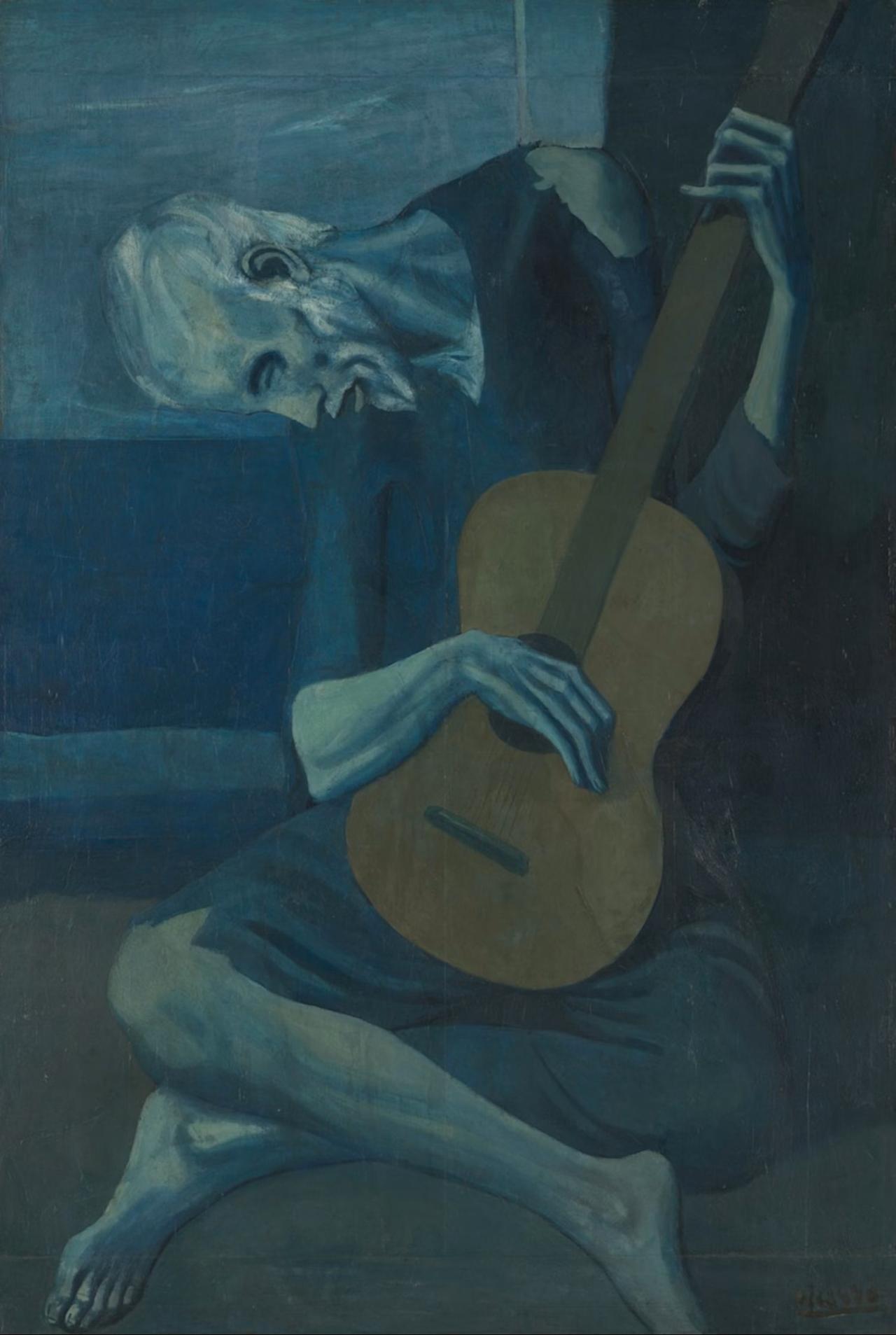
The Old Guitarist (Yaşlı Gitarist), painted by Pablo Picasso between 1903 and 1904, is an oil on canvas work. The piece is situated within the artist’s early period known as the Blue Period. The composition depicts an elderly, impoverished man with his guitar, focusing on human physical and emotional fragility through formal simplicity and a limited color palette.
The work is linked not only to an artistic phase but also to a personal tragedy in Picasso’s life. The suicide of his close friend Carlos Casagemas in 1901 profoundly affected the artist’s psychological state and laid the groundwork for the onset of the Blue Period. Under the influence of this event, Picasso increasingly turned to themes of melancholy and solitude in his works.
The painting is currently held by the Art Institute of Chicago in the United States and is displayed as part of the institution’s modern art collection.
Created during the early phase of Pablo Picasso’s career, The Old Guitarist is regarded among works reflecting his personal and social observations. This period encompassed Picasso’s experience of economic hardship, his marginal position as an artist in Paris, and his focus on themes such as poverty, isolation, and social exclusion. Within this context, The Old Guitarist stands as one of the works in which Picasso deepened his figurative expression and elevated the human body as a vehicle of meaning.
The Old Guitarist (The Art Institute of Chicago)
The years 1903–1904, during which the work was produced, correspond to Picasso’s artistic phase known as the Blue Period. During this time, the artist predominantly employed blue and cool tones near blue in his compositions and centered figures from the lower strata of society. The Old Guitarist exemplifies the defining characteristics of the Blue Period through its color palette, choice of figure, and spatial minimalism. Art historians note that the influence of the Spanish painter El Greco is particularly evident in the formal distortions and dramatic limb structures of figures in this period.
The Old Guitarist was executed in oil on canvas. The surface treatment is controlled and restrained; layers of paint are applied to emphasize the volume of the figure. Anatomical proportions have been deliberately elongated and distorted. This deformation serves as a narrative device to underscore the figure’s physical vulnerability and bodily exhaustion. The background is treated as an integrated plane, stripped of detail.
At the center of the composition is an elderly man depicted in a crouched or seated posture. His body leans forward, his head lowered and fused with his torso. The guitar rests in the figure’s lap and forms the visual focus of the composition. The figure’s eyes are distinctly closed or absent, implying blindness. This motif of blindness, frequently explored by Picasso during this period, emphasizes the figure’s inner world and solitude. The eyes are closed or indistinct; facial expression is devoid of pronounced features. This approach aims not to depict individual identity but to represent a universal human condition.
The dominant colors in the work are blue and cool tones near blue. The color palette is deliberately restricted; spatial depth is achieved through subtle color transitions. The guitar is rendered in relatively warmer tones, creating a visual contrast that highlights the relationship between the figure and the instrument. The use of light is not dramatic but diffuse and soft; the figure’s volume is defined by shadows.
The Old Guitarist embodies themes commonly addressed in Blue Period paintings: melancholy, solitude, and poverty. The figure’s physical posture, closed composition, and color selection generate an introspective narrative. The guitar functions as a symbol of the figure’s limited connection to life. Music here is portrayed not as a public performance but as a personal existential practice. Additionally, the motif of the blind musician has deep roots in Spanish culture; artists such as Goya also treated similar figures, and this theme clearly attracted Picasso’s interest.
In the painting, the figure is not idealized, and anatomical accuracy is subordinated to expressive intent. Elongated limbs, a slender torso, and a bent posture are formal choices that emphasize physical frailty. Picasso’s approach transforms the figure from an aesthetic object into a carrier of narrative. The ambiguity of space allows the figure to be considered outside of time and place.
The Old Guitarist represents a crucial stage in Picasso’s artistic development. The work reflects a period in which the artist deepened his narrative relationship with the figure and intensified his formal experiments. Due to its synthesis of the thematic and formal characteristics of the Blue Period, it is regarded as one of the foundational reference works in studies examining early modern art’s understanding of the figure.


Dimension(s) | 122.9 × 82.6 cm | ||||||||
|---|---|---|---|---|---|---|---|---|---|
Color Usage | Dominance of blue and cool tones | ||||||||
Composition | Single-figure simplified composition | ||||||||
Art Period | Blue Period | ||||||||
Type of Work | Figurative painting | ||||||||
Technique | Oil on canvas | ||||||||
Year of Production | Between 1903 and 1904 | ||||||||
Artist | Pablo Picasso | ||||||||
Location | Art Institute of Chicago United States of America | ||||||||
No Discussion Added Yet
Start discussion for "The Old Guitarist (Painting)" article
Position Within the Artist’s Life
Date of Creation and Context of the Blue Period
Technical Features and Material Use
Composition Structure
Color Use and Light
Thematic Content and Layers of Meaning
Formal Approach and Figurative Understanding
Artistic Context