

This article was automatically translated from the original Turkish version.
+2 More
Plevne March is a military march composed from folk songs that emerged among the people, commemorating the resistance and heroism displayed by the Ottoman army under the command of Gazi Osman Pasha during the Siege of Plevna in the 1877–1878 Russo-Turkish War (also known as the 93 War). The march became one of the war’s most enduring symbols and generated widespread resonance across the Ottoman territories and around the world.
Plevne March (Master Kemânkeş)
The Battles of Plevna took place on the western front of the 1877–1878 Russo-Turkish War between 8 July and 10 December 1877. Under the command of Gazi Osman Pasha, the Ottoman army held a defensive position for 145 days against numerically and materially superior Russian and Romanian forces. This resistance is regarded as one of the most distinguished chapters in Ottoman military history and served as a vital source of morale for the population.
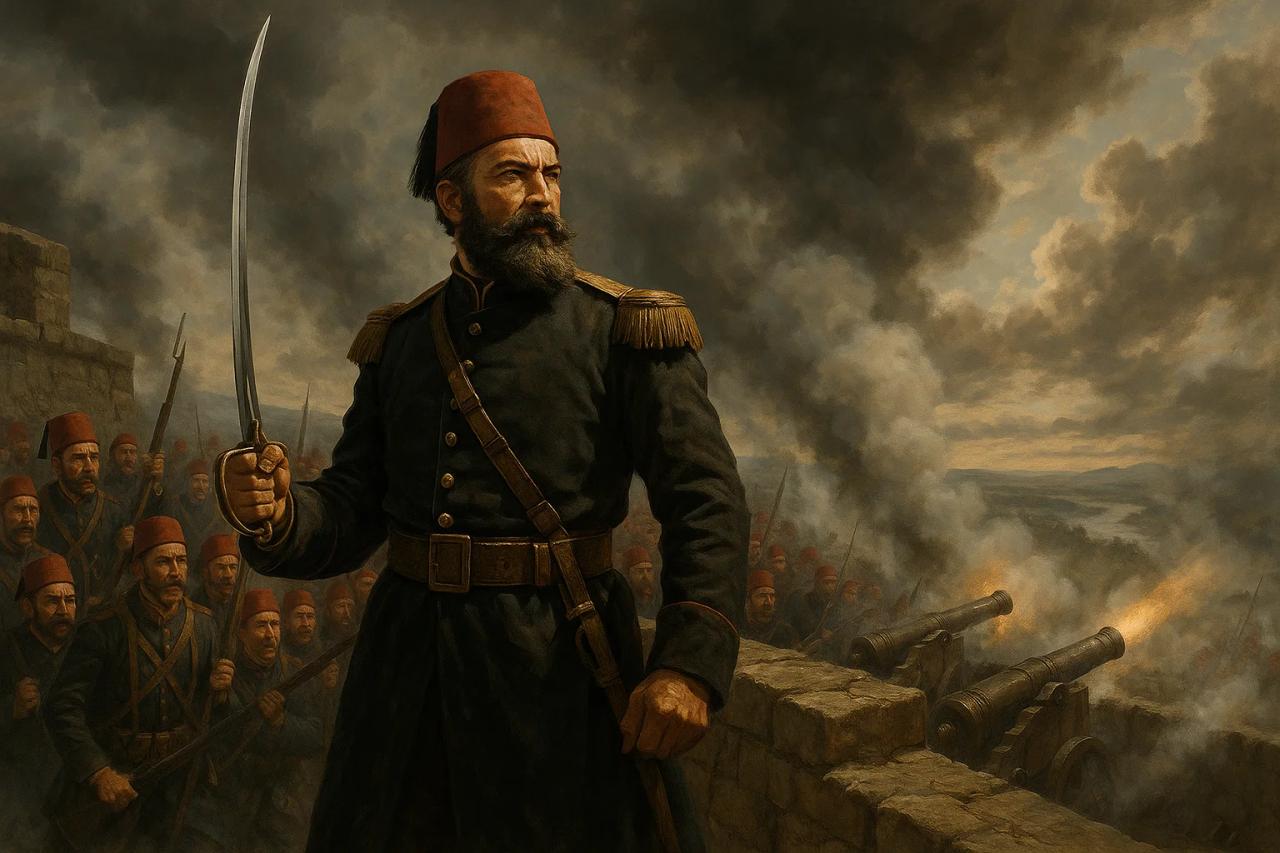
Representative Image of the Battles of Plevna (Generated by Artificial Intelligence.)
During the Battles of Plevna, folk songs naturally arose among the soldiers and civilians, reflecting the events, heroism, and emotions of the conflict. These songs were transmitted orally from generation to generation and adopted by Turkish communities across diverse regions. In Mehmet Naci Önal’s work Plevna Folk Songs, a total of 51 Plevna folk songs sung in the Balkans, Crimea, Kirkuk, Kazakhstan and Türkiye have been collected.【1】
The most frequently repeated quatrains from the Plevna folk songs were first arranged into a military march by Miralay Mehmet Ali Bey (1825–1895), a bandmaster of the Mızıka-i Hümayun. This composition played a crucial role in spreading the songs across wide geographical areas. The lyrics of the march vary slightly across different sources, incorporating various quatrains.
The Plevne March is based on syllabic meter and typically consists of lines of eight and eleven syllables. Its lyrics explore themes such as the Danube River, the resistance of Gazi Osman Pasha, love of homeland, and steadfastness against the enemy. Here is a well-known version of the march:
The Danube River says it will not flow
It says it will not wash away my surroundings
The glorious Osman Pasha
Will not leave Plevna
Can this be so, can this be so
Can a child strike his father
Those traitors of the nation
Will this world belong to you
I struck my sword against stone
The stone split from top to bottom
The glorious name of Osman Pasha
May he and his soldiers live for thousands of years.【2】
Abuğ, Elif Sena. “Mehmet Naci Önal - Plevne Türküleri.” *Çukurova Üniversitesi İlahiyat Fakültesi Dergisi (ÇÜİFD)*, 2021. Accessed September 28, 2025. https://doi.org/10.30627/CUILAH.993167
Kirişçi Yıldız, Beyza. “Plevne Marşı’nın Hikayesi.” GZT Jurnalist Infografik. Accessed September 28, 2025. https://www.gzt.com/infografik/jurnalist/plevne-marsinin-hikayesi-2932/1
Ministry of National Defense. *Gazî Osman Paşa ve Plevne Savunması: Gazi Osman Paşa’nın Plevne Savunması ve Türk Askerinin Kahramanlık Destanı.* Ankara: Genelkurmay Basımevi, 1982. Accessed September 28, 2025. https://www.msb.gov.tr/Content/Upload/Docs/askeritariharsiv/25_gaziosman_pasa_plevne_savunmasi.pdf
Yüksel, Ahmet, and Hasan Babacan. “Plevne ve Gazi Osman Paşa’yı Dünya Gözüyle Görmek.” *History Studies* 10, no. 6 (2018): 245–268. Accessed September 28, 2025. https://www.historystudies.net/dergi/plevne-ve-gazi-osman-pasayi-dunya-gozuyle-gormek2018095330298.pdf
Üstad Kemânkeş. “Plevne Marşı.” YouTube video. Accessed September 28, 2025. https://www.youtube.com/watch?v=JJ01mUvSm04&list=RDJJ01mUvSm04&start_radio=1
[1]
Elif Sena Abuğ, “Mehmet Naci Önal - Plevne Türküleri,” Çukurova Üniversitesi İlahiyat Fakültesi Dergisi (ÇÜİFD), 2021. https://doi.org/10.30627/CUILAH.993167
[2]
Elif Sena Abuğ, “Mehmet Naci Önal - Plevne Türküleri,” Çukurova Üniversitesi İlahiyat Fakültesi Dergisi (ÇÜİFD), 2021. s. 796. https://doi.org/10.30627/CUILAH.993167

Historical Background
Origins of the Plevna Folk Songs
Composition of the Plevne March
Lyrics and Musical Structure
Dissemination and Impact of the Plevne March