Artist | Vincent van Gogh | ||||||||
|---|---|---|---|---|---|---|---|---|---|
Date(s) | April–May 1885 | ||||||||
Location | Van Gogh Museum Amsterdam | ||||||||
Technique | Oil on Canvas | ||||||||
Dimension(s) | 82 x 114 cm | ||||||||
Color Palette | Earth Tones, Low-contrast Grayish Green and Browns | ||||||||
Topic | A Simple Evening Meal Scene Where a Peasant Family is Eating Potatoes | ||||||||
Significance | Van Gogh’s First Large-scale Figurative Work; Sincerely and Symbolically Portrays Peasant Life | ||||||||
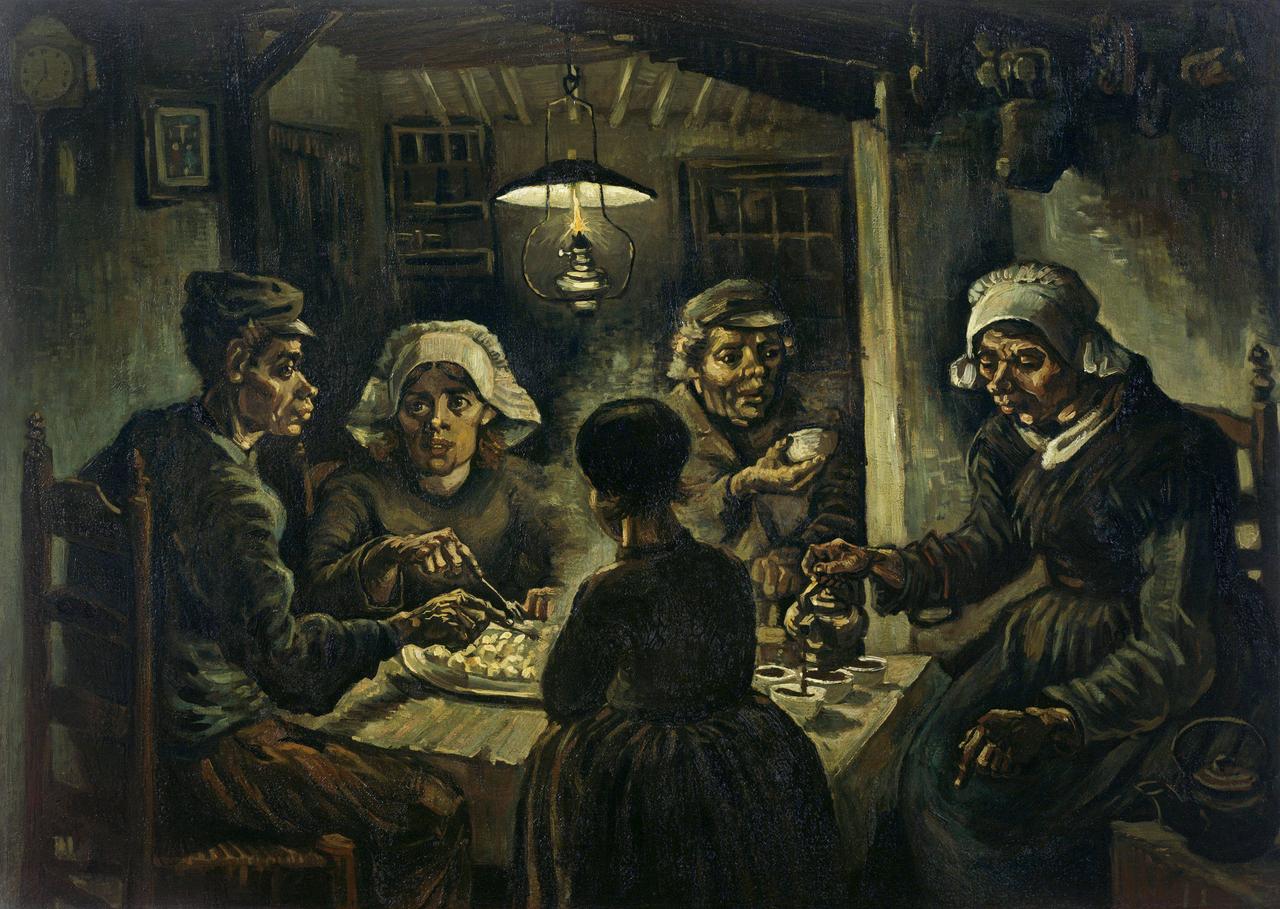
The Potato Eaters, painted by Dutch artist Vincent van Gogh (1853–1890) in April–May 1885 in the town of Nuenen, Netherlands, is an oil-on-canvas painting measuring 82 x 114 cm. Today, it is housed in the Van Gogh Museum in Amsterdam (Vincent van Gogh Foundation collection). The painting depicts an evening meal scene of a five-member peasant family eating potatoes and drinking coffee under a dim lamp at a shared table.
As Van Gogh’s first large-scale and thematically cohesive figurative work, this painting reflects the artist’s admiration for peasant life, his power of social observation, and his spiritual quest. The deliberately dark color palette, the harshness of the figures, and the imbalance in the composition show that Van Gogh prioritized expressive sincerity over academic perfection.
After moving in with his family in the Brabant region’s town of Nuenen in 1883, Van Gogh intensified his observations of peasant life and developed close contact with local agricultural workers. In particular, the De Groot-van Rooij family served as models for this work. Before starting the painting, Van Gogh created over 40 portrait studies, more than 20 hand drawings, and numerous interior sketches throughout the winter. This process was part of his previously stated goal of mastering figurative painting.
Although the main composition was painted within only three days, this speed was the result of months of preparatory work. After completing the piece, Van Gogh sent it to his brother Theo in hopes of receiving feedback from the Parisian art circles. However, the painting was not well received at the time and was even criticized by some artists as being “caricature-like.”
Some of the criticism targeted Van Gogh’s shortcomings in perspective, anatomical proportions, and spatial arrangement. Yet the artist emphasized in many of his letters that his priority was not technical perfection but bringing the painting to life and conveying its character. For Van Gogh, these figures represented not only “realism” but also a moral and spiritual condition.
Vincent van Gogh began his art career relatively late, at the age of 27, and left a profound mark on art history in a short span of just ten years. Born in the town of Zundert, Netherlands, Van Gogh initially tried to follow in his father’s footsteps by becoming a clergyman and preaching to miners in Belgium. However, conflicts with religious authorities and a personal emotional crisis led him toward art.

Vincent van Gogh (1853–1890). (flickr)
Van Gogh’s early works are characterized by dark colors, emotional intensity, and a focus on peasant life. His greatest supporter and companion was his brother Theo van Gogh. The hundreds of letters he wrote to Theo reflect his deep thoughts on art and life, his loneliness, and his inner search. Completed in 1885, The Potato Eaters is seen as the first fruit of his artistic maturity. The artist would later evaluate the painting as follows:
“That painting of the potato eaters I did in Nuenen was, in the end, the best thing I did.”【1】
The painting shows five figures sharing a simple dinner around a common table. The only light source in the composition is a single oil lamp. Van Gogh interpreted this dim light as a spiritual moment of unity that transcends individual solitude. As he wrote in one of his letters:
“I wanted to convey the idea that these people, who are eating their potatoes by the light of their lamp, have dug the earth with those same hands. That it is thus that they have honestly earned their food.”【2】
The figures' hands are large and bony, their faces tired and coarse; these details reflect not only physical hardship but also the material and spiritual weight of their lives. The beverage pouring from the teapot in the woman’s hand is not coffee but chicory—a common substitute among the poor at the time—highlighting their deprivation.
The earth tones used by Van Gogh—especially grays, greenish blues, and dark browns—reinforce the connection between the peasants and nature, creating a metaphorical link between the potatoes and the figures’ faces and hands. In the artist’s own words:
“Their faces are the color of a dusty unpeeled potato.”【3】

Potato Eaters, Vincent van Gogh. (rawpixel)
The potato (Solanum tuberosum) was brought to Europe from the Americas in the 16th century, initially used as an ornamental or medicinal plant. However, from the late 17th century onwards, it became a staple food, especially in Central and Northern Europe. Compared to grains, it offered higher yields and required labor, making it a key resource for the poor both nutritionally and economically.
The famines of the late 18th century (notably 1770–72) increased the significance of the potato as a staple food, contributing to population growth in the 19th century. However, this dependence also led to catastrophic events such as the Great Irish Famine in the 1840s due to potato blight, which caused massive poverty and migration.
Although Van Gogh does not directly reference this historical background, the potato serves as a symbol in the painting—not just a food, but an emblem of labor, solidarity, and poverty. Van Gogh's aim was to present this modest table as “a kind of spiritual ritual,” reminding urban art lovers of the sincerity and value of rural life.
Before completing the final version, Van Gogh created two earlier versions, three studies, and even produced a lithograph of the work, which was distributed in Paris via his brother. The interplay of light and shadow in the painting resembles the clair-obscur technique. The artist intentionally left the proportions of the figures imperfect, using exaggerated hands and faces to develop a distinctive expressive language.
After this composition, Van Gogh would shift to brighter colors and simpler forms, but The Potato Eaters remains the pinnacle of his figurative realism.
After the artist’s death, the painting passed to his brother Theo, then to Theo’s wife Jo van Gogh-Bonger, and later to their son Vincent Willem van Gogh. In 1962, it was transferred to the Vincent van Gogh Foundation, and since 1973, it has been permanently exhibited at the Van Gogh Museum in Amsterdam. An earlier version of the painting is held at the Kröller-Müller Museum in Otterlo. Over time, The Potato Eaters has become one of Van Gogh’s most recognized works, frequently featured in exhibitions, textbooks, and art historical discussions.
De Jong, H. “Potato in Europe: History, Nutrition and Its Influence on Human Health.” American Journal of Potato Research 93 (2016): 1–12. Accessed August 7, 2025. https://link.springer.com/article/10.1007/s12230-016-9529-1.
Dsouza, Jeanne. “The Potato Eaters: Brushstrokes of Sickness and Sustenance.” Hektoen International. Accessed August 7, 2025. https://hekint.org/2021/08/02/the-potato-eaters-brushstrokes-of-sickness-and-sustenance/.
Hautvast, Joseph G. A. J. “The Potato Eaters.” The Lancet 354, no. 9186 (1999): 1446. Accessed August 7, 2025. https://www.thelancet.com/journals/lancet/article/PIIS014067369990380X/fulltext.
Kröller-Müller Museum. “The Potato Eaters.” Kröller-Müller Museum. Accessed August 7, 2025. https://krollermuller.nl/en/vincent-van-gogh-the-potato-eaters-1.
Museo Nacional Thyssen-Bornemisza. “The Potato Eaters, Vincent van Gogh.” Museo Nacional Thyssen-Bornemisza. Accessed August 7, 2025. https://www.museothyssen.org/en/collection/artists/gogh-vincent-van/potato-eaters.
Philadelphia Museum of Art. “Van Gogh’s The Potato Eaters.” Philadelphia Museum. Accessed August 7, 2025. https://philamuseum.org/calendar/exhibition/van-gogh-potato-eaters.
Potter, Polyxeni. “Sometimes the Naked Taste of Potato Reminds Me of Being Poor.” Emerging Infectious Diseases 15, no. 6 (June 2009): 1000–1001. Accessed August 7, 2025. https://pmc.ncbi.nlm.nih.gov/articles/PMC2727344/pdf/AbouttheCoverJune09.pdf.
Prins, Laura. “Towards The Potato Eaters: The Long-Awaited Genesis of a Masterpiece.” 2015. Accessed August 7, 2025. https://d1wqtxts1xzle7.cloudfront.net/71842871/Prins_2015_Van_Gogh_s_potato_eaters-libre.pdf.
Van Gogh Museum. “The Potato Eaters JPG.” Flickr. Accessed August 7, 2025. https://www.flickr.com/photos/28355810@N05/9473277472/in/photostream/.
Van Gogh Museum. “The Potato Eaters.” Van Gogh Museum. Accessed August 7, 2025. https://www.vangoghmuseum.nl/en/collection/s0005v1962.
Vincent van Gogh Gallery. “The Potato Eaters by Vincent van Gogh.” Vincent van Gogh Gallery. Accessed August 7, 2025. https://www.vincentvangogh.org/potato-eaters.jsp.
Zucker, Steven, and Beth Harris. “Van Gogh, The Potato Eaters.” SmartHistory. Accessed August 7, 2025. https://smarthistory.org/van-gogh-potato-eaters/.
[1]
Laura Prins, “Towards The Potato Eaters: The Long-Awaited Genesis of a Masterpiece,” in The New Potato Eaters: Van Gogh in Nuenen, 1883–1885, ed. Paul Williamson (2015), 46, Accessed August 7, 2025, https://www.academia.edu/32041217/Towards_The_Potato_Eaters_The_Long_Awaited_Genesis_of_a_Masterpiece.
[2]
Museo Thyssen-Bornemisza. “The Potato Eaters.” Museo Thyssen-Bornemisza Collection. Accessed August 7, 2025. https://www.museothyssen.org/en/collection/artists/gogh-vincent-van/potato-eaters.
[3]
Van Gogh Museum. “The Potato Eaters.” Van Gogh Museum Collection. Accessed August 7, 2025. https://www.vangoghmuseum.nl/en/collection/s0005v1962.

Artist | Vincent van Gogh | ||||||||
|---|---|---|---|---|---|---|---|---|---|
Date(s) | April–May 1885 | ||||||||
Location | Van Gogh Museum Amsterdam | ||||||||
Technique | Oil on Canvas | ||||||||
Dimension(s) | 82 x 114 cm | ||||||||
Color Palette | Earth Tones, Low-contrast Grayish Green and Browns | ||||||||
Topic | A Simple Evening Meal Scene Where a Peasant Family is Eating Potatoes | ||||||||
Significance | Van Gogh’s First Large-scale Figurative Work; Sincerely and Symbolically Portrays Peasant Life | ||||||||
No Discussion Added Yet
Start discussion for "The Potato Eaters (Painting)" article
History and Creation Process
The Painter: Vincent van Gogh (1853–1890)
Artistic Content and Narrative
The Historical Context of the Potato and Its Role in the Painting
Technical Features
Conservation and Museum Display
This article was created with the support of artificial intelligence.