
This article was automatically translated from the original Turkish version.
+1 More
Author(s) | Nihad Sâmi Banarlı | ||||||||
|---|---|---|---|---|---|---|---|---|---|
Publisher(s) | Kubbealtı Neşriyat | ||||||||
First Publication Year | 1972 | ||||||||
Number of Pages | 317 | ||||||||
Type(s) | Deneme Dil ve Edebiyat | ||||||||
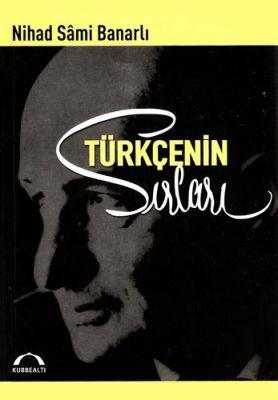
The Secrets of Turkish is a significant work by Nihad Sâmi Banarlı that reveals his historical, aesthetic, and cultural perspective on the Turkish language. The work argues for the preservation of traditional structures in the face of language policies and advocates for the adoption of the language as embraced by the people. Banarlı’s approach draws attention to the importance of national consciousness and literary aesthetics while emphasizing that the language must develop in harmony with its origins.
The work consists of essays written by Banarlı on the Turkish language. Comprising forty-three sections, these texts complement each other both formally and thematically, offering a comprehensive approach to Turkish phonology, aesthetic dimensions, historical development, and expressive power. Since its first publication in 1972, the book has reached a broad readership through multiple editions.
Banarlı views Turkish not merely as a means of communication but as a historical, cultural, and aesthetic heritage. According to him, words in Turkish have been shaped by the emotional world of the people and, over time, refined in sound and meaning to attain the value of precious jewels. This understanding is expressed in the following passage by the author:
“Such words in languages, like drops of spring rain falling into mother-of-pearl and then transformed through time and patience into large, luminous pearls, have been shaped with care and endurance.” 【1】
The author sees language as the memory and identity of a nation. To him, tampering with language is equivalent to tampering with the essence of the nation. For this reason, he criticizes ideological interventions imposed from outside on Turkish. He asserts that responsibility for the language belongs not only to language and literature teachers but to all segments of society.
Banarlı defines Turkish as an “imperial language.” This language has enriched itself by absorbing words from various regions and adapting them to its own structure. He opposes the movement of purism that excludes words adopted by the people. According to him, the strength of imperial languages lies in their ability to nationalize the words they incorporate.
The concept of “White Language” represents Banarlı’s advocacy of moderate simplification. He argues that linguistic simplification is possible only through words embraced and shaped by the people. Ömer Seyfettin is identified as a representative of this approach, while literary groups such as Servet-i Fünun and Fecr-i Ati are regarded as important stages in this linguistic evolution.
In the work, the combination of words to form new and meaningful compounds is termed “marriage of words.” The resulting compound words—such as demiryolu (railway), karayel (northerly wind), yavruağzı (cub’s mouth), and cankurtaran (lifesaver)—are highlighted as evidence of Turkish’s richness. The author also notes that this concept extends to personal names and is shaped by popular approval.
Banarlı criticizes certain newly coined words introduced during the language reform, such as görüt, tümce, ilginç, and aygıt. He argues that these words contribute nothing to Turkish unless they are adopted by the people. He also contends that certain morphological changes—such as replacing -sal and -sel with nispet î’si—are inconsistent and contrary to linguistic aesthetics.
Banarlı notes that many words used in Turkish have been inscribed into the people’s memory through centuries of evolution. Therefore, he advocates preserving and sustaining words accepted by the people rather than rejecting them. In his view, the history of words is equivalent to the history of the nation.
The author regards Turkish as an ideal poetic language in terms of aesthetics and harmony. The poetry of Yahya Kemal, along with works by Mehmet Akif Ersoy, Ahmet Haşim, and Faruk Nafiz Çamlıbel, is cited as evidence supporting this view.
Banarlı grounds his thoughts on the Turkish language in the views of Ali Şir Nevâî. Nevâî’s description of Turkish as a “rose garden” serves as a source that supports the author’s emotional and affectionate approach to the language.
Banarlı, Nihad Sâmi. *Türkçenin Sırları*. İstanbul: Kubbealtı Neşriyat, 1972. Accessed June 26, 2025. https://kubbealti.org.tr/kitap/turkcenin-sirlari
Dıramalı, Cansu. “Kitap Tanıtma: Türkçenin Sırları.” *Türk Dünyası Araştırmaları* 117, no. 231 (November–December 2017): 229–234. Accessed June 26, 2025. https://dergipark.org.tr/en/download/article-file/1513786
“Türkçenin Sırları.” *Türk Edebiyatı Platformu*. Accessed June 26, 2025. https://www.turkedebiyati.org/turkcenin-sirlari/
[1]
Nihad Sâmi Banarlı, Türkçenin Sırları (İstanbul: Kubbealtı Neşriyat, 1972), aktaran Cansu Dıramalı, “Kitap Tanıtma: Türkçenin Sırları,” Türk Dünyası Araştırmaları 117, no. 231 (Kasım–Aralık 2017): 234.

Author(s) | Nihad Sâmi Banarlı | ||||||||
|---|---|---|---|---|---|---|---|---|---|
Publisher(s) | Kubbealtı Neşriyat | ||||||||
First Publication Year | 1972 | ||||||||
Number of Pages | 317 | ||||||||
Type(s) | Deneme Dil ve Edebiyat | ||||||||
No Discussion Added Yet
Start discussion for "The Secrets of Turkish (Book)" article
Content and Thematic Structure
An Aesthetic Perspective on Turkish
Language and Nation
Turkish as an Imperial Language
White Language and Linguistic Simplification
Marriage of Words
Criticized Transformations and New Words
Historical Depth and Word Preservation
Turkish as a Poetic Language
Reference to Ali Şir Nevâî