

This article was automatically translated from the original Turkish version.
Original Title | The Straight Story | ||||||||
|---|---|---|---|---|---|---|---|---|---|
Production Year / Country | 1999 / USA | ||||||||
Genre | Drama road film | ||||||||
Director(s) | David Lynch | ||||||||
Screenplay(s) | John Roach Mary Sweeney | ||||||||
Duration | 111 minutes | ||||||||
Language(s) | English | ||||||||
Main Cast | Richard Farnsworth (Alvin Straight), Sissy Spacek (Rose Straight), Harry Dean Stanton (Lyle Straight), Everett McGill (Tom the Dealer), James Cada (Danny Riordan), Barbara E. Robertson (Deer Woman) | ||||||||
Notable Achievements | Cannes 1999 Golden Palm nomination; Oscar 2000 Best Actor nomination; Independent Spirit Award for Best Actor; NYFCC Awards for Best Actor and Cinematography | ||||||||
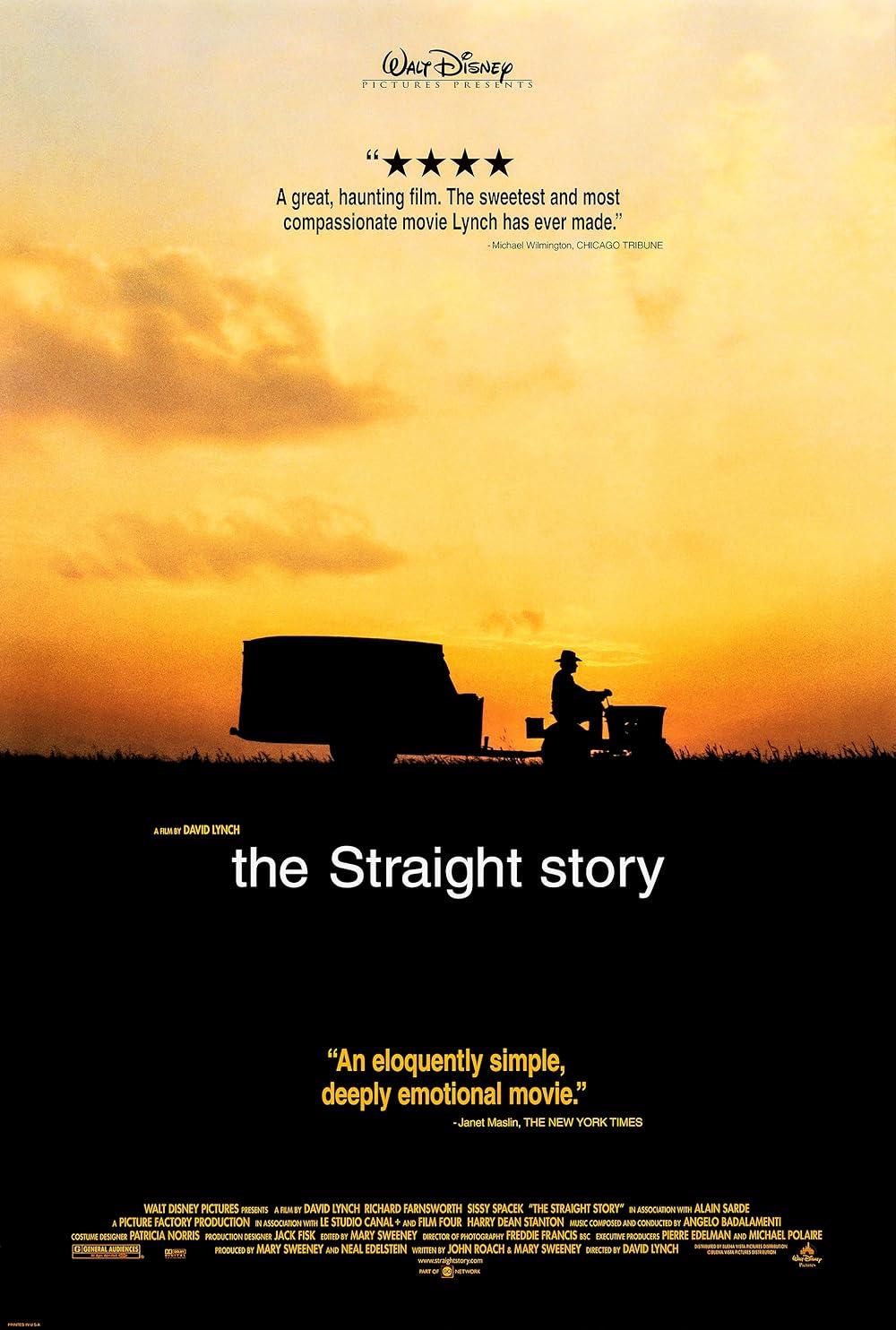
Straight’s Story is a road and reconciliation film inspired by a true event, focusing on an elderly townsman’s journey to confront his past. The narrative unfolds across the American Midwest with a simple, low-tempo, episodic progression. At its center is a character whose physical capabilities are limited but whose determination is unwavering. The visual storytelling highlights the quiet serenity of rural landscapes and the subtlety of everyday encounters. Emotional intensity is built not through grand dramatic climaxes but through small encounters and brief conversations. The choice of time and place generates a cinematic language that gently amplifies the theme of the journey. The result is a personal story of reconciliation told in a simple yet powerful voice against a broad social backdrop.
The formal approach approaches the protagonist’s inner world through unobtrusive camera work and a calm narrative rhythm. The brief stories of individuals met along the way accompany his reckoning with the past, adding layers to the narrative. The sound design uses musical cues sparingly; natural elements such as wind, road, and engine sounds define the atmosphere. The film aims to evoke empathy without relying on didactic or melodramatic devices. Simplicity and stillness make visible the possibility of inner acceptance as significant as the physical distance traveled. The structure brings to light moments of human solidarity within everyday reality. This choice is one of the factors that distinguish and render the film enduring within its genre.
The story begins when an elderly man sets out on a journey to meet his sick brother. Lacking a car and a driver’s license, the protagonist chooses to travel on a lawnmower, embarking on a path that demands patience. Along the way, the people he meets offer small gestures and brief conversations that both assist him and enrich the narrative fabric. Regrets and fractures from the past resurface at every stage of the journey. The storytelling relies not on grand events but on the quiet intensity of everyday encounters. As the journey progresses, the significance of the intended meeting becomes as weighty as the journey itself. The tale transforms from a simple visit into a life accounting.
The narrative structure maintains a linear flow while adopting an episodic form. Each stop functions like a small mirror reflecting a fragment of the protagonist’s personal history. Dialogues avoid ornate rhetoric, instead generating emotional resonance through everyday speech and short sentences. The mise-en-scène breathes through balanced transitions between expansive outdoor spaces and modest interiors. The road itself is treated as a dramatic figure embodying the protagonist’s resistance. Thus movement and distance become authentic companions to inner transformation. All these choices solidify the narrative’s power in its modest scale.

Alvin Straight in Straight’s Story – IMDb
The cinematography draws on wide shots that depict the agricultural texture and seasonal transitions of the Midwest. The use of color and light merges the tranquility of pastoral landscapes with a melancholic tone. The camera mostly operates with static or limited movement, adapting to the protagonist’s slow pace. The editing avoids sharp dramatic emphasis, foregrounding the internal continuity of the episodic narrative. Transitions between scenes are supported by audio bridges and ambient noise. The overall technical approach prioritizes emotional authenticity over spectacle. The measured harmony between form and content underscores the film’s subtle yet profound impact.
In cinematography, the variability of natural light allows the landscape to establish an authentic atmosphere without idealization. Wind, engine, and road sounds become defining elements of each scene’s emotional tone. The sound design does not amplify scenes but reveals their environmental reality. Location choices emphasize the protagonist’s solitude and resolve through a balanced interplay of interior and exterior spaces. The editing carries the tension between physical frailty and mental resilience at a consistent rhythm. This approach interprets the journey theme through cinematic patience and stillness. The outcome is a technical framework that conveys high expressive power through minimal gestures.
Richard Farnsworth (Alvin Straight) portrays the protagonist with a blend of dignity, delicacy, and determination. His performance advances through an internal voice that avoids grand gestures, generating emotional impact through the simplicity of speech. The character’s stubbornness is balanced by gentle mannerisms, and this contrast fuels the journey’s persuasive power. The actor’s age and physical appearance enhance the role’s realism. Thus the lead becomes the central gravitational force representing the film’s moral backbone. The audience experiences the protagonist’s personal reckoning through extended close-ups and prolonged silences. This interpretation establishes a tone that is both calm and deeply unsettling, in harmony with the narrative.
Sissy Spacek (Rose Straight) embodies the supporting axis, portraying fragile familial bonds and forming one of the story’s emotional pillars. Harry Dean Stanton (Lyle Straight) represents the face of the bridge between past and present as the intended recipient of the final meeting. Everett McGill (Tom the Dealer) brings the tone of local life to the narrative as one of the characters encountered on the road. James Cada (Danny Riordan) creates a moment of respite during the journey with his hospitable and intuitive demeanor. Brief yet memorable roles such as Barbara E. Robertson (Deer Woman) illustrate the diversity of individual life stories. The restrained performances of the supporting cast support the protagonist’s transformation without obscuring it. A balance is maintained between ensemble acting and individual interpretation.
Critics locate the source of the film’s dramatic power in the equilibrium between simple storytelling and deep emotion. The small stories of characters met along the way provide a framework that accompanies the protagonist’s reckoning with his past. The naturalism of the cinematography enables the landscape to create an authentic atmosphere without idealization. Dialogues reveal the inner lives of characters through the subtlety of everyday speech. The rhythm invites the viewer into an emotional flow, avoiding manipulative exaggerations. The human weight carried by the lead performance ensures the continuity of the drama. The overall picture makes visible the cinematic power of simplicity.
Moreover, the film transforms the “road” from a sequence of events into a stage for inner confrontation. The balance between sound and silence throughout the narrative strengthens the connection between landscape and emotion. The episodic structure reinforces thematic continuity rather than disrupting it; each stop carries a trace from the protagonist’s past. Camera scale and framing choices carefully adjust the viewer’s distance. In this way, the production explores the possibilities of human solidarity without romanticizing an outsider’s perspective. Ultimately, the film stands as an example that proves the impact of small gestures and few words. This positioning explains its sustained critical attention over the years.
IMDb. "The Straight Story (1999)." Accessed October 8, 2025. https://www.imdb.com/title/tt0166896/
IMDb. "The Straight Story – Awards." Accessed October 8, 2025. https://www.imdb.com/title/tt0166896/awards/?ref_=tt_ov_at_op_awd
IMDb. "The Straight Story – Filming Locations." Accessed October 8, 2025. https://www.imdb.com/title/tt0166896/locations/?ref_=tt_ov_at_dt_flmg
IMDb. "The Straight Story – Full Cast & Crew." Accessed October 8, 2025. https://www.imdb.com/title/tt0166896/fullcredits/?ref_=tt_ov_at_pop_cst
IMDb. "The Straight Story – Media Index." Accessed October 8, 2025. https://www.imdb.com/title/tt0166896/mediaindex/?ref_=tt_ov_at_pop_ph
IMDb. "The Straight Story – Plot Summary." Accessed October 8, 2025. https://www.imdb.com/title/tt0166896/plotsummary/?ref_=tt_ov_at_pl_pl
IMDb. "The Straight Story – Release Info." Accessed October 8, 2025. https://www.imdb.com/title/tt0166896/releaseinfo/?ref_=tt_ov_at_dt_rdat
MUBI. "The Straight Story." Accessed October 8, 2025. https://mubi.com/tr/tr/films/the-straight-story
MUBI. “The Straight Story – Awards.” Accessed October 8, 2025. https://mubi.com/tr/films/the-straight-story/awards
RogerEbert.com. “The Straight Story (1999).” Accessed October 8, 2025. https://www.rogerebert.com/reviews/the-straight-story-1999
The Straight Story. Directed by David Lynch. Asymmetrical Productions; Le Studio Canal+; Walt Disney Pictures, 1999.

Original Title | The Straight Story | ||||||||
|---|---|---|---|---|---|---|---|---|---|
Production Year / Country | 1999 / USA | ||||||||
Genre | Drama road film | ||||||||
Director(s) | David Lynch | ||||||||
Screenplay(s) | John Roach Mary Sweeney | ||||||||
Duration | 111 minutes | ||||||||
Language(s) | English | ||||||||
Main Cast | Richard Farnsworth (Alvin Straight), Sissy Spacek (Rose Straight), Harry Dean Stanton (Lyle Straight), Everett McGill (Tom the Dealer), James Cada (Danny Riordan), Barbara E. Robertson (Deer Woman) | ||||||||
Notable Achievements | Cannes 1999 Golden Palm nomination; Oscar 2000 Best Actor nomination; Independent Spirit Award for Best Actor; NYFCC Awards for Best Actor and Cinematography | ||||||||
No Discussion Added Yet
Start discussion for "The Story of Straight (Film)" article
Subject and Narrative Structure
Production and Technical Features
Actors and Characters
Critical Evaluation
Awards and Selections