This article was automatically translated from the original Turkish version.
+2 More
Original Name(s) | The Three Ages of Woman | ||||||||
|---|---|---|---|---|---|---|---|---|---|
Date(s) | 1905 | ||||||||
Style | Symbolism, Art Nouveau | ||||||||
Technique | Oil on canvas | ||||||||
Artist | Gustav Klimt | ||||||||
Location | National Gallery of Modern Art Rome / Italy | ||||||||
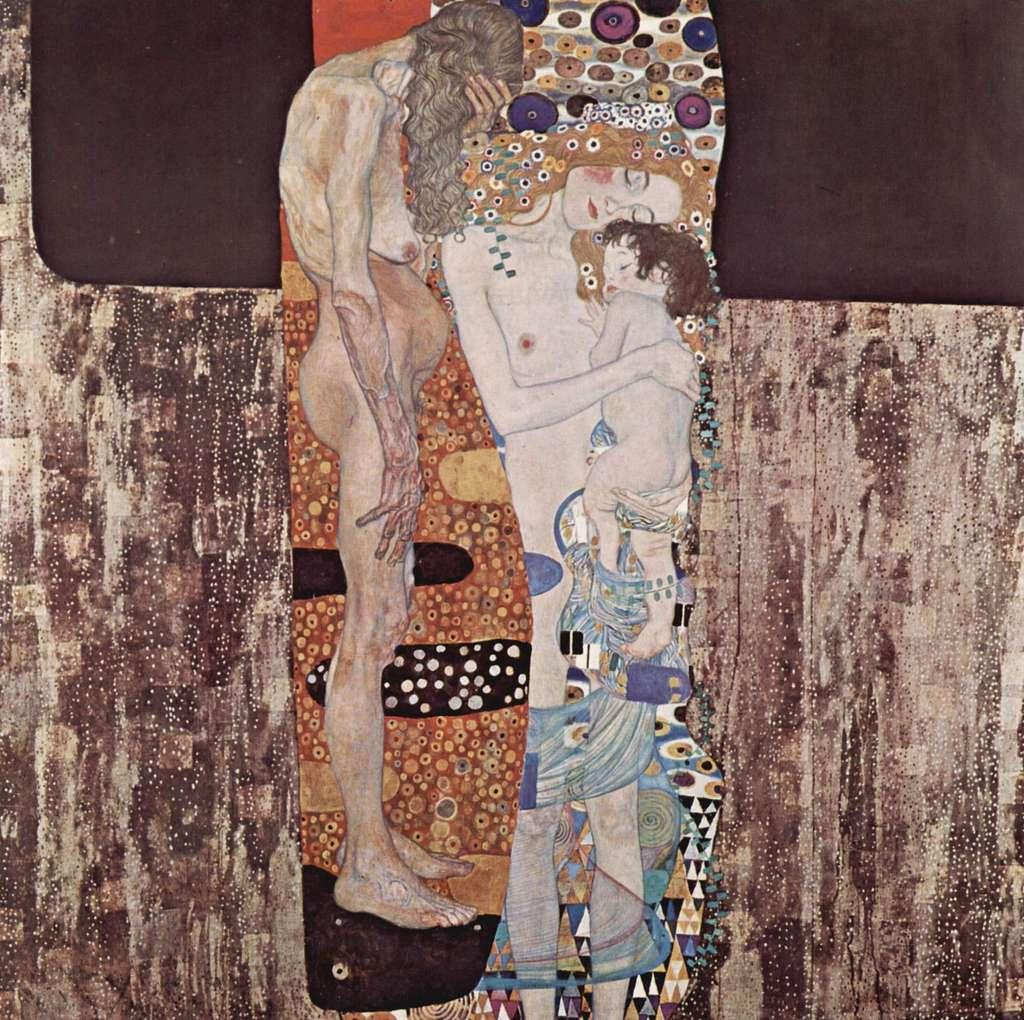
The Three Ages of Woman is an oil painting created in 1905 by Austrian painter Gustav Klimt, in which the artist explores the themes of life and death, fertility, and the female body through a symbolic language.
The work depicts three stages of a woman’s life—childhood, adulthood, and old age—through three female figures. The young woman on the right, holding a child in her arms, symbolizes the continuity of life. The elderly woman on the left represents the aging of the body and the final stage of life. The elderly woman’s body is rendered with exceptional realism and detail by Klimt. Elements such as blue veins, sagging skin, prominent bones, and a sunken abdomen dramatically convey physical decline. Her head bowed forward and eyes closed signify the sorrow associated with the passage of time.
Klimt’s depiction of the elderly woman is formally inspired by Auguste Rodin’s sculpture The Old Courtesan (1884), as noted in the artist’s own comments on the painting.【1】
The background of the painting, while decorative, employs a distinct symbolic use of color. Black areas are understood to refer to the concepts of death and void, while bronze and gold tones evoke the continuity and cyclical nature of life.【2】 These color fields serve not to anchor the figures in a defined space but to reinforce the symbolic dimension of the narrative.
The figures are positioned on a shallow plane rather than in spatial depth. This approach aligns with Klimt’s Jugendstil aesthetic, placing the figures in a timeless and universal context.
The circular decorative motifs in the background, resembling cells or eggs, allude to fertility and the biological origins of life. These circular forms symbolize energy and nature, while the dark areas surrounding the figures represent void and death.
The Three Ages of Woman is associated with the concepts of Eros and Thanatos, representing the tension between life and death. The young woman and child embody Eros, symbolizing life and fertility, while the elderly woman is linked to Thanatos through the imagery of bodily decay and approaching death.【3】
This Eros–Thanatos dichotomy in the painting also relates to the vanitas tradition of German and Flemish Renaissance art, in which beauty and death are depicted side by side to emphasize the transience of life.
Not only the formal qualities but also the symbolic and allegorical structure of Klimt’s The Three Ages of Woman consistently emphasize the full spectrum of human life from birth to death; thus, the work presents the cycle of life in a dramatic and symbolic language.【4】 The painting is interpreted within the context of Symbolist tendencies in early 20th-century European art, where it is connected to philosophical reflections on the transience of life and intergenerational continuity.
After its completion in 1905, The Three Ages of Woman was exhibited at the Deutscher Künstlerbund exhibition in Berlin (1905), the Venice Biennale (1910), and the International Exhibition in Rome (1911), where it was displayed in the Austrian pavilion and awarded a gold medal. Italy incorporated the painting into the collection of the newly established Galleria Nazionale d’Arte Moderna in 1912.
Art History Project. "Gustav Klimt, The Three Ages of Woman." Art History Project. Accessed December 16, 2025. https://www.arthistoryproject.com/artists/gustav-klimt/the-three-ages-of-woman/
Google Arts & Culture. "Gustav Klimt: The Three Ages." Google Arts and Culture. Accessed December 16, 2025. https://artsandculture.google.com/story/gustav-klimt-the-three-ages/8QVBXs2pR3BlKg
Gustav-Klimt.com. "The Three Ages of Woman (1905)." Accessed December 16, 2025. https://www.gustav-klimt.com/The-Three-Ages-Of-Woman.jsp
Picryl. “Gustav Klimt 020 – The Yorck Project Masterpieces of Painting.” Picryl. Accessed January 16, 2026. https://picryl.com/media/gustav-klimt-020-54dfcf
[1]
Gustav-Klimt.com, “The Three Ages of Woman (1905),” Gustav-Klimt.com, erişim 16 Aralık 2025,
[2]
Gustav-Klimt.com, “The Three Ages of Woman (1905),” Gustav-Klimt.com, erişim 16 Aralık 2025,
[3]
Google Arts & Culture, “Gustav Klimt: The Three Ages,” Google Arts and Culture, erişim 16 Aralık 2025,
[4]
Google Arts & Culture, “Gustav Klimt: The Three Ages,” Google Arts and Culture, erişim 16 Aralık 2025,

Original Name(s) | The Three Ages of Woman | ||||||||
|---|---|---|---|---|---|---|---|---|---|
Date(s) | 1905 | ||||||||
Style | Symbolism, Art Nouveau | ||||||||
Technique | Oil on canvas | ||||||||
Artist | Gustav Klimt | ||||||||
Location | National Gallery of Modern Art Rome / Italy | ||||||||
No Discussion Added Yet
Start discussion for "The Three Ages of Woman (Table)" article
Subject and Description
Formal Characteristics
Symbolism and Thematic Context
Artistic Context