


This article was automatically translated from the original Turkish version.
As the human population grows, the Earth and its resources remain constant. When individuals act in their own self-interest regarding resources that are accessible to all but owned by none, and in doing so ultimately deplete those resources, a collapse occurs. This phenomenon is known as the "Tragedy of the Commons."
This economic theory was first introduced in 1833 by the British economist William Forster Lloyd, who criticized the degradation of common pastures. Later, in the 1960s, ecologist Garrett Hardin Science Magazine first used this term in his article The Tragedy of the Commons.
This theory explains the tendency of individuals to make decisions based on their personal needs without regard for the negative effects they impose on others. When individuals make choices, they aim to maximize their own benefit. However, if many people attempt to do the same, it can lead to the long-term depletion of a shared resource. More specifically, it implies that population growth creates increasing pressure on limited resources, thereby threatening sustainability.
In a common pasture, each herder is expected to try to keep as many cattle as possible. As a rational actor, a herder asks himself, either explicitly or implicitly, consciously or unconsciously: "What benefit do I gain by adding one more animal to the herd?" He encounters two types of components as a result: positive and negative.
When we combine these partial benefits, the rational conclusion for the herder is to add another animal to the herd—and then another. But this is the same conclusion reached by every rational herder sharing the common resource. The tragedy begins here: each herder is trapped in a system that compels him to increase his herd indefinitely on a finite resource. Freedom within the commons leads to ruin for all.
Historically, the Grand Banks off the coast of Newfoundland, Canada, were among the richest fishing grounds in the world. Technological advances (such as trawler vessels) and the absence of strict fishing limits led to overexploitation. As a result, the cod fishery experienced a collapse in the early 1990s. This also caused the destruction of livelihoods, an influx of environmental refugees, and long-term impacts on the Northwest Atlantic ecosystem.
This example demonstrates that short-term individual incentives often override long-term goals of common sustainability.
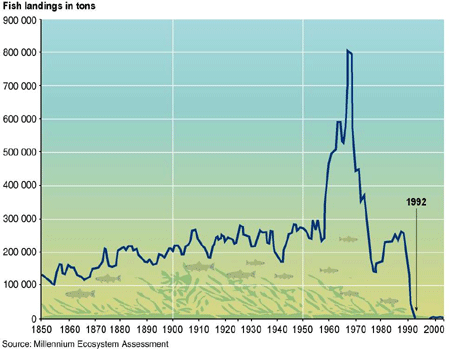
The collapse of the Atlantic cod stocks off the east coast of Newfoundland in 1992 (PennState College of Earth and Mineral Sciences)
【1】
Individuals can internalize the costs and benefits of using a scarce resource when they hold exclusive rights to it.
These are easier to implement and monitor, and they allow for rapid intervention when urgent problems arise with the resource.
The government sets an upper limit (cap) on resource use and allocates permits (for emissions, usage rights, etc.). This ensures that environmental targets are strictly maintained.
A market-based solution can be created by taxing negative externalities to close the gap between private cost and social cost, and by incentivizing positive externalities or clean technologies.
Earth.Org. "Ortak Malların Trajedisi Nedir?" Earth.org. Accessed July 6, 2025. https://earth.org/data_visualization/what-is-the-tragedy-of-the-commons/
Economics Help. "Ortak Malların Trajedisi." Accessed July 6, 2025. https://www.economicshelp.org/blog/2436/economics/tragedy-of-the-commons/
Harvard Business School Online. "Ortak Malların Trajedisi: Sürdürülebilirlik Üzerindeki Etkisi." HBS Online Blog. Accessed July 6, 2025. https://online.hbs.edu/blog/post/tragedy-of-the-commons-impact-on-sustainability-issues
Penn State University. “Ortak Malların Trajedisi.” *Geography 30, Penn State*. Accessed July 6, 2025. https://www.e-education.psu.edu/geog30/node/343
Sustainable Environment. "Ortak Malların Trajedisi." Sustainable Environment. Accessed July 6, 2025. https://www.sustainable-environment.org.uk/Earth/Commons.php
[1]
1992'de Newfoundland'ın Doğu Kıyısı açıklarındaki Atlantik morina balığı stoklarının çöküşü. Balık çıkarma miktarı 1850-1960 yılları arasında nispeten sabitti (yıllık 300.000 tonun altında), hızla arttı ve 1970 civarında 800.000 tonun üzerine çıktı; 1970-1990 yılları arasında sert bir düşüşün ardından çok küçük bir artışın (300.000'in oldukça altına) ardından morina balığı stokları 1992'de tamamen çöktü.

No Discussion Added Yet
Start discussion for "The Tragedy of the Partners" article
Origin of the Term
Development of the Tragedy of the Commons
Case Study: Atlantic Cod
Ways to Prevent the Tragedy of the Commons
Property Rights
Fishing Quotas and Quota Rights
Tradable Permits (Cap and Trade)
Taxes and Incentives