

This article was automatically translated from the original Turkish version.
+2 More
History | 19 November 1938 – 21 November 1938 | ||||||||
|---|---|---|---|---|---|---|---|---|---|
Place of Origin | Dolmabahçe Sarayı, Istanbul, Türkiye | ||||||||
Intermediate Stops | Gülhane Parkı, Sarayburnu, Haydarpaşa, Ankara Garı | ||||||||
Transportation Vehicles | Cart, warship, train | ||||||||
Arrival Date in Ankara | 20 November 1938 | ||||||||
Temporary Tomb | Etnografya Müzesi, Ankara, Türkiye | ||||||||
Final Burial | 10 November 1953, Anıtkabir, Ankara, Türkiye | ||||||||
Institutions Managing the Ceremony | Turkish Armed Forces, Government | ||||||||
Funeral Prayer | 19 November 1938, Dolmabahçe Sarayı | ||||||||
The transportation of Atatürk’s coffin from Istanbul to Ankara refers to the funeral process that began following the death of Mustafa Kemal Atatürk in Istanbul on 10 November 1938. This process was both a manifestation of official and societal respect for the founding leader of modern Türkiye Republic and a multi-stage event organized within the framework of state protocol. Atatürk’s body was temporarily preserved at the Ankara Ethnography Museum until it was transferred to Anıtkabir on 10 November 1953, approximately fifteen years after his death. The transportation of the coffin from Istanbul to Ankara was carried out as a state ceremony of significant historical and diplomatic importance.

State Officials and Ceremony Area (AA)
Following Atatürk’s death at Dolmabahçe Palace on 10 November 1938, his body was placed on a catafalque and opened to the public for viewing on the morning of 11 November 1938. After a massive public turnout, on 16 November the body was removed from Dolmabahçe Palace in an official ceremony and transported by the navy’s designated Zafer torpedo boat to Sarayburnu, where it was transferred onto the battleship Yavuz.
The battleship Yavuz was assigned the task of transporting Atatürk’s coffin from Istanbul to İzmit Gulf. Naval units accompanying the funeral vessel included warships, transforming the sea transport into a full-scale state ceremony.

The Battleship Yavuz (
After the battleship Yavuz arrived at İzmit Gulf, Atatürk’s body was transported by road to İzmit Railway Station, where a specially prepared funeral train awaited. The body was placed with disciplined organization into a specially constructed carriage and set on its journey to Ankara.
Along the entire route of the funeral train, the body was met with public moments of silence and reverence in numerous cities, towns, and villages. This process, marked by the participation of both state officials and citizens, was regarded as a national expression of mourning and loyalty. The train arrived at Ankara Railway Station on the morning of 20 November 1938.
The body of Atatürk, received in Ankara, was transported with ceremonial honors to the Ethnography Museum. The procession included military units, state officials, and representatives of foreign countries. On 21 November 1938, the body was placed in a temporary tomb within the Ethnography Museum, where it remained for fifteen years.
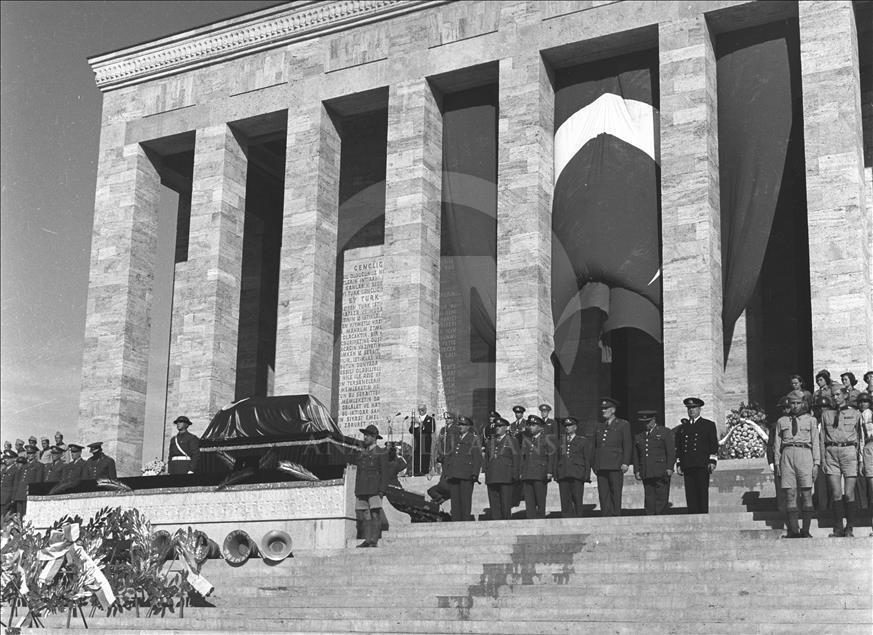
During this period, the completion of the Anıtkabir project was awaited. Upon the completion of Anıtkabir in 1953, the body was transferred on 10 November 1953 in a new state ceremony to its final resting place at Anıtkabir.

Atatürk’s Coffin on the Catafalque Before Transfer from the Ethnography Museum to Anıtkabir on 10 November 1953 (AA)
The funeral ceremonies of Atatürk generated significant反响 not only within Türkiye but also in the international public sphere. Representatives from numerous countries attended the ceremonies in Istanbul and Ankara. Many states, including Britain, the Soviet Union, France, Germany, Iran, Iraq, and Greece, participated with official delegations, underscoring Mustafa Kemal Atatürk’s global influence.
The transportation of Atatürk’s coffin from Istanbul to Ankara was not merely the burial process of a state leader; it also became one of the symbolic events of the Republic’s history. This planned, phased process transformed into a national mourning ceremony through the active participation of both state authorities and the public. Atatürk’s body has since been enshrined in historical records as a testament to the respect and gratitude owed to the founder of the Türkiye Republic.

Prime Minister Adnan Menderes (right), President Celal Bayar (second from right), CHP General Secretary İsmet İnönü (second from left in back), Speaker of Parliament Refik Koraltan (second from left), Atatürk’s sister Makbule Atadan (left), Interior Minister Mehmet Ethem (far right), during the Transfer of Atatürk’s Body to Anıtkabir on 10 November 1953 (AA)
Anadolu Ajansı. "Büyük Önder Atatürk'ün Cenazesinin Anıtkabir'e Yolculuğu (Fotoğraf Galerisi)." Accessed July 8, 2025. https://www.aa.com.tr/tr/pg/foto-galeri/buyuk-onder-ataturkun-cenazesinin-anitkabire-yolculugu-
Atabey, Figen. "Atatürk’e Denizden Yapılan Cenaze Töreni." Atatürk Araştırma Merkezi Dergisi. Accessed July 8, 2025. https://atamdergi.gov.tr/tam-metin/83/tur
Güler, Ali. "Atatürk’ün Ölümü, Cenaze Namazı ve Defin İşlemi." Altaylı.net. Accessed July 8, 2025. https://www.altayli.net/ataturkun-olumu-cenaze-namazi-ve-defin-islemi.html#_ednref1
Ministry of National Defense. "Atatürk’ün Vefatı." Accessed July 8, 2025. https://ata.msb.gov.tr/Genel/icerik/ataturkun-vefati
Özgen, Yüksel. "Atatürk’ün Cenazesinin İstanbul’dan Ankara’ya Nakli." *Atatürk Ansiklopedisi*. Accessed July 8, 2025. https://ataturkansiklopedisi.gov.tr/detay/864/Atat%C3%BCrk%E2%80%99%C3%BCn-Cenazesinin-%C4%B0stanbul%E2%80%99dan-Ankara%E2%80%99ya-Nakli

History | 19 November 1938 – 21 November 1938 | ||||||||
|---|---|---|---|---|---|---|---|---|---|
Place of Origin | Dolmabahçe Sarayı, Istanbul, Türkiye | ||||||||
Intermediate Stops | Gülhane Parkı, Sarayburnu, Haydarpaşa, Ankara Garı | ||||||||
Transportation Vehicles | Cart, warship, train | ||||||||
Arrival Date in Ankara | 20 November 1938 | ||||||||
Temporary Tomb | Etnografya Müzesi, Ankara, Türkiye | ||||||||
Final Burial | 10 November 1953, Anıtkabir, Ankara, Türkiye | ||||||||
Institutions Managing the Ceremony | Turkish Armed Forces, Government | ||||||||
Funeral Prayer | 19 November 1938, Dolmabahçe Sarayı | ||||||||
No Discussion Added Yet
Start discussion for "The Transfer of Atatürk’s Remains from Istanbul to Ankara" article
Preparations Before the Funeral Ceremony
Land Transportation of the Coffin from İzmit to Ankara
Ceremonies in Ankara and the Temporary Tomb
International Participation and Diplomatic Representation