
This article was automatically translated from the original Turkish version.
“Zombie” evokes images of pale-eyed, slow-moving, brain-hungry monsters. But the origins of this mythical figure and the transformations it has undergone over time are far more intriguing than you might imagine. Let us now examine the historical journey of zombies with a deeper, academic perspective.
The word “zombie” derives from West African terms such as “nzambi” or “zumbi”, which carry meanings like “spirit,” “life force,” or “divine being.” The concept was transported to the Caribbean, especially Haiti, through the Atlantic slave trade, where it underwent a profound semantic transformation.
According to the research of anthropologist Wade Davis, the Haitian belief in zombies is directly tied to Vodou culture. In this belief system, a zombie is not a reanimated corpse but rather a person whose will has been stripped away. Davis suggests that certain toxins used in some cases — such as tetrodotoxin — could induce a death-like state, reinforcing the perception of “zombification.” 【1】
The zombie figure must also be understood not merely as a source of fear but as a cultural reflection of deep historical trauma. The mass forced displacement of millions of Africans during the Atlantic slave trade, along with their severance from identity and freedom, forms the historical backdrop of this concept.
In Haiti, the belief in zombies became a metaphor for the physical and psychological devastation wrought by brutal slavery. The zombie represents not only “the reanimation of a dead body” but also a person stripped of agency, deprived of any control over their own life. Indeed, during the Haitian Revolution, as the idea of freedom became central, “becoming a zombie” — that is, living without consciousness or will — was perceived as more terrifying than death itself.
The zombie is not merely a figure of fear; it is also a cultural reflection of historical traumas such as colonialism, slavery, and loss of identity.
Night of the Living Dead Trailer Summary (CRITERION)
Although the concept of the zombie entered the Western world in the 20th century, it acquired its modern form with the 1968 film Night of the Living Dead. Director George A. Romero redefined the zombie, detaching it from magic and transforming it into a biological and social threat.
Romero’s zombies are:
The film is also interpreted as a metaphor for the Cold War era, nuclear fears, and social tensions. In academic literature, this transformation is described as the zombie’s evolution into a “cultural signifier”.【2】
The zombie figure has been reimagined in different contexts throughout history:【3】
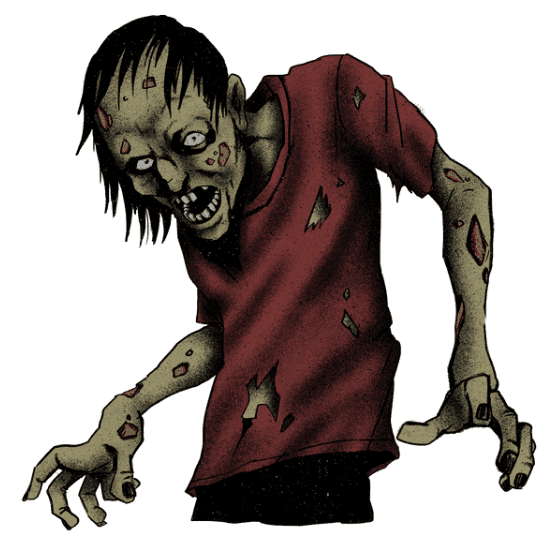
Classic Hollywood Zombie Image (Generated by AI)
Zombie Outbreak Song (Kids Funny Songs)
Zombies are not only cultural phenomena but also cognitive and psychological ones. The human mind develops a strong sense of unease when confronted with a “familiar yet distorted human form”; this reaction is explained by the “uncanny valley” effect.
Moreover, some scientists link the popularity of zombies to the following concepts:
Zombie narratives do not merely generate fear; they also reflect the human mind’s perception of threat and its survival instincts.【4】
The zombie originated as an African concept of spirit, acquired cultural meaning in the Caribbean, and transformed into a global icon of popular culture.
Today, what we call a zombie is:
Zombie stories are not merely about the dead.
In fact, they are stories about the fears of the living.
Bishop, Kyle William. *American Zombie Gothic: The Rise and Fall (and Rise) of the Walking Dead in Popular Culture*. Jefferson: McFarland, 2010. Accessed March 22, 2026. https://archive.org/details/americanzombiego0000bish/page/n1/mode/2up.
Criterion. "NIGHT OF THE LIVING DEAD Trailer." YouTube, November 8, 2018. Accessed March 22, 2026. https://youtu.be/V5XwrRFP7Zw?si=3I5eYcOWnMdBYKIg.
Davis, Wade. *The Serpent and the Rainbow*. New York: Simon & Schuster, 1985. Accessed March 22, 2026. https://archive.org/details/serpentrainbow0000davi_h7w0
Kids Funny Songs. "Zombie epidemic Song & More." YouTube, March 18, 2023. Accessed March 22, 2026. https://youtu.be/d2u4ywJL0jY?si=oGgQxv1WPixQQ5TR
Platts, Todd K. "Locating Zombies in the Sociology of Popular Culture." University ofMissouri Sosyoloji Department. Accessed March 22, 2026. https://www.academia.edu/2076353/Locating_Zombies_in_the_Sociology_of_Popular_Culture
Taylor, Joanne Marie. "21st Century Zombies: New Media, Cinema, and Performance." PhD thesis, University of California, Berkeley, 2011. Accessed March 22, 2026. https://escholarship.org/content/qt9hq1z1t7/qt9hq1z1t7_noSplash_9f2253951219fccdb0b6fe0a8208c9a5.pdf
[1]
Wade Davis, The Serpent and the Rainbow (New York: Simon & Schuster, 1985), accessed 22 March 2026, https://archive.org/details/serpentrainbow0000davi_h7w0
[2]
Kyle William Bishop, American Zombie Gothic: The Rise and Fall (and Rise) of the Walking Dead in Popular Culture (Jefferson: McFarland, 2010), accessed 22 March 2026, https://archive.org/details/americanzombiego0000bish/page/n1/mode/2up
[3]
Joanne Marie Taylor, 21st Century Zombies: New Media, Cinema, and Performance (PhD diss., University of California, Berkeley, 2011), accessed 22 March 2026, https://escholarship.org/content/qt9hq1z1t7/qt9hq1z1t7_noSplash_9f2253951219fccdb0b6fe0a8208c9a5.pdf
[4]
Todd K. Platts, “Locating Zombies in the Sociology of Popular Culture,” University of Missouri Department of Sociology, accessed 22 March 2026, https://www.academia.edu/2076353/Locating_Zombies_in_the_Sociology_of_Popular_Culture
What Is a Zombie and Where Does It Come From?
The History Behind the Zombie: A Symbol of Trauma
Encounter with Popular Culture
Historical Evolution of Zombies
Haitian Zombies (19th Century)
Classic Hollywood Zombies (1930–1960)
Modern Zombies (Post-1968)
Digital Age Zombies
Scientific and Psychological Perspectives
Conclusion
