

+1 More

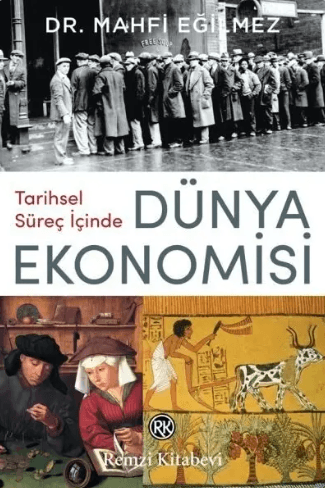
The World Economy in Historical Perspective (Book)
Author(s) | Mahfi Eğilmez | ||||||||
|---|---|---|---|---|---|---|---|---|---|
Publisher(s) | Remzi Bookstore | ||||||||
Publication Date | September 19, 2019 | ||||||||
Page Count | 208 | ||||||||
Language(s) | Turkish | ||||||||
Genre | Economics History | ||||||||
The book The World Economy in Historical Perspective is a comprehensive work that examines the historical development of global economic systems. It provides an extensive overview of the emergence, evolution, and transformation of economic structures. The book analyzes various periods, starting from ancient economies through the Middle Ages, the Renaissance, and the modern global economic order.
It covers a wide timespan, from the rise of agriculture-based economies to the Industrial Revolution and subsequent economic transformations. Topics such as the expansion of global trade, colonialism, the evolution of financial structures, and the foundations of modern economics are explored in detail.
In later chapters, the book delves into 20th-century economic crises, the Bretton Woods system, neoliberal policies, and the economic impacts of globalization. These sections assess how economic fluctuations have influenced political and social structures, and how these processes have shaped contemporary global economics.
Emergence and Evolution of Economic Structures
Economic structures began to form when human communities transitioned to a sedentary lifestyle. While early societies practiced hunter-gatherer economies, the discovery of agriculture introduced concepts such as production and private ownership, which laid the groundwork for trade and exchange economies. Surplus production eventually facilitated the spread of barter systems and paved the way for economic specialization.
Economic Structures in Antiquity, the Middle Ages, and the Renaissance
During antiquity, the Mediterranean basin—particularly under the Roman Empire and Hellenistic kingdoms—became a hub of commerce. In the Middle Ages, economies became more localized under feudal systems, and trade was limited. However, the Renaissance saw an expansion in trade networks and a rise in urbanization, which profoundly altered the structure of European economies.
Development of Agriculture-Based Economies
Agricultural economies dominated human history for an extended period. In this model, production was primarily for local consumption, with land ownership at the core of economic activity. Increased agricultural output supported population growth and the permanent expansion of settled life.
Industrial Revolution and Economic Transformations
The Industrial Revolution, which began in the late 18th century, brought about radical changes in production processes. The widespread use of steam power and mechanization increased productivity and accelerated trade and capital flows. The revolution prompted a shift from rural, agrarian economies to urban, industrial ones, reshaping labor structures significantly.
Expansion of Global Trade
With the Age of Exploration, European trade networks expanded, giving rise to the Atlantic trade system. The transport of valuable resources such as spices, gold, and silver into European markets created new global power dynamics. This period laid the foundation for transoceanic trade and global economic interdependence.
Colonialism and Its Economic Impact
Colonialism, which gained momentum from the 16th century onwards, was marked by European states establishing political and economic dominance across the globe. It significantly altered local economies in South America, Africa, and Asia. The exploitation of natural resources and the transformation of indigenous production systems were among the prominent outcomes of this process.
Evolution of Financial Structures
The development of financial systems is closely tied to economic growth and capital mobility. The establishment of banking systems, the spread of credit mechanisms, and the formation of stock markets are key foundations of modern economies. From the 19th century onward, diversification in financial instruments facilitated international capital flows and had a profound impact on global markets.
Foundations of the Modern Economy
The modern economy is based on a mixed model that balances market mechanisms, capitalist production, and state intervention. Following the Industrial Revolution, rapidly expanding capitalist economies redefined production and consumption relations. Nation-states’ economic policies began playing a decisive role in shaping the functioning of global markets.
Economic Crises of the 20th Century
The 20th century was shaped by major economic crises. The Great Depression of 1929 triggered massive market collapses, leading to widespread unemployment, poverty, and political instability. Likewise, the oil crises of the 1970s disrupted global economic balances through a sharp rise in energy prices. These crises prompted the development of new economic stabilization policies.
The Bretton Woods System
Established in 1944 after World War II to ensure global economic stability, the Bretton Woods system was based on a fixed exchange rate regime. Pegging the U.S. dollar to gold created a sense of monetary security in international trade and laid the groundwork for institutions such as the International Monetary Fund (IMF) and the World Bank.
Neoliberal Policies
Since the 1980s, neoliberalism has emerged as a dominant economic paradigm emphasizing free-market principles. This approach promoted reduced government intervention, privatization, and liberalization of global trade.
Economic and Social Impacts of Globalization
Globalization accelerated with liberalized trade and advances in technology and communication. The global circulation of capital, goods, and services intensified, increasing interdependence among world economies.
Impact of Economic Fluctuations on Political and Social Structures
Economic crises and fluctuations have affected not only financial markets but also social systems. Income inequality and rising unemployment have fueled social unrest and contributed to political instability in many regions.
Eğilmez, Mahfi. Tarihsel Süreç İçinde Dünya Ekonomisi. İstanbul: Remzi Bookstore, 2019.

The World Economy in Historical Perspective (Book)
Author(s) | Mahfi Eğilmez | ||||||||
|---|---|---|---|---|---|---|---|---|---|
Publisher(s) | Remzi Bookstore | ||||||||
Publication Date | September 19, 2019 | ||||||||
Page Count | 208 | ||||||||
Language(s) | Turkish | ||||||||
Genre | Economics History | ||||||||
No Discussion Added Yet
Start discussion for "The World Economy in Historical Perspective (Book)" article
Key Themes
This article was created with the support of artificial intelligence.


