


This article was automatically translated from the original Turkish version.
+2 More
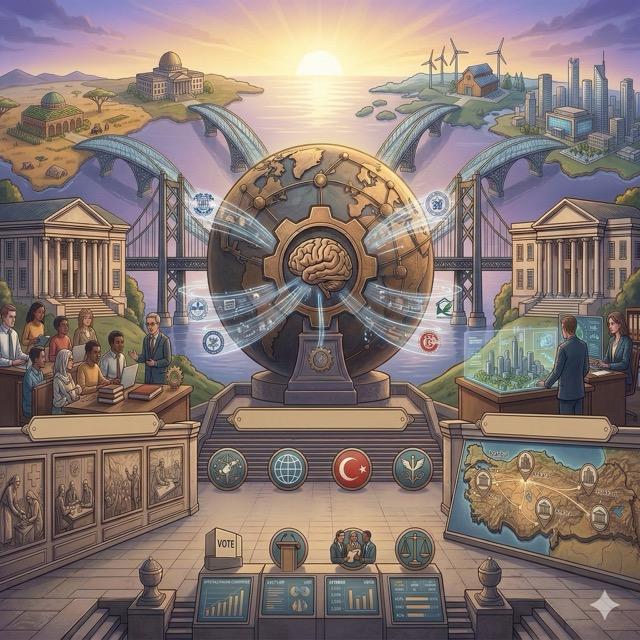
Düşünce Kuruluşu (Yapay Zekâ ile Oluşturulmuştur)
Think tanks are institutional structures that conduct research on public policy, international relations, economics, security, and social issues with the aim of informing policymakers and the public. These organizations are regarded as important actors in modern states, providing information and analysis to decision-making processes. Housing researchers specialized in public policy, these institutions take on functions such as developing policy recommendations, producing strategic analysis, and shaping public debate.【1】
There is no single, definitive definition of the term “think tank” in the literature. However, the generally accepted approach defines think tanks as institutions that conduct research on public policy and seek to influence policy-making processes through these studies.【2】
According to Thierry de Montbrial, a think tank is an open organization with a permanent staff of researchers and experts that generates ideas to contribute to the development of public or private strategies.【3】The defining feature of these institutions is their development of analyses and recommendations that contribute to policy production.
According to another definition, think tanks are typically non-profit research organizations that focus on public policy.【4】However, these organizations may occupy different ideological positions and provide advisory services to various actors.

Think Tank Representative Visual (Generated by Artificial Intelligence)
The concept of the think tank is contested in the social sciences and has been approached in various ways in the literature. While some researchers define think tanks as independent research centers, others view them as institutions that serve as bridges between academia, the state, and politics.【5】
Think tanks often occupy the intersection of different institutional domains. For this reason, some researchers describe them as “boundary spanners.”【6】This perspective emphasizes the role of think tanks as intermediary institutions that facilitate the production and transfer of knowledge between academia, policy, and the media.
The emergence of think tanks in their modern form dates back to the early 20th century. The first think tanks in the United States and the United Kingdom were established with the aim of shaping public policy on the basis of scientific research.【7】
Institutions such as Chatham House and Council on Foreign Relations, established especially after World War I, are widely recognized as pioneers of the modern think tank model.【8】After World War II, the number of think tanks increased significantly, and these institutions began to exert influence particularly in the fields of foreign policy, defense strategies, and economic policy. Today, the number of think tanks has grown rapidly worldwide, with an estimated 6,900 think tanks existing as of 2015.【9】
The core functions of think tanks can be summarized as follows:
These organizations contribute to shaping public policy through research, reports, and policy recommendations.【10】
In the literature, think tanks are classified according to various criteria. Some of these include:
Institutions grounded in scientific research and employing methods similar to those used in universities.
Organizations that directly develop policy recommendations aimed at public policy.
Organizations that promote specific ideological or political viewpoints.
Organizations financed by the state or maintaining close ties with public institutions. The operational domains and funding sources of think tanks are key factors in determining their types.【11】
The United States hosts the highest concentration of think tanks. American think tanks have been particularly influential in the fields of foreign policy and security. The Brookings Institution, RAND Corporation, and Heritage Foundation are among the most well-known organizations in this domain.【12】Over time, think tanks have become widespread in Europe, Asia, and Latin America, becoming important actors in policy-making processes in many countries.【13】
In Türkiye, the development of think tanks dates back to the 1960s. However, their number and influence have remained limited compared to developed countries.【14】According to research, while there are approximately fifty think tanks on paper in Türkiye, the number of actively functioning organizations is significantly lower.【15】The main reasons include insufficient funding, institutionalization challenges, and a shortage of academic personnel. Strengthening think tanks in Türkiye is considered essential for enhancing the country’s policy-making capacity.
Think tanks have also been subject to criticism. Some of these critiques include:
These critiques have contributed to ongoing academic debates regarding the role and independence of think tanks in political processes.【16】
Hauck, Juliana Cristina Rosa. “What Are ‘Think Tanks’? Revisiting the Dilemma of the Definition.” *Brazilian Political Science Review* 11, no. 2 (2017). Accessed March 6, 2026.
Karabulut, Bilal. 2010. “Dünyada ve Türkiye’de Think Tank Kuruluşları: Karşılaştırmalı Bir Analiz”. Gazi Akademik Bakış 4, no. 7: 91–104. Accessed March 6, 2026. Accessed Linki
Montbrial, Thierry de, and Thomas Gomart. *What Is a Think Tank? A French Perspective*. Paris: Ifri, 2019. Accessed March 6, 2026. Accessed Linki
Pautz, Hartwig. “Revisiting the Think-Tank Phenomenon.” *Public Policy and Administration* 26, no. 4 (2011): 419–435. Accessed March 6, 2026. Accessed Linki
Ruser, Alexander. “What to Think About Think Tanks: Towards a Conceptual Framework of Strategic Think Tank Behaviour.” *International Journal of Politics, Culture, and Society* 31 (2018): 179–192. Accessed March 6, 2026. Accessed Linki
Zariç, Sami. “Türkiye’de Think-Tank Kuruluşları ve Karşılaştıkları Sorunlar.” *Akademik Bakış Dergisi* 31 (2012). Accessed March 6, 2026. Accessed Linki
[1]
Hartwig Pautz, “Revisiting the Think-Tank Phenomenon,” Public Policy and Administration 26, no. 4 (2011): 419–435.
[2]
Juliana Cristina Rosa Hauck, “What Are ‘Think Tanks’? Revisiting the Dilemma of the Definition,” Brazilian Political Science Review 11, no. 2 (2017): 1–3.
[3]
Thierry de Montbrial and Thomas Gomart, What Is a Think Tank? A French Perspective (Paris: Ifri, 2019), 6–7.
[4]
Alexander Ruser, “What to Think About Think Tanks: Towards a Conceptual Framework of Strategic Think Tank Behaviour,” International Journal of Politics, Culture, and Society 31 (2018): 180–181.
[5]
Hauck, “What Are ‘Think Tanks’?”, 2–4.
[6]
Hauck, “What Are ‘Think Tanks’?”, 3.
[7]
Hauck, “What Are ‘Think Tanks’?”, 4.
[8]
Montbrial and Gomart, What Is a Think Tank?, 5.
[9]
Hauck, “What Are ‘Think Tanks’?”, 2.
[10]
Ruser, “What to Think About Think Tanks,” 181.
[11]
Pautz, “Revisiting the Think-Tank Phenomenon,” 421–423.
[12]
Hauck, “What Are ‘Think Tanks’?”, 2.
[13]
Pautz, “Revisiting the Think-Tank Phenomenon,” 420.
[14]
Sami Zariç, “Türkiye’de Think-Tank Kuruluşları ve Karşılaştıkları Sorunlar,” Akademik Bakış Dergisi 31 (2012): 1–2.
[15]
Zariç, “Türkiye’de Think-Tank Kuruluşları ve Karşılaştıkları Sorunlar,” 1.
[16]
Ruser, “What to Think About Think Tanks,” 182.


Düşünce Kuruluşu (Yapay Zekâ ile Oluşturulmuştur)
Definition
Conceptual Framework
History
Functions of Think Tanks
Types of Think Tanks
Academic Think Tanks
Policy-Oriented Think Tanks
Advocacy Think Tanks
State-Supported Think Tanks
Think Tanks Worldwide
Think Tanks in Türkiye
Critiques and Debates