


This article was automatically translated from the original Turkish version.
The Three Musicians (Painting)
Type(s) | Figurative composition | ||||||||
|---|---|---|---|---|---|---|---|---|---|
Dimension(s) | (MoMA version) Approximately 200 × 222 cm | ||||||||
Location | Philadelphia: Philadelphia Museum of Art New York: Museum of Modern Art (MoMA) | ||||||||
Work Type | Two large-scale paintings (series) | ||||||||
Technique | Oil on canvas | ||||||||
Movement / Style | Synthetic Cubism | ||||||||
History | 1921 | ||||||||
Artist | Pablo Picasso | ||||||||
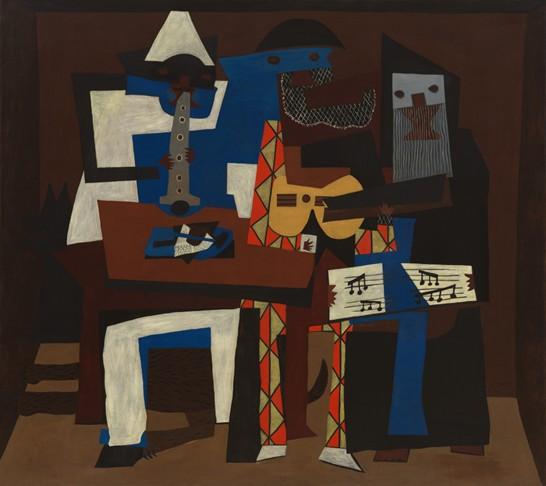
The Three Musicians is a pair of large-scale oil paintings completed by Spanish artist Pablo Picasso in the summer of 1921 in Fontainebleau, serving as a monumental synthesis of Synthetic Cubism. One version is held in the collection of the Museum of Modern Art (MoMA) in New York, while the other is housed at the Philadelphia Museum of Art. This work represents one of the most significant turning points in Picasso’s career, synthesizing his early 1910s Analytic Cubist experiments with a more colorful, planar, and constructed formal language.
The year 1921, when the work was produced, was a period of notable duality in Picasso’s artistic approach. During this time, the artist simultaneously created figurative works in a Neoclassical style grounded in traditional and volumetric forms, while also pushing Cubist aesthetics to their most mature and decorative expression. The Three Musicians is an example of a “virtual collage,” in which Picasso’s earlier paper collage (papiers collés) technique was fully translated onto canvas using oil paint.【1】
The Synthetic Cubist phase to which this work belongs is based on the principle of assembling fragments not to deconstruct objects, but to recombine them into a new reality.【2】 The intense fragmentation and limited palette characteristic of Analytic Cubism give way in this work to broader, more recognizable, and interacting color blocks. Picasso no longer deconstructed objects but reconstructed them on the canvas, reducing the perception of depth entirely to a flat surface, thereby reinforcing modern art’s emphasis on planarity.
The Three Musicians goes beyond a superficial depiction of a musical ensemble to encompass deep thematic layers relating to Picasso’s personal history and friendships. The work evokes Picasso’s close relationships and bohemian life in Paris before World War I, while the war’s destruction and the dispersal of his friends introduce an underlying melancholy beneath the cheerful musical theme. The masked nature of the figures is interpreted as a symbol of the threshold between life and death; their motionless postures, as if performing a silent concert, are read as an effort to immortalize friends who had already departed from the artist’s world.【3】
The work depicts three musician figures arranged side by side within a shallow stage-like space. These characters are drawn from the traditional European theatrical stock types of Commedia dell'arte. To the left is Pierrot, playing the clarinet in a white costume; at the center is Harlequin, playing the guitar in a yellow and orange diamond-patterned costume; and on the right is a Friar holding sheet music, dressed in a dark robe. In the lower left corner, the silhouette of a dog, its form nearly integrated into the dark background, can be discerned beneath the figures’ feet.
The Three Musicians (MoMA)
Art historians agree that the three figures in the painting serve as symbolic representations of important individuals in Picasso’s life:
Harlequin: The primary figure Picasso used throughout his career to represent himself.
Pierrot: Symbolizes his close friend, the poet Guillaume Apollinaire, who died in 1918.
Friar: Represents his other friend, the poet Max Jacob, who had withdrawn to a monastery at the time.
The Three Musicians (MoMA)
In the summer of 1921, Picasso developed this theme on two separate large canvases. The version held at MoMA in New York measures approximately 200 x 222 cm and exhibits a more rigid, angular, and monumental composition than the Philadelphia version.【4】 The second version, located at the Philadelphia Museum of Art, has a more vertical orientation and displays a more fluid character in its color transitions and arrangement of forms compared to the MoMA example.
The Three Musicians marks a pivotal moment in which Pablo Picasso elevated Cubist ideals to a monumental scale and redefined the visual language of modern art. The work is not merely a formal experiment but also a multilayered narrative reflecting the artist’s personal relationships, losses, and shifting perception of time.【5】 These paintings, which unite the theoretical and aesthetic possibilities of Synthetic Cubism, played a decisive role in the development of figurative abstraction in 20th-century modern art.【6】
Art in Context. "Three Musicians by Pablo Picasso - An Analysis of the Cubist Painting." Accessed January 25, 2026. https://artincontext.org/three-musicians-by-pablo-picasso/
Haşlakoğlu, Oğuz. "Pablo Picasso - Üç Müzisyen Üzerine." *Gümüşmaviatlas*. Accessed January 25, 2026. https://dergipark.org.tr/tr/pub/gumusmaviatlas/article/98820
Khan Academy. "Pablo Picasso, The Three Musicians." Accessed January 25, 2026. https://www.khanacademy.org/humanities/art-1010/cubism-early-abstraction/cubism/a/pablo-picasso-the-three-musicians
PabloPicasso.org. "Three Musicians, 1921 by Pablo Picasso." Accessed January 25, 2026. https://www.pablopicasso.org/three-musicians.jsp
The Museum of Modern Art (MoMA). "Pablo Picasso. Three Musicians. Fontainebleau, summer 1921." Accessed January 25, 2026. https://www.moma.org/collection/works/78630
[1]
Oğuz Haşlakoğlu, "Pablo Picasso - Üç Müzisyen Üzerine," Gümüşmaviatlas, access date 25 January 2026, https://dergipark.org.tr/tr/pub/gumusmaviatlas/article/98820
[2]
Khan Academy, "Pablo Picasso, The Three Musicians," access date 25 January 2026, https://www.khanacademy.org/humanities/art-1010/cubism-early-abstraction/cubism/a/pablo-picasso-the-three-musicians
[3]
PabloPicasso.org, "Three Musicians, 1921 by Pablo Picasso," access date 25 January 2026, https://www.pablopicasso.org/three-musicians.jsp
[4]
Art in Context, "Three Musicians by Pablo Picasso - An Analysis of the Cubist Painting," access date 25 January 2026, https://artincontext.org/three-musicians-by-pablo-picasso/
[5]
Art in Context, "Three Musicians by Pablo Picasso - An Analysis of the Cubist Painting," access date 25 January 2026, https://artincontext.org/three-musicians-by-pablo-picasso/
[6]
Art in Context, "Three Musicians by Pablo Picasso - An Analysis of the Cubist Painting," access date 25 January 2026, https://artincontext.org/three-musicians-by-pablo-picasso/

The Three Musicians (Painting)
Type(s) | Figurative composition | ||||||||
|---|---|---|---|---|---|---|---|---|---|
Dimension(s) | (MoMA version) Approximately 200 × 222 cm | ||||||||
Location | Philadelphia: Philadelphia Museum of Art New York: Museum of Modern Art (MoMA) | ||||||||
Work Type | Two large-scale paintings (series) | ||||||||
Technique | Oil on canvas | ||||||||
Movement / Style | Synthetic Cubism | ||||||||
History | 1921 | ||||||||
Artist | Pablo Picasso | ||||||||
No Discussion Added Yet
Start discussion for "Three Musicians (Painting)" article
Historical and Theoretical Context
The Synthetic Phase of Cubism and the Process of “Construction”
Thematic Emphases and Narrative
Composition and Figurative Elements
Iconographic and Biographical Analysis
Comparative Evaluation of the Versions