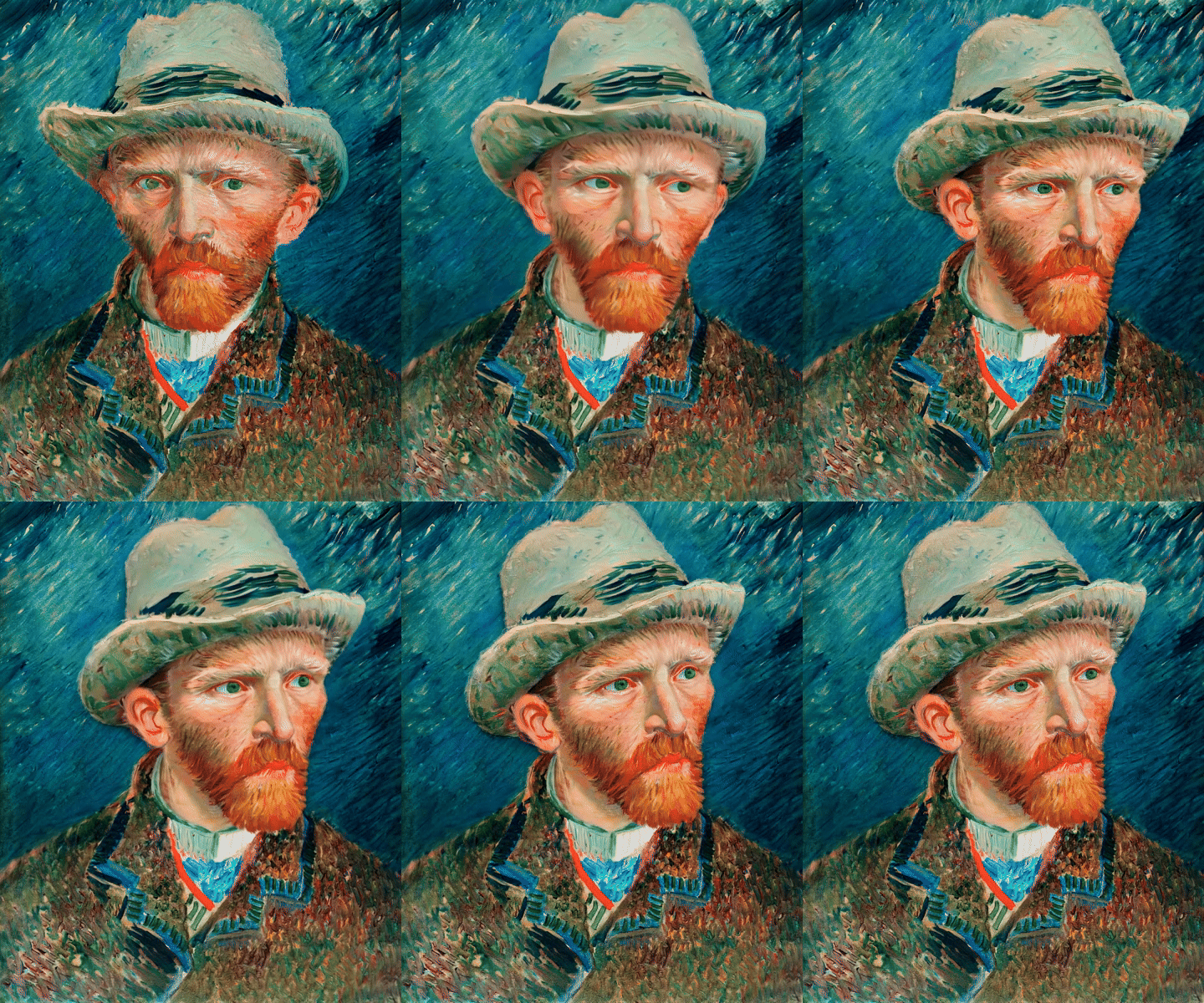
Doğum tarihi | 1853-03-30 | ||||||||
|---|---|---|---|---|---|---|---|---|---|
Ölüm tarihi | 1890-07-29 | ||||||||
Place of Death | Auvers-sur-Oise / France | ||||||||
Place of Birth | Zundert / Netherlands | ||||||||
Nationality | Netherlands | ||||||||
Profession(s) | Painter | ||||||||
Major Works | Irises (1889) Starry Night (1889) Sunflowers (1888) Bedroom in Arles (1888) The Potato Eaters (1885) | ||||||||
Number of Works | Approximately 2,100 (860 oil paintings, the rest drawings and watercolors) | ||||||||
Art Movement | Post-Impressionism | ||||||||
Full Name | Vincent Willem van Gogh | ||||||||
Vincent van Gogh, full name Vincent Willem van Gogh (1853–1890), was a Dutch Dutch post-impressionist painter. Over the course of his life, he produced approximately 2,100 artworks and contributed to the development of modern art through his innovative use of color, brushwork, and emotional expression, spanning his artistic career from rural life to his periods in Paris and Arles.【1】
Vincent Willem van Gogh was born on 30 March 1853 in the village of Zundert, Netherlands. His father, Theodorus van Gogh, was a minister in the Dutch Reformed Church; his mother was Anna Cornelia Carbentus. The family was active in religious and cultural circles. Vincent was named after an older brother who had died a year before his birth.
Van Gogh’s childhood was spent in the rural areas of the Netherlands. It is noted that from an early age he showed an interest in drawing, observed nature, and experimented with sketches. Before receiving formal art education, he attended various schools, but his education lacked continuity and was frequently interrupted. In 1869, at the age of 16, he began working for Goupil & Cie, a firm dealing in art reproductions. This role took him to The Hague, London, and Paris. During this time, he gained direct exposure to the art market and visited museums and galleries. However, he failed to establish stability in his professional life and left the company in 1876.
After this departure, Van Gogh attempted to pursue a religious life. He worked briefly as a teacher and later sought training to become a preacher. Between 1878 and 1879, he served as a missionary among miners in the Borinage region of Belgium. During this period, he lived in poverty and was dismissed from his post due to a lifestyle deemed inappropriate by the official church. These early experiences laid the foundation for his eventual turn to art. Around 1880, Van Gogh decided to become a painter, marking the beginning of his professional artistic career.
Vincent van Gogh, despite abandoning formal educational plans, continued to seek service to God and viewed drawing as a means of expression. He frequently added small sketches to letters he wrote to his brother Theo, recording his observations and beginning to document what he saw through drawing. Theo’s advice to focus on drawing convinced Van Gogh that he could serve God through art as well.
In October 1880, Van Gogh moved to Brussels, where he began refining his drawing techniques and established contact with other artists. Since he had no income, he relied largely on financial support from his brother Theo. Van Gogh’s family disapproved of his decision to become an artist, viewing it as a sign of social failure. However, this did not prevent Vincent from developing his talents and focusing on his work.
During this period, Van Gogh formed a relationship with a woman named Sien Hoornik, a former sex worker who lived with her daughter. Vincent decided to live with Sien to help her. She became both his model and his companion, but the relationship was disapproved of by his family and social circle. This relationship ended after about a year and a half.
In this period, while living in Brussels and various cities in the Netherlands, Van Gogh received painting and drawing lessons from his cousin Anton Mauve in The Hague. Mauve taught Van Gogh the fundamentals of watercolor and oil painting, and Van Gogh visited his studio nearly every day. Under Mauve’s guidance, Van Gogh developed his skills in perspective and composition.
Van Gogh continued to work, believing his drawing and painting techniques were still immature. During this time, observations of nature and rural life shaped the thematic and visual structure of his works. Vincent also drew inspiration from themes of love, human relationships, and religious values, which found expression in the subject matter and emotional intensity of his art. His intense productivity and discipline laid the groundwork for his short but highly concentrated artistic career.

The Potato Eaters, Vincent van Gogh (Van Gogh Museum)
In December 1883, Vincent van Gogh returned to Nuenen with his family. He initially worked in a small studio at the back of the house, but after a few months rented a larger space elsewhere in the village to expand his production. Nuenen provided Van Gogh with an environment of a “peasant painter,” as it was populated by many farmers, rural laborers, and weavers. Van Gogh took every opportunity to sketch and paint them.
In early 1884, he offered to send his works to Theo, who provided him with financial support, hoping Theo could sell them in the Paris art market. This plan did not succeed in the short term; French tastes favored brighter colors, while Van Gogh’s works featured prominent dark tones.
Living with his family also led to various conflicts. His family, struggling to live with their eldest son, were disturbed by Vincent’s stubborn and disorganized lifestyle. Shortly after his father’s death in March 1885, Van Gogh left the family home and moved into his studio to focus on his painting The Potato Eaters. During this period, his works increasingly featured scenes of daily rural life, such as peasants gathered around a plate of potatoes. He spent most of his income on art supplies and later decided to enroll in the art academy in Antwerp, marking the beginning of his permanent departure from the Netherlands.
Antwerp offered Van Gogh access to quality materials, life-drawing clubs, and churches, museums, and galleries filled with artworks. However, the academic instruction he received there felt overly traditional and technically limited. Vincent did not remain long in this Flemish city; soon after, he decided to join his brother Theo in Paris and study in the atelier of Fernand Cormon, a popular artist among foreign students. Van Gogh arrived in Paris in late February 1886, beginning this new phase. During this time, he combined his observations of rural life with study of academic techniques, achieving a significant step in his development as an artist. His peasant portraits and daily life studies from Nuenen, the foundational training received in Antwerp, and his transition to Paris laid the groundwork for his subsequent productive periods.
Influenced by the modern art environment in Paris, Van Gogh began using more vibrant colors and developed a distinctive style characterized by short, expressive brushstrokes. The themes of his works also changed; the rural laborers were replaced by cafés, boulevards, areas along the Seine River, and still lifes. He experimented with portraits, subjects with commercial value, but due to the relatively high cost of models, he mostly painted self-portraits.
Works Created by Van Gogh During His Time in Arles (Van Gogh Museum)
Two years later, Vincent planned to leave the intensity of Parisian urban life and seek the tranquility of the countryside by moving to Provence. On 20 February 1888, he arrived in the town of Arles, situated on the Rhône River, and began painting its blooming gardens, harvest workers, and boats along the river.
In Arles, his style became more free and expressive. Van Gogh, in correspondence with his brother Theo, planned to establish a “Studio of the South” for a group of artists to sell their works in Paris. To this end, he rented four rooms in the Yellow House on Place Lamartine. Paul Gauguin became the first and only artist to work with him in this house. Van Gogh and Gauguin experienced a productive period together, but their differing artistic philosophies and personalities frequently led to arguments. While Gauguin primarily worked from memory and imagination, Van Gogh preferred to paint what he saw directly before him.
As tensions escalated, Gauguin threatened to leave, placing Vincent under immense pressure. During this time, Van Gogh cut off part of his own ear and was admitted to a hospital in Arles. After being discharged in January 1889, he continued painting, but his mental fluctuations persisted. In May 1889, he voluntarily admitted himself to the Saint-Paul-de-Mausole psychiatric hospital in Saint-Rémy.【2】

Almond Blossom, Vincent van Gogh (Van Gogh Museum)
The Paris and Arles periods were decisive for Van Gogh’s use of color and technique. During this time, Van Gogh developed a strong interest in Japanese woodblock prints, particularly those of Utagawa Hiroshige. The flat areas of color, bold outlines, and compositional structures of these prints influenced his painting technique. Vincent and his brother Theo collected these prints, and Van Gogh directly reinterpreted some of them.
At the hospital in Saint-Rémy, he expressed his observations and emotions through brushwork. In his paintings from this period, movement and perception of light came to the forefront. Thanks to the permissions granted by the hospital, Van Gogh maintained his productivity. On good days, he painted in the institution’s walled garden, and later he was permitted to work outside the hospital grounds. Despite ongoing mental fluctuations, he completed approximately 150 paintings during his year in Saint-Rémy.
This period also brought developments in Van Gogh’s personal life. His brother Theo married Johanna Bonger in Amsterdam in April 1889, and in January 1890, Vincent received the news by mail that his brother and sister-in-law had a son; they named their son Vincent Willem van Gogh. Vincent sent them a special painting, Almond Blossom. In a note about the work, he wrote: “I wish I had named the child after my father, whom I have thought of so often lately, rather than after myself; but since it is so, I immediately began painting a picture for him, to hang in his nursery—large white almond blossoms against a blue sky.”【3】
The Starry Night is the most striking visual expression of Vincent van Gogh’s time in the asylum. The artist painted this work in 1889, based on the view from the window of his room at the sanatorium in Saint-Rémy-de-Provence; however, he painted it from memory during daylight hours, not directly from the night scene. Thus, the painting is less a literal depiction of the landscape than a visionary reflection of the artist’s inner world.

The Starry Night, Vincent van Gogh (MoMA)
The Starry Night has been part of the permanent collection of the Museum of Modern Art (MoMA) in New York since 1941. Today, it is not only one of Van Gogh’s most famous works but also universally recognized as an icon symbolizing the artist’s spiritual struggle and his profound connection with nature.【4】
Wheat Field with Cypresses is one of Vincent van Gogh’s first major landscapes painted in 1889 in Saint-Rémy, centered on cypress trees. In late June 1889, Van Gogh decided to produce a series of works featuring these trees, and this painting became one of the most magnificent examples of the series, which the artist himself regarded as one of his finest landscapes of the summer season.【5】

Wheat Field with Cypresses near Eygalières, Haut Galline, Vincent van Gogh (Met Museum)
Irises, one of Vincent van Gogh’s first subject-based works created during his stay at the asylum in Saint-Rémy. The artist painted this work before his first mental crisis there. Consequently, the painting does not yet reflect the intense tension and pessimistic mood frequently seen in his later works.
The flowers depicted in the painting are based on irises growing in the small, open garden where Van Gogh was permitted to walk and sit. He painted this scene directly from observation, approaching the flowers with admiration and joy. In this sense, the work is regarded as an early expression of the artist’s admiration for nature and his desire for healing. Irises is dated 1889 and is now part of the permanent collection of the J. Paul Getty Museum.【6】

Irises (Irises), Vincent van Gogh (rawpixel)
From the moment he arrived in Arles, Vincent van Gogh became intensely focused on expressing the effect of night landscapes in his paintings. Throughout 1888, he frequently mentioned this idea in his letters, noting that the night possessed richer colors than the day.

Starry Night Over the Rhone, Vincent van Gogh (Musée d'Orsay)
The artist gave concrete form to this pursuit in September 1888 with the painting Starry Night Over the Rhone. In this work, blue tones dominate; the city lights glow orange as they reflect on the water, and the stars become focal points illuminating the night. This painting is one of Van Gogh’s first major works on the theme of night and is now part of the permanent collection of the Musée d’Orsay.【7】
In May 1890, Vincent van Gogh left the asylum in Saint-Rémy and moved to the village of Auvers-sur-Oise in the north. Auvers provided Van Gogh with the necessary tranquility and silence, while also being close enough to Paris to visit his brother Theo. There he met Dr. Paul Gachet, who would oversee his care; Gachet, himself a painter, advised Vincent to focus entirely on his art. During this period, Van Gogh painted the surrounding gardens and wheat fields with intense productivity.
In early July 1890, Vincent traveled to Paris to visit Theo and his family. There he learned that Theo was considering leaving his long-standing position at the art gallery. Theo’s plans to start his own business became a source of financial uncertainty and anxiety for Vincent, significantly affecting his mental health and deepening his pessimism about the future.
On 27 July 1890, Vincent shot himself in the chest in a wheat field. He returned to his room at the Auberge Ravoux, wounded. He died from his injuries on 29 July.【8】Vincent van Gogh was buried in Auvers on 30 July 1890.
Approximately six weeks after Vincent van Gogh’s death, his brother Theo organized a memorial exhibition to introduce Vincent’s works to the public. However, Theo’s health deteriorated due to the difficulties of organizing the exhibition and his own medical issues. Shortly after the exhibition, he resigned from his job at Boussod and suffered a severe nervous breakdown. About six months after his brother’s death, he died in a clinic in Utrecht in January 1891.
Vincent’s artworks passed into the care of Theo’s widow, Johanna van Gogh. Jo organized various exhibitions to raise awareness of Vincent’s work. She also classified and prepared for publication the letters exchanged between Vincent and Theo. In 1914, she published the first edition of these letters. Jo also wrote a biographical introduction to the letters, helping establish Vincent not merely as an artist but as a deeply introspective individual. Thanks to these efforts, interest in Van Gogh’s work steadily increased. After Jo’s death in 1925, the collection passed to Theo’s son, Vincent Willem van Gogh. He lent his uncle’s paintings to the Stedelijk Museum in Amsterdam in 1930.
The growing recognition of Van Gogh’s works led to increasing demands for a permanent museum to house the collection. In 1962, with the approval of the Dutch government, Vincent Willem van Gogh transferred the collection to the Vincent van Gogh Foundation; in return, the government pledged to build the Van Gogh Museum and ensure the permanent public accessibility of the collection. Eleven years later, the works were moved from the Stedelijk Museum to a specially designed building by Gerrit Rietveld. The Van Gogh Museum, opened by Queen Juliana on 2 June 1973, now welcomes approximately two million visitors annually and continues to preserve Vincent van Gogh’s legacy on an international scale.【9】
Getty Museum Collection. “Vincent van Gogh.” getty.edu. Erişim tarihi: 31 Ocak 2026. https://www.getty.edu/art/collection/person/103JV9
MoMA. "Vincent van Gogh. The Starry Night. Saint Rémy, June 1889." MoMA. Accessed January 30, 2026. https://www.moma.org/collection/works/79802
Musée d'Orsay. "La Nuit étoilée." musee-orsay.fr. Accessed January 30, 2026. https://www.musee-orsay.fr/en/artworks/la-nuit-etoilee-78696
National Gallery of Art Collection. "Self-Portrait, 1889, Vincent van Gogh." nga.gov. Accessed January 31, 2026. https://www.nga.gov/artworks/106382-self-portrait
Rawpixel. "Detail from Self-portrait (1887) by Vincent van Gogh – video remix." 4K HD video. Accessed January 24, 2026. https://www.rawpixel.com/video/18779856/video-van-gogh-face-person
Rawpixel. "Vincent Van Gogh's Irises (1889). Famous painting, original from the J. Paul Getty Museum." Rawpixel. Accessed January 30, 2026. https://www.rawpixel.com/image/537382/free-illustration-image-van-gogh-impressionism
Tate Kids. "Who Was Vincent van Gogh?" tate.org.uk. Accessed January 31, 2026. https://www.tate.org.uk/kids/artists/who-vincent-van-gogh
The Metropolitan Museum of Art. "Wheat Field with Cypresses." *metmuseum.org.* Accessed January 31, 2026.
Van Gogh Museum. "After Vincent's Death." vangoghmuseum.nl. Accessed January 31, 2026. https://www.vangoghmuseum.nl/en/art-and-stories/vincents-life-1853-1890/after-vincents-death
Van Gogh Museum. "Almond Blossom." vangoghmuseum.nl. Accessed January 31, 2026. https://www.vangoghmuseum.nl/en/collection/s0176V1962
Van Gogh Museum. "From Dark to Light." vangoghmuseum.nl. Accessed January 31, 2026. https://www.vangoghmuseum.nl/en/art-and-stories/vincents-life-1853-1890/from-dark-to-light
Van Gogh Museum. "Hospitalization." vangoghmuseum.nl. Accessed January 31, 2026. https://www.vangoghmuseum.nl/en/art-and-stories/vincents-life-1853-1890/hospitalization
Van Gogh Museum. "Looking for a Direction." vangoghmuseum.nl. Accessed January 31, 2026. https://www.vangoghmuseum.nl/en/art-and-stories/vincents-life-1853-1890/looking-for-a-direction
Van Gogh Museum. "Paesant Painter." Accessed January 31, 2026. https://www.vangoghmuseum.nl/en/art-and-stories/vincents-life-1853-1890/peasant-painter
Van Gogh Museum. "South of France." vangoghmuseum.nl. Accessed January 31, 2026. https://www.vangoghmuseum.nl/en/art-and-stories/vincents-life-1853-1890/south-of-france
Van Gogh Museum. "The Patato Eaters." vangoghmuseum.nl. Accessed January 31, 2026. https://www.vangoghmuseum.nl/en/collection/s0005V1962
Van Gogh Museum. "Vincent's Final Months." vangoghmuseum.nl. Accessed January 31, 2026. https://www.vangoghmuseum.nl/en/art-and-stories/vincents-life-1853-1890/vincents-final-months
Van Gogh Museum. "What paintings did Van Gogh create in Arles?" YouTube. Accessed January 31, 2026. https://youtu.be/CP3GEKo7dKg?si=hl4j7vP74RTgRlM4
Van Gogh Museum. "Young Vincent." vangoghmuseum.nl. Accessed January 31, 2026. https://www.vangoghmuseum.nl/en/art-and-stories/vincents-life-1853-1890/young-vincent
Van Gogh Museum. “First Steps as an Artist.” vangoghmuseum.nl. Accessed January 31, 2026. https://www.vangoghmuseum.nl/en/art-and-stories/vincents-life-1853-1890/first-steps-as-an-artist
Van Gogh Museum. “Vincent’s Life 1853–1890.” vangoghmuseum.nl. Accessed January 31, 2026. https://www.vangoghmuseum.nl/en/art-and-stories/vincents-life-1853-1890
Vincent van Gogh Gallery. "Irises, 1889 by Vincent Van Gogh." vincentvangogh.org. Accessed January 30, 2026. https://www.vincentvangogh.org/irises.jsp
Vincent van Gogh Gallery. "Starry Night: 10 Secrets of Vincent van Gogh Night Stars Painting." *vincentvangogh.org.* Accessed January 31, 2026. https://www.vincentvangogh.org/starry-night.jsp
Vincent van Gogh Gallery. "Vincent van Gogh Biography." VincentVanGogh.org. Accessed January 31, 2026. https://www.vincentvangogh.org/
[1]
Tate Kids, “Who Was Vincent van Gogh?” tate.org.uk, Access date: 31 January 2026, https://www.tate.org.uk/kids/artists/who-vincent-van-gogh
[2]
Van Gogh Museum, “Vincent’s Life 1853–1890,” vangoghmuseum.nl, Access date: 31 January 2026, https://www.vangoghmuseum.nl/en/art-and-stories/vincents-life-1853-1890
[3]
Van Gogh Museum, ''After Vincent's Death,'' vangoghmuseum.nl, Access date: 31 January 2026,
https://www.vangoghmuseum.nl/en/art-and-stories/vincents-life-1853-1890/after-vincents-death
[4]
Vincent van Gogh Gallery. ''Starry Night:10 Secrets of Vincent van Gogh Night Stars Painting.'' vincentvangogh.org. Access date: 31 January 2026. https://www.vincentvangogh.org/starry-night.jsp
[5]
The Metropolitan Museum of Art, ''Wheat Field with Cypresses,'' metmuseum.org, Access date: 31 January 2026,
[6]
Vincent van Gogh Gallery, ''Irises, 1889 by Vincent Van Gogh,'' vincentvangogh.org, Access date: 30 January 2026, https://www.vincentvangogh.org/irises.jsp
[7]
Musée d'Orsay, ''La Nuit étoilée,'' musee-orsay.fr, Access date: 30 January 2026, https://www.musee-orsay.fr/en/artworks/la-nuit-etoilee-78696
[8]
Van Gogh Museum, ''Vincent's Final Months,'' vangoghmuseum.nl, Access date: 31 January 2026, https://www.vangoghmuseum.nl/en/art-and-stories/vincents-life-1853-1890/vincents-final-months
[9]
Van Gogh Museum, ''Hospitalization,'' vangoghmuseum.nl, Access date: 31 January 2026,
https://www.vangoghmuseum.nl/en/art-and-stories/vincents-life-1853-1890/hospitalization


Doğum tarihi | 1853-03-30 | ||||||||
|---|---|---|---|---|---|---|---|---|---|
Ölüm tarihi | 1890-07-29 | ||||||||
Place of Death | Auvers-sur-Oise / France | ||||||||
Place of Birth | Zundert / Netherlands | ||||||||
Nationality | Netherlands | ||||||||
Profession(s) | Painter | ||||||||
Major Works | Irises (1889) Starry Night (1889) Sunflowers (1888) Bedroom in Arles (1888) The Potato Eaters (1885) | ||||||||
Number of Works | Approximately 2,100 (860 oil paintings, the rest drawings and watercolors) | ||||||||
Art Movement | Post-Impressionism | ||||||||
Full Name | Vincent Willem van Gogh | ||||||||
Early Life
Beginnings and Development in Art
Early Works and Academic Experiences
Arles Period and Health Issues
Paris and Saint-Rémy Period
Notable Works
The Starry Night
Wheat Field with Cypresses
Irises
The Starry Night Over The Rhone
Death
Posthumous Period and Legacy