

This article was automatically translated from the original Turkish version.
+2 More
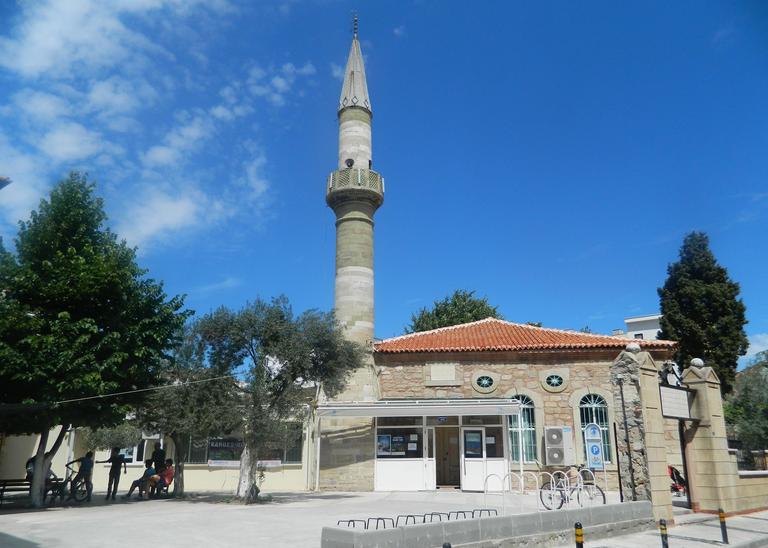
Tıflı Camii is a historical religious structure located in the center of Çanakkale province, built during the late 19th century under the Ottoman Empire. It is situated on Çarşı Street in the Fevzipaşa neighborhood. The building has undergone various repairs throughout its history and is currently open for worship and accessible to the public.
According to the marble foundation inscription on the western entrance of the mosque, the structure was commissioned by Sultan Abdülhamid II in the Hijri year 1308, corresponding to the Gregorian year 1891. The name of the mosque derives from the Ottoman Turkish word "tıfl," meaning "child," which over time came to be pronounced as "Tıflı" by the local population. The primary reason for this naming was that the mosque was constructed to serve the students of an adjacent old sıbyan mekteb (elementary school). The mosque was designed as an integral part of the school, enabling children to practice their religious education in a practical setting.
It is known that this school, now completely demolished, was built in 1870 during the reign of Sultan Abdülaziz by the provincial governor Kayserili Ahmet Paşa. After the school was discontinued, the poetic inscription that once adorned it was removed and relocated to the western courtyard entrance of the mosque. Additionally, the building is listed in an archival record dated Hijri 1341 (Gregorian 1922) among the endowments of Yörük Hüseyin Ağa.
The mosque features a square plan and a broken roof. Roughly hewn and rubble stones were used in its construction, while finely cut stone was employed for door and window openings. The upper sections of the walls are encircled by stepped brick cornices arranged in four rows. The building has two entrances, located on the western and northern facades. The western entrance, designed with a semicircular arch, bears the foundation inscription.
The windows on the facades and their ornamental iron grilles were shaped to reflect the Empire style. The mihrap on the southern wall projects outward in a semicircular form and is covered by a half-conical dome. The single-balconied minaret, situated in the northwestern corner, is constructed from finely cut stone. A sunburst motif is carved into the front face of its square base.
The interior of the mosque is generally characterized by a flat wooden ceiling. The wooden ceiling is divided into sections by moldings, with a large medallion in the center reflecting the Empire style. This medallion is adorned with rays emanating outward from the center, rosette flowers, and stylized acanthus leaves.
The mihrap niche, located on the qibla wall, features a semicircular arch and a pentagonal cross-section, bounded by impost capitals. The arch sections of the mihrap are decorated with vegetal motifs, acanthus leaves, and bay branches. Along the northern wall runs a wooden gallery supported by wooden pillars, accessible via the minaret staircase in the northwestern corner. The wooden minbar, positioned on the western edge of the harim, has a very simple form and is believed to have been restored at a later date.

History and Origin of the Name
Architectural Structure and Exterior Features
Interior Space and Decorative Features