


This article was automatically translated from the original Turkish version.
TinyML
Fundamental Methods | Model pruning, quantization, compression, and hardware acceleration are used as optimization techniques. | ||||||||
|---|---|---|---|---|---|---|---|---|---|
Application Area(s) | They are used in fields such as wearable devices and industrial automation. smart sensors UAV systems | ||||||||
Tiny Machine Learning (TinyML) is a technology field that enables the execution of machine learning algorithms on low-power embedded hardware. This field makes it possible for artificial intelligence models, which traditionally require high computational power, large memory capacity, and significant energy consumption, to operate on devices with limited resources such as microcontrollers. In this context, TinyML forms the foundation of next-generation intelligent systems by integrating the computational capabilities of machine learning with the hardware efficiency of embedded systems.
Microcontrollers typically operate with several hundred kilobytes of memory, limited processing power, and low energy consumption. TinyML aims to develop compact models capable of performing tasks such as classification, regression, and anomaly detection on these devices. This allows data to be processed directly at the edge, that is, on the device itself. This architecture reduces latency, eliminates dependency on the cloud, and improves energy efficiency. Additionally, it enables systems to make autonomous decisions in situations where network connectivity is unavailable or data security is critical.
TinyML has been developed in recent years to meet the growing demand for low-power intelligent applications. By performing data processing directly on the device, it minimizes the need for network connectivity, thereby offering advantages in critical factors such as data privacy and processing speed. This unique structure of TinyML makes it possible to run machine learning models even on devices with limited memory and processing power.
Tiny Machine Learning emerged from the convergence of machine learning and embedded systems technologies. While traditional machine learning algorithms are executed in server or cloud environments requiring high computational power, large memory capacity, and continuous power supply, embedded systems are defined by low energy consumption, limited processing power, and compact design.
TinyML unifies these two domains by enabling machine learning models to run on resource-constrained hardware such as microcontrollers.
TinyML systems minimize latency and reduce dependence on network connectivity by processing data at the edge. This enhances data privacy and enables real-time decision-making mechanisms. The goal of TinyML is to perform machine learning operations with high accuracy while consuming the lowest possible power and memory. This approach holds significant potential in fields such as IoT devices wearable technologies and autonomous systems.
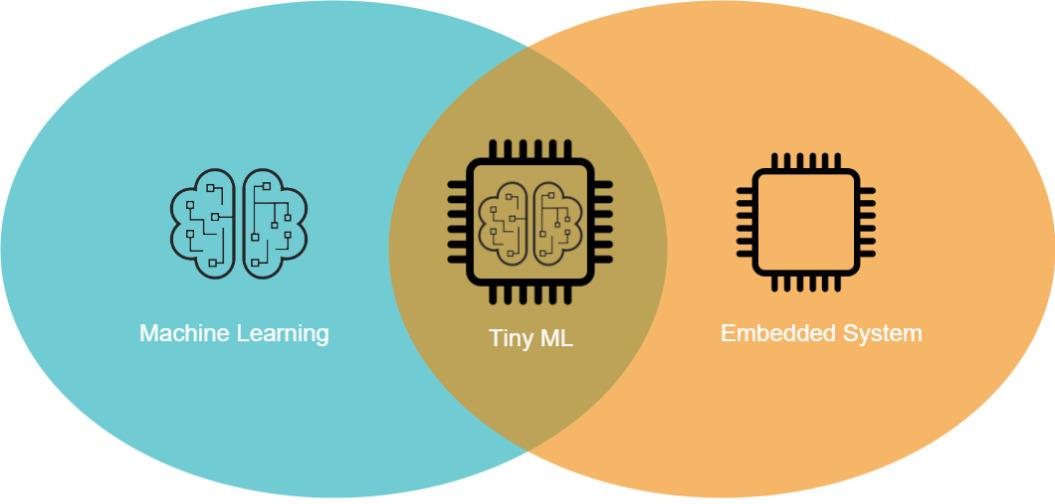
Conceptual diagram illustrating the relationship between the TinyML concept and machine learning and embedded systems. (Mehmet Alperen Bakıcı)
Tiny Machine Learning applications have become feasible through optimizations implemented at both the hardware and software levels. TinyML systems are designed to enable machine learning models to run on low-power microcontrollers.
In TinyML systems, low-power microcontrollers are preferred. Given the limited memory capacity of these devices, memory-efficient model designs are developed. Additionally, real-time data processing capabilities are a critical requirement, especially in autonomous and edge systems.
In TinyML applications, techniques such as model pruning, quantization, and compression are used to reduce model size and computational load. Hardware-accelerated libraries such as CMSIS-NN enhance machine learning performance on ARM Cortex-M architectures. Furthermore, optimized software solutions like TensorFlow Lite allow models developed during the training phase to be easily integrated onto microcontrollers.
Thanks to these technical strategies, TinyML can perform complex tasks such as data processing and autonomous decision-making on resource-constrained devices with minimal power consumption.
Today, TinyML is preferred across many sectors due to its advantages in data privacy, low power consumption, and real-time decision-making.
Abadade, Y., Temouden, A., Bamoumen, H., Benamar, N., Chtouki, Y., and Hafid, A. S. “A Comprehensive Survey on TinyML.” IEEE Access 11 (2023): 96892–96922. https://ieeexplore.ieee.org/document/10177729?denied=. Accessed May 13, 2025.
Bakıcı, Mehmet Alperen. *Real-Time Anomaly Detection in UAV Systems Using TinyML on ARM Cortex-M Microcontrollers*. Master's thesis, İstanbul Teknik Üniversitesi, Fen Bilimleri Enstitüsü, 2024. Advisor: Prof. Dr. Ece Olcay Güneş.YÖK Tez No: 908560. https://tez.yok.gov.tr/UlusalTezMerkezi/tezSorguSonucYeni.jsp. Accessed May 13, 2025.
Google Developers. "TensorFlow Lite for Microcontrollers." Google AI Edge. Accessed May 13, 2025. https://ai.google.dev/edge/litert/microcontrollers/overview.
Kallimani, Raghavendra, Kaushik Pai, Prateek Raghuwanshi, Shruti Iyer, and Oscar L. López. “TinyML: Tools, Applications, Challenges, and Future Research Directions.” *Multimedia Tools and Applications* (2023): 1–31. https://link.springer.com/article/10.1007/s11042-023-16740-9. Accessed May 13, 2025.
Lai, Liangzhen, Naveen Suda, and Vikas Chandra. “CMSIS-NN: Efficient Neural Network Kernels for Arm Cortex-M CPUs.” *arXiv preprint* arXiv:1801.06601 (2018). https://arxiv.org/abs/1801.06601. Accessed May 13, 2025.
Warden, Pete, and Daniel Situnayake. TinyML: Machine Learning with TensorFlow Lite on Arduino and Ultra-Low-Power Microcontrollers. Sebastopol, CA: O’Reilly Media, 2020.

TinyML
Fundamental Methods | Model pruning, quantization, compression, and hardware acceleration are used as optimization techniques. | ||||||||
|---|---|---|---|---|---|---|---|---|---|
Application Area(s) | They are used in fields such as wearable devices and industrial automation. smart sensors UAV systems | ||||||||
No Discussion Added Yet
Start discussion for "TinyML (Tiny Machine Learning)" article
The Intersection of Machine Learning and Embedded Systems
Technical Foundations of TinyML
Hardware Foundations
Software Foundations
Applications of TinyML