This article was automatically translated from the original Turkish version.
Registration Number | 990 | ||||||||
|---|---|---|---|---|---|---|---|---|---|
Registration Date | 03.01.2022 | ||||||||
Application Number | C2018/142 | ||||||||
Application Date | 27.06.2018 | ||||||||
Name of the Geographical Indication | Tokat Bez Sucuk | ||||||||
Product / Product Group(s) | Processed and Unprocessed Meat Products | ||||||||
Type of Geographical Indication | Geographical indication | ||||||||
Applicant/Registrant(s) | Tokat Chamber of Commerce and Industry | ||||||||
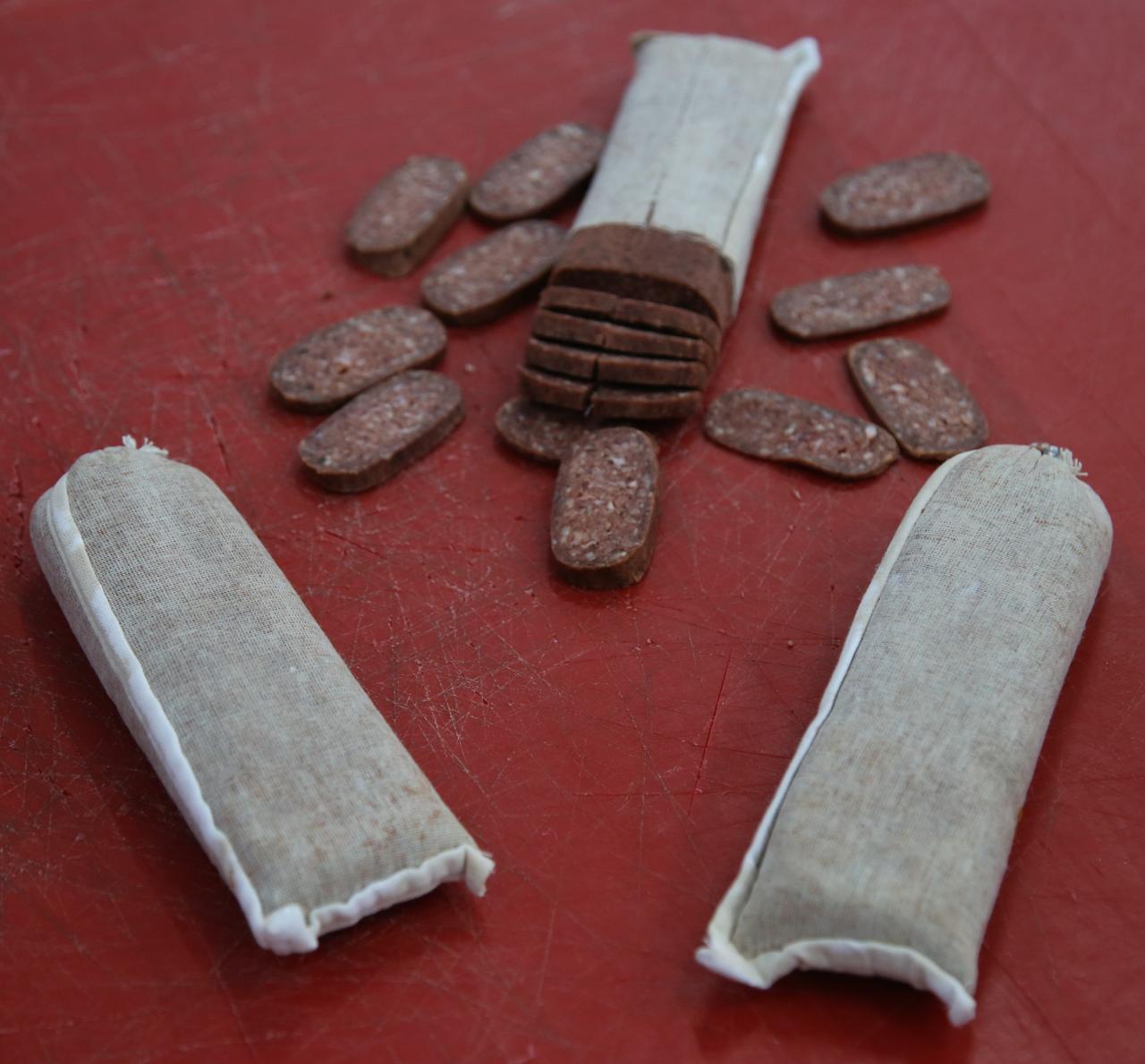
Tokat Bez Sucuk is a fermented sausage prepared using 100% beef from calves raised in natural environments or pastures, along with specified proportions of lamb meat. The sausage mixture is stuffed into fabric casings, sealed with clips at the openings, and then dried. The product undergoes natural fermentation and maturation while being hung. The color and tone of Tokat Bez Sucuk range from brick red to dark brown. There is no air gap between the fabric casing and the sausage mass. Its average weight is 200–250 grams and it is preserved under vacuum packaging before being offered for sale.

Tokat Bez Sucuğu (Culture Portal )
Tokat Bez Sucuk is made from the carcass meat of calves raised in natural environments or pastures. In production, sheep tail fat is generally preferred; however, internal fat, rendered fat, or fat from muscle tissue may also be used in specified quantities. Spices include hot red pepper, sweet red pepper, black pepper, cumin, allspice, garlic, and salt; cinnamon and clove may be added optionally. Sugar, nitrite salts (in amounts not exceeding 150 mg/kg), and phosphate salts may be used to ensure proper fermentation.
The sausage mixture is stuffed into unbleached white mermerşahi fabric casings made of 100% cotton thread. During fermentation, microorganisms of the genera Lactobacillus, Staphylococcus, and Micrococcus play a role. The product inside the fabric casings is rolled two to three times with a roller to achieve a flattened shape. After maturation, Tokat Bez Sucuk reaches a weight of 200–250 grams, its color varies from brick red to dark brown, and there is no air gap between the fabric casing and the meat mass. The product’s pH, total meat protein, collagen, moisture, and fat content comply with food regulations.
Tokat Bez Sucuk is produced exclusively within the boundaries of Tokat Province. The ingredients used and the production method are specific to this geographical region. All production stages, processing, and related procedures are carried out within Tokat Province.

Tokat Bez Sucuğu (Culture Portal )
Production consists of three stages: formulation, fermentation, and maturation/drying. In the formulation stage, meat, fat, and other ingredients are mixed in specified proportions at a temperature not exceeding 10–12 °C. The homogenized sausage mixture is filled into fabric casings using an automatic stuffing machine, and the ends are sealed with clips.
In the fermentation and maturation stage, the fabric casings are placed on hanging carts and subjected to natural fermentation in controlled rooms where humidity and temperature can be adjusted. Initially, the relative humidity is 85% and the temperature is 24–26 °C. Over successive days, humidity and temperature are gradually reduced; after 10–12 days, the relative humidity reaches 65% and the temperature drops to 12 °C. During fermentation and maturation, the fabric casings are rolled two to three times with a roller.
During fermentation, microorganisms of the genera Lactobacillus, Staphylococcus, and Micrococcus play a key role. During natural fermentation, lactic acid bacteria break down sugars to produce lactic acid, causing the product’s pH to decrease and its water-holding capacity to reduce. Aroma compounds are formed through the breakdown of proteins and fats. After maturation is complete, the product is placed in vacuum packaging and can be stored at 2–4 °C for up to four months.
Inspections of Tokat Bez Sucuk are coordinated by the Tokat Chamber of Commerce and Industry. Experts from the Department of Food Engineering at Gaziosmanpaşa University and the Tokat Provincial Directorate of Agriculture and Forestry participate in these inspections. Inspections are conducted at least twice annually; additional inspections are carried out upon complaint or need. Inspection criteria include the suitability of ingredients, the appropriateness of the fabric casing, microbial and environmental conditions, compliance with production methods, the product’s physical and chemical properties, and packaging and storage conditions.
Culture Portal. "Tokat’ta Ne Alınır: Bez Sucuk." Türkiye Kültür Portalı. Accessed August 18, 2025. https://www.kulturportali.gov.tr/turkiye/tokat/nealinir/bez-sucuk.
Geographical Indications. "Tokat Bez Sucuk Geographical Indication File." PDF. Turkish Patent and Trademark Office. Accessed August 18, 2025. https://ci.turkpatent.gov.tr/Files/GeographicalSigns/e5d7c8e6-811d-4298-b988-f5df12440d9e.pdf.
Geographical Indications. "Tokat Bez Sucuk." Turkish Patent and Trademark Office. Accessed August 18, 2025. https://ci.turkpatent.gov.tr/cografi-isaretler/detay/38593.

Registration Number | 990 | ||||||||
|---|---|---|---|---|---|---|---|---|---|
Registration Date | 03.01.2022 | ||||||||
Application Number | C2018/142 | ||||||||
Application Date | 27.06.2018 | ||||||||
Name of the Geographical Indication | Tokat Bez Sucuk | ||||||||
Product / Product Group(s) | Processed and Unprocessed Meat Products | ||||||||
Type of Geographical Indication | Geographical indication | ||||||||
Applicant/Registrant(s) | Tokat Chamber of Commerce and Industry | ||||||||
Distinctive Characteristics
Geographical Boundary and Production Area
Ingredients
Production Method
Inspection and Control