This article was automatically translated from the original Turkish version.
+1 More
Type of Geographical İndication | Mahreç Sign | ||||||||
|---|---|---|---|---|---|---|---|---|---|
Application Date | 03.03.2021 | ||||||||
Registration Number | 819 | ||||||||
Registration Date | 06.08.2021 | ||||||||
Product / Product Group(s) | Handicraft Products Other Than Carpets Kilims and Textiles | ||||||||
Province(s) | Tokat | ||||||||
Applicant/Registrant(s) | Tokat Chamber of Commerce and Industry | ||||||||
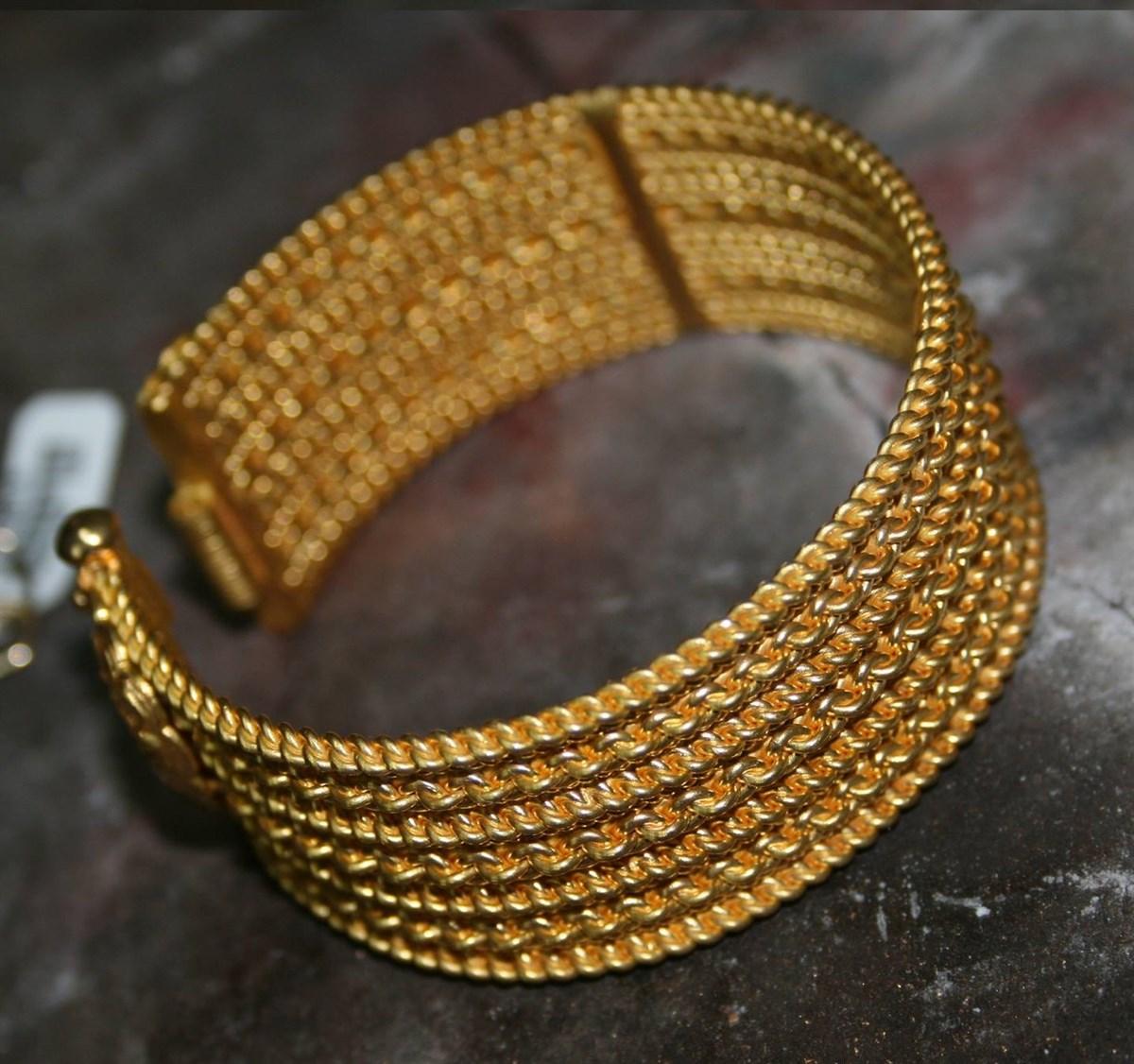
The Tokat bracelet, also known as the Tokat Mengil Bracelet, is a traditional craft product unique to the province of Tokat. The production process begins with drawing gold into wire form, followed by shaping the wires into spirals, chains, and triangles. Different models of Tokat bracelets are created by arranging these wires in specific numbers and sequences. The bracelets, with an average weight ranging between 80 and 110 grams, come to life through mastery of wirework, intricate arrangement, and delicate craftsmanship.

Tokat Bileziği (Tokat Governorate)
The types and usage of wires vary according to the number of rows in the bracelet. In three-row bracelets, two triangles, two spirals, and one chain wire are used. In the five-row model, three triangles, four spirals, and two chain wires are employed. Seven-row bracelets typically feature four triangles, six spirals, and three chain wires, while the nine-row model, the widest variant, includes five triangles, eight spirals, and four chain wires. This variation demonstrates the technical diversity of the Tokat bracelet.
The first stage of production involves melting gold ingots and casting them into molds, followed by shaping them into bars. These bars are cleaned in a sulfuric acid solution and then passed through a wire-drawing machine to reduce their thickness. The wires are annealed and dipped in beeswax to produce wires of varying thicknesses.
The prepared woven wires are cut to appropriate lengths and formed into rings, with their ends soldered. After annealing, the surface is cleaned with a hydrochloric acid solution. The woven wires are arranged on a fixture according to a specific sequence (triangle – spiral – chain – spiral – triangle, etc.). Gold bands are soldered onto the inner surface to secure the structure, after which the bracelet is removed from the fixture.

Tokat Bileziği (Tokat Governorate)
The clasp component is manufactured using the sand-casting technique and welded to the ends of the bracelet. When the two ends are joined, they form a heart shape. The surface is cleaned and polished using an acid bath and gold-plating solution. Finally, the clasp area is engraved with a diamond stylus to achieve the final form.
With a history spanning over a century, the Tokat bracelet has become not merely a piece of jewelry but a cultural heritage. This bracelet, shaped through production techniques unique to the province of Tokat and requiring mastery at every stage, has been officially registered by the Tokat Chamber of Commerce and Industry under Law No. 6769 on Industrial Property. All production stages are carried out within the boundaries of Tokat province, and oversight is conducted through collaboration among expert institutions.
T.C.Tokat Valiliği Official Website. "Tokat Bileziği." Accessed July 7, 2025. https://www.tokat.gov.tr/tokat-bilezigi
Turkish Patent and Trademark Office. "Tokat Bileziği / Tokat Mengil Kolluğu." Geographical Indications Portal. Accessed July 7, 2025. https://ci.turkpatent.gov.tr/cografi-isaretler/detay/3564

Type of Geographical İndication | Mahreç Sign | ||||||||
|---|---|---|---|---|---|---|---|---|---|
Application Date | 03.03.2021 | ||||||||
Registration Number | 819 | ||||||||
Registration Date | 06.08.2021 | ||||||||
Product / Product Group(s) | Handicraft Products Other Than Carpets Kilims and Textiles | ||||||||
Province(s) | Tokat | ||||||||
Applicant/Registrant(s) | Tokat Chamber of Commerce and Industry | ||||||||
Wire Types and Bracelet Typology
Production Process
Preparation of Gold
Shaping the Wires
Assembly and Arrangement of the Bracelet
Clasp Mechanism and Final Finishing
Geographical Scope and Protection Status