This article was automatically translated from the original Turkish version.
+1 More
Type of Geographical İndication | Signpost | ||||||||
|---|---|---|---|---|---|---|---|---|---|
Application Date | 14.06.2023 | ||||||||
Registration Number | 1673 | ||||||||
Registration Date | 19.12.2024 | ||||||||
Product / Product Group(s) | Rugs and kilims | ||||||||
Province(s) | Tokat | ||||||||
Applicant/Registrant(s) | Tokat Provincial National Education Directorate | ||||||||
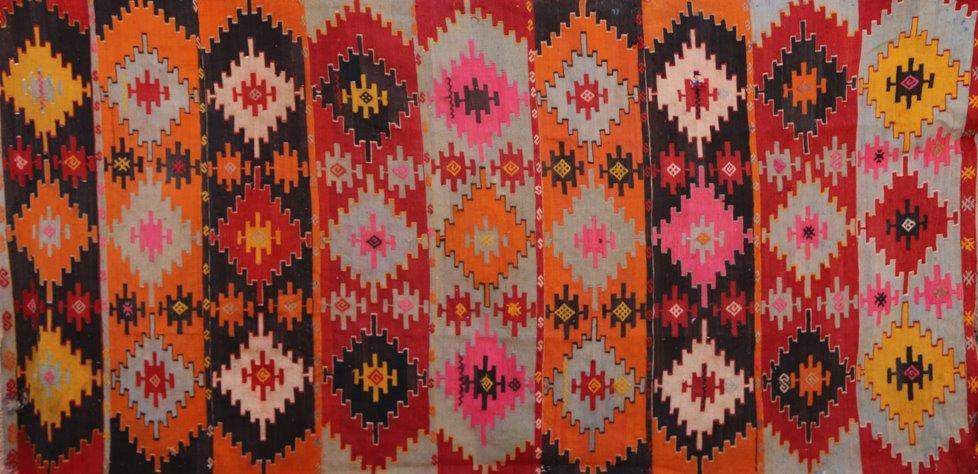
Tokat Kızık Kilim is a traditional handwoven product named after the village of Kızık in the province of Tokat, with a deep historical heritage. These kilims are entirely handwoven using 100% wool yarn and are distinguished by their fine and durable structure, original motifs, colors, and weaving techniques. Traditionally used as floor coverings, quilts, cushions, and wall hangings, Kızık kilims are now also utilized in bags, wallets, keychains, chairs, poufs, and various accessories. On December 19, 2024, the Tokat Provincial Directorate of National Education registered the Tokat Kızık Kilim as a geographical indication.

Tokat Kızık Kilim (Tokat Governorate)
Tokat Kızık Kilim is produced using a combination of flat weave, tilif (ilikli), and cicim weaving techniques. The ground of the kilims is woven using the flat weave technique, while the motifs are created with the tilif/ilikli technique; within the innermost areas, zigzag or curved patterns are raised using the cicim technique. The tight weaving of finely twisted wool yarns produces elegant and detailed designs. The primary colors used in the kilims are red, blue, green, and black. Traditionally, natural dyes derived from plant roots were used, though synthetic dyeing methods are now also preferred.
The most distinctive feature of Kızık kilims is their region-specific motifs, shaped according to local cultural beliefs, each carrying unique meanings:
The motifs are stylized symbols woven into the kilim to express the weavers’ emotions, thoughts, joys, sorrows, desires, and fears. Along the edges of the designs, open spaces known as ajur or ilik, created using the tilif weaving technique, add a unique aesthetic to the kilims. In this technique, colored weft threads that alternate between upper and lower warp threads wrap around the final warp thread at the motif boundary, defining their contours. When applying motifs composed of horizontal and diagonal lines, vertical lines are woven in stepped patterns.
Tokat Kızık Kilim is woven on portable wooden looms, typically made from pine wood. The loom is supported by wooden posts including the power post, warp post, and winding post. The production process consists of three main stages:

Kızık Kilim on the Loom (AA)
Tokat Kızık Kilim is an important part of Tokat province’s cultural heritage. In the past, kilims were commonly given as dowry gifts to newlywed couples, woven to offer protection from misfortune and to bring good fortune.
The production of Tokat Kızık Kilim takes place exclusively within the province of Tokat, with all stages completed within this geographic boundary. The conformity of the kilims is annually inspected by a four-member oversight body composed of experts from the Tokat Provincial Directorate of Industry and Technology and the Tokat Provincial Directorate of Culture and Tourism, under the coordination of the Tokat Provincial Directorate of National Education. Additional inspections are conducted as needed or upon complaint. During inspections, compliance with material standards, adherence to production methods, use of the tilif weaving technique, application of original motifs, and correct usage of the geographical indication emblem are verified.
Anadolu Ajansı. 2025. “Coğrafi işaretli ‘Kızık kilimi’ dokumacılığı, üniversitede gelecek nesillere aktarılıyor.” Accessed July 18, 2025. https://www.aa.com.tr/tr/kultur/cografi-isaretli-kizik-kilimi-dokumaciligi-universitede-gelecek-nesillere-aktariliyor/3524544.
T.C.Tokat Valiliği. 2025. “Kızık Kilimi ve Aynalı Çarığın Tescil Belgesi Teslim Edildi.” May 30, 2025. Accessed July 18, 2025. https://www.tokat.gov.tr/kizik-kilimi-ve-aynali-carigin-tescil-belgesi-teslim-edildi.
Turkish Patent and Trademark Office. "Tokat Kızık Kilimi" Geographical Indications Portal. Accessed July 18, 2025. https://ci.turkpatent.gov.tr/cografi-isaretler/detay/9623.

Type of Geographical İndication | Signpost | ||||||||
|---|---|---|---|---|---|---|---|---|---|
Application Date | 14.06.2023 | ||||||||
Registration Number | 1673 | ||||||||
Registration Date | 19.12.2024 | ||||||||
Product / Product Group(s) | Rugs and kilims | ||||||||
Province(s) | Tokat | ||||||||
Applicant/Registrant(s) | Tokat Provincial National Education Directorate | ||||||||
Features and Motifs
Production Process
Cultural Significance
Monitoring and Registration