


This article was automatically translated from the original Turkish version.
+1 More
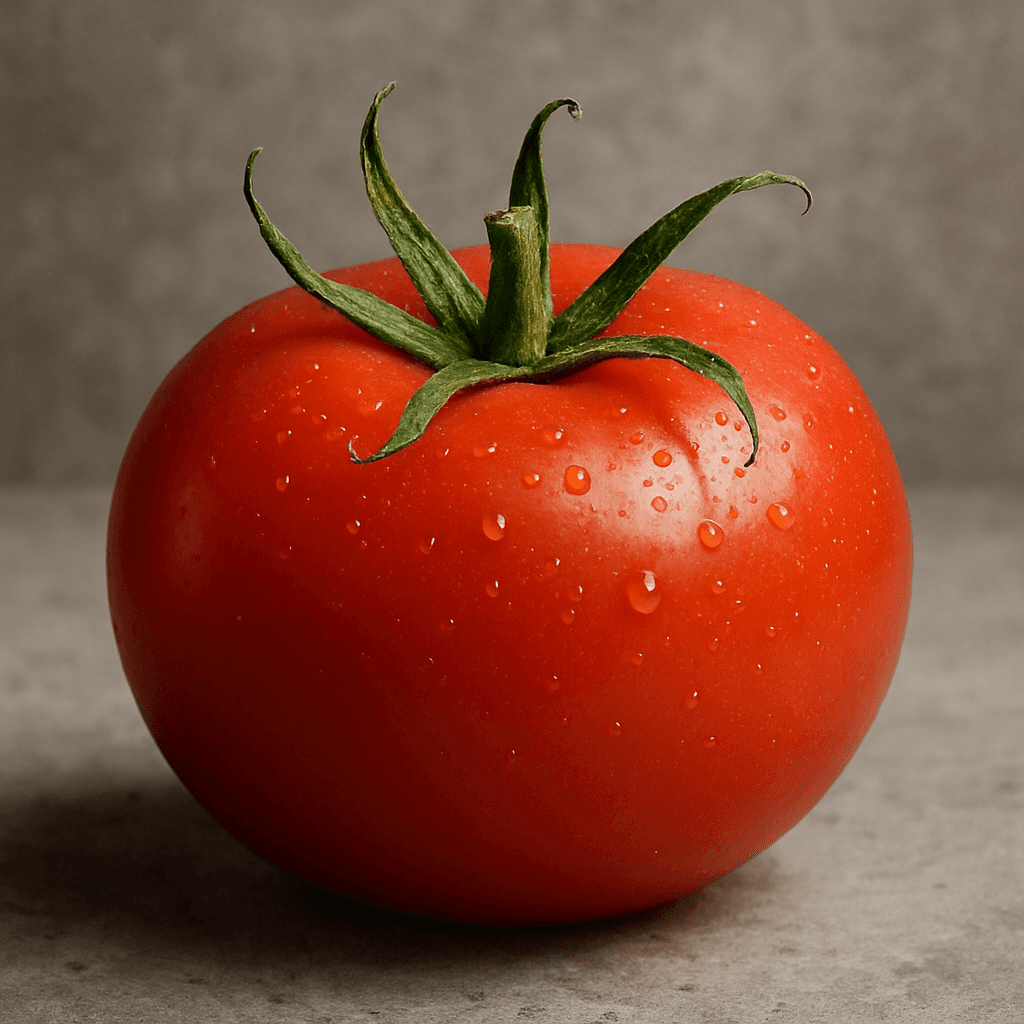
Tomato
Kingdom (Regum) | Plants (Plants) | ||||||||
|---|---|---|---|---|---|---|---|---|---|
Division (Diviso) | Magnoliophyta (Flowering plants) | ||||||||
Class (Classis) | Magnoliopsida (Dicotyledons) | ||||||||
Order (Ordo) | Solanales | ||||||||
Family (Familia) | Solanaceae (Nightshade family) | ||||||||
Genus (Genus) | Solanum | ||||||||
Species (Species) | Solanum lycopersicum | ||||||||
Synonym (Eski Ad) | Lycopersicum esculentum Mill. | ||||||||
Tomato (Lycopersicon esculentum) is one of the most commonly encountered plants worldwide, both on dining tables and in industrial food products. Originating from the highland regions of South America, this plant is not merely an agricultural crop; it also plays a central role in nutrition, culture, trade, and science. Today, tomato is cultivated in more than 170 countries and has become one of the foundational pillars of global agriculture.

Tomato (Generated by Artificial Intelligence)
The origin of the tomato extends to the Andean regions of Peru, Ecuador, and Chile. Wild forms of the tomato grew there and reached Mexico approximately two thousand years ago, where it was cultivated and named “xitomatl” by the Aztecs. In Aztec cuisine, the tomato was a fundamental ingredient in sauces and soup bases. It was introduced to Europe in the 16th century by Spanish explorers.
Initially spreading in Spain and Italy, the plant was long regarded as poisonous in other parts of Europe and was grown only as an ornamental. From the 17th century onward, it began to be cooked and consumed in Italian cuisine, later entering French and English kitchens. It arrived in the Ottoman Empire toward the end of the 18th century, where it was known as “Frenk badıcanı.” Over time, the terms “domat” and then “domates” became established.
The tomato is an annual plant belonging to the Solanaceae family. It typically grows between 50 cm and 2 meters in height. Its main stem is covered with hairs and usually requires support for optimal growth. The leaves are hairy and compound; this structure influences the plant’s transpiration regulation and defense mechanisms.
The plant produces yellow, five-petaled flowers that are self-pollinating, making it well-suited for open-field cultivation and controlled hybrid breeding. The fruits are generally round or slightly flattened. Red varieties are the most common, but yellow, orange, black, purple, and green varieties also exist.
Technically, the tomato fruit is a fruit, as it develops from the ovary of the flower. However, in nutritional and culinary contexts, it is classified as a vegetable.
The tomato is a low-calorie, nutrient-rich food. One hundred grams contain only about 18 calories. It is high in vitamin C and has immune-boosting properties. It is also rich in important vitamins and minerals, including vitamin A, vitamin K, folic acid, potassium, and magnesium.
Its most notable compound is lycopene, a carotenoid pigment responsible for the tomato’s red color. This substance is a powerful antioxidant that combats free radicals in cells and is believed to reduce the risk of certain types of cancer. A 2023 study by Harvard University demonstrated that regular tomato consumption reduces the risk of prostate cancer. Scientific studies also support its benefits for cardiovascular health, skin health, and anti-aging effects.
The tomato prefers temperate and warm climates. The optimal growth temperature ranges from 20–28°C during the day and 12–20°C at night. Cold weather slows growth, and frost can be completely destructive.
Although it appears non-selective regarding soil, it achieves its best development in well-drained, organically rich, slightly clayey or sandy-loamy soils. The soil pH should be between 5.5 and 7. Saline and heavy soils can lead to problems such as root rot.
Tomato cultivation employs a wide variety of methods. It can be produced through open-field farming, greenhouse cultivation, soilless farming (hydroponics), plastic tunnels, and protected cultivation systems. In Türkiye, greenhouse production is widespread in regions with a Mediterranean climate, such as Antalya, Mersin, and Adana. Hydroponic farming is emerging as a modern and sustainable solution in areas with limited water resources.
Irrigation must be carefully planned throughout the growth cycle. Consistent and controlled irrigation, particularly during fruit set and ripening stages, significantly influences both yield and quality. Drip irrigation is among the most efficient methods in this regard.
One of the most common pests of the tomato, especially prevalent in Türkiye and the Mediterranean basin, is Tuta absoluta (tomato leafminer). It damages leaves, fruits, and flowers, causing significant yield losses. Other important pests include whitefly, red spider mite, aphids, and leafminer flies.
Among diseases, fungal infections such as powdery mildew, fusarium wilt, and botrytis (gray mold) are widespread. Bacterial spot, tomato canker, and viral mosaic diseases also reduce production quality. Integrated pest management, biological control, and the use of resistant varieties are key strategies for combating these issues.
Global annual tomato production exceeds 190 million tons. China is the largest producer, followed by India, the United States, and Türkiye. Türkiye is a major exporter of table and sauce tomatoes to the European market.
Antalya is the central hub for greenhouse farming and tomato production in Türkiye. The Black Sea region contributes to market diversity by offering later-season production in open fields. Moreover, tomato plays a critical role in Türkiye in the utilization of non-agricultural land, job creation, and rural development.
Giovannucci, E. (1999). Tomatoes, tomato-based products, lycopene, and cancer: Review of the epidemiologic literature. Journal of the National Cancer Institute, 91(4), 317–331. https://doi.org/10.1093/jnci/91.4.317
Klee, H. J., & Tieman, D. M. (2013). "Genetic Challenges of Flavor Improvement in Tomato." *Trends in Genetics*, 29(4), 257–262. https://pubmed.ncbi.nlm.nih.gov/23332147/
Türkiye İstatistik Kurumu (TÜİK). "Bitkisel Üretim İstatistikleri 2024." Accessed May 14, 2025. https://data.tuik.gov.tr/Bulten/Index?p=Bitkisel-Uretim-Istatistikleri-2024-53447

Tomato
Kingdom (Regum) | Plants (Plants) | ||||||||
|---|---|---|---|---|---|---|---|---|---|
Division (Diviso) | Magnoliophyta (Flowering plants) | ||||||||
Class (Classis) | Magnoliopsida (Dicotyledons) | ||||||||
Order (Ordo) | Solanales | ||||||||
Family (Familia) | Solanaceae (Nightshade family) | ||||||||
Genus (Genus) | Solanum | ||||||||
Species (Species) | Solanum lycopersicum | ||||||||
Synonym (Eski Ad) | Lycopersicum esculentum Mill. | ||||||||
No Discussion Added Yet
Start discussion for "Tomato (Lycopersicon esculentum)" article
Origin and History
Botanical Characteristics
Nutritional and Health Significance
Climate and Soil Requirements
Cultivation Techniques and Practices
Pests and Diseases
Tomato in Türkiye and the World