

This article was automatically translated from the original Turkish version.
+1 More
Location | Bursa Türkiye | ||||||||
|---|---|---|---|---|---|---|---|---|---|
Founder(s) | II. Selim | ||||||||
Construction Date(s) | After 1553 16th century | ||||||||
Architecture(s) | Octagonal plan Domed Stone and brick | ||||||||
Decoration | Iznik tiles, Carnation and lily motifs, 21x25 cm; 18 tiles missing | ||||||||
In the Osmangazi district of Bursa, within the Muradiye Külliyesi, the Şehzade Mustafa Türbesi stands southwest of the tombs of II. Murat and Alaattin. It commemorates one of the most tragic events in Ottoman dynastic history. Also known in sources as the Mustafa-i Cedid Türbesi, the structure was commissioned by Prince Selim II, brother of Şehzade Mustafa, in memory of Mustafa, the son of Kanuni Sultan Süleyman and Mahidevran Sultan. A two-line marble inscription measuring 0.15 x 0.30 metres above the tomb’s entrance reveals that it was erected in memory of the prince, executed by his father’s order in 1553 on the Konya Plain.

Şehzade Mustafa Türbesi (Türkiye Culture Portal)
Şehzade Mustafa, one of the most prominent heirs to the Ottoman throne, assumed significant responsibilities at a young age but remained overshadowed by court intrigues. His execution by strangulation in Konya Ereğlisi, on his father’s orders during the Nahçıvan campaign, profoundly affected the political balance of the era. His body was brought to Bursa and buried in this tomb within the Muradiye Külliyesi.
The tomb is an octagonal structure built using a combination of stone and brick. The main body is constructed with three courses of brick and one course of cut stone, crowned by a lead-covered dome resting on an octagonal drum. The entrance portal is made of marble and displays simple yet elegant craftsmanship.
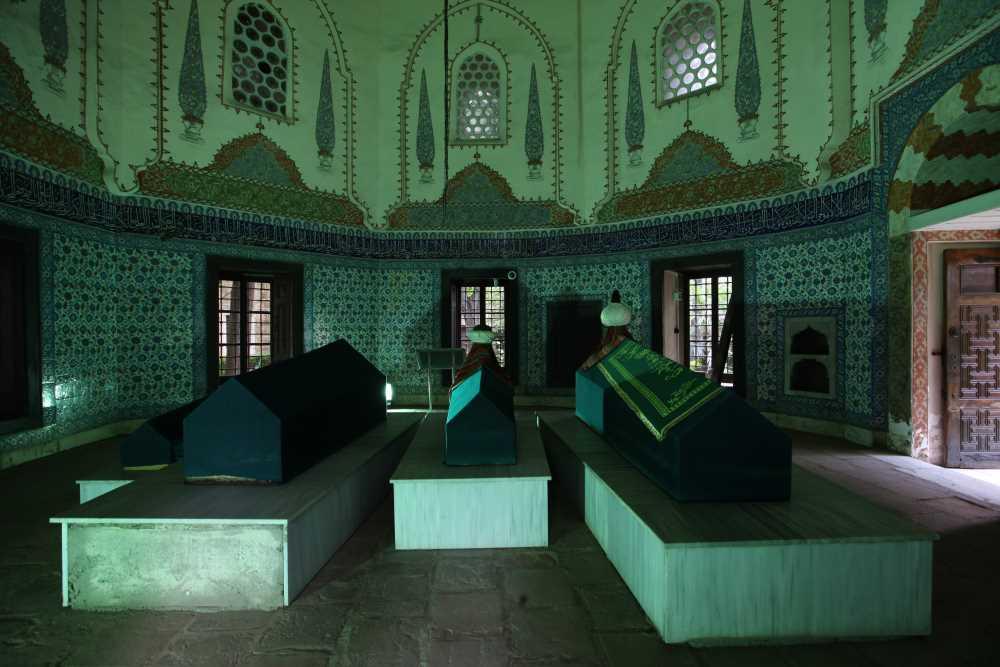
The interior walls are clad with 16th century Iznik tiles featuring carnation and lily motifs in blue, green and red on a white background, extending up to three metres from the floor. The tiles are framed by a border composed of curved branches and are square in form, measuring 21 x 25 cm. It is known that 18 tile pieces are currently missing. The tomb’s floor is paved with square bricks, while the upper sections remain relatively plain.
The Iznik tiles used in the tomb are regarded as among the most refined examples of Ottoman classical tile art. The carnation and lily motifs, executed on a white ground, reflect the aesthetic sensibilities of the period through their harmonious colour and pattern composition. The tile cladding serves as a visual focal point that complements the architectural design.
Positioned in harmony with other dynastic tombs within the Muradiye Külliyesi, the Şehzade Mustafa Türbesi draws attention for both its architectural and historical value. While preserving the painful memory of the struggle for the Ottoman throne, it also showcases the high artistic standards of the classical period. For this reason, the structure is a valuable subject of study for both historians and art historians.
Today, the tomb retains its original structure to a large extent. Apart from the missing tiles on the walls, its architectural form and interior decoration exemplify the characteristic features of Ottoman classical period tombs. Due to its historical and artistic significance, it holds an important place as a cultural heritage site for both domestic and international visitors.
The Şehzade Mustafa Türbesi forms part of the Ottoman family necropolis within the Muradiye Külliyesi. Its location and aesthetic arrangement contribute to the overall harmony of the complex, reflecting the period’s understanding of funerary architecture.
Bursa Regional Directorate. "Şehzade Mustafa Türbesi." Bursa Regional Directorate. Accessed August 16, 2025. https://alanbaskanligi.bursa.bel.tr.
Culture and Museums General Directorate. "Tiles Removed and Stolen from the Tomb of Şehzade Mustafa in Bursa." Culture and Museums General Directorate. Accessed August 16, 2025. https://kvmgm.ktb.gov.tr/TR-44576/bursa-ili-sehzade-mustafa-turbesinden-sokulerek-calinan-ciniler.html.
Kültür Portalı. "Şehzade Mustafa Türbesi." Accessed August 16, 2025. https://www.kulturportali.gov.tr/turkiye/bursa/gezilecekyer/sehzade-mustafa-turbesi.

Location | Bursa Türkiye | ||||||||
|---|---|---|---|---|---|---|---|---|---|
Founder(s) | II. Selim | ||||||||
Construction Date(s) | After 1553 16th century | ||||||||
Architecture(s) | Octagonal plan Domed Stone and brick | ||||||||
Decoration | Iznik tiles, Carnation and lily motifs, 21x25 cm; 18 tiles missing | ||||||||
No Discussion Added Yet
Start discussion for "Tomb of Prince Mustafa " article
History
Architectural Features
Interior Space and Decoration
Tiles and Material Details
Art Historical Significance and Evaluation
Conservation Status and Importance
Location within the Muradiye Külliyesi