

This article was automatically translated from the original Turkish version.
+1 More
Name(s) | Tomika-chō (Gifu) Poltergeist Case | ||||||||
|---|---|---|---|---|---|---|---|---|---|
Type(s) | Paranormal Case | ||||||||
Place | Japan Gifu Prefecture Tomika-chō | ||||||||
Date(s) | 1999–2000 | ||||||||
Space | Four-story apartment building | ||||||||
Events Experienced | cameras failing to function at specific locations compass deviations plants wilting faster than normal ghostly apparitions around the building male and female figures plates and bowls being thrown cabinet doors opening gas stoves igniting on their own faucets and showers turning on spontaneously electrical appliances turning on by themselves Recurring unusual sounds | ||||||||
Researchers | Tatsu Hirukawa Mikio Yamamoto Hideyuki Kokubo | ||||||||
Results | after which the phenomena visibly diminished from late 2000 Joh-rei (spiritual purification) ritual | ||||||||
The Tomika-chō (Gifu) Poltergeist Case is a series of reported phenomena occurring in 2000 at a municipal apartment building in Tomika-chō, Gifu Prefecture, including unusual sounds, objects allegedly moving on their own, electrical appliance anomalies, and some visual accounts.【1】
The case gained widespread public attention after complaints, which had become noticeable following moves into the four-story complex opened in 1999, were reported in the media in late 2000. Interactions with local authorities, media interest, visits by external mediums, and a purification ritual called “Joh-rei” conducted at the request of residents became integral parts of the process.

System Installed in Room 305 to Investigate Paranormal Events (Hideyuki Kokubo)
Short-term measurements conducted during the same period showed no anomalies in background radiation or low-frequency magnetic fields; however, two unusual electrical signals were recorded on the measurement circuit in Room 305.【2】 Although reports indicated a reduction in incidents after the ritual, this observation has not been supported by any scientific study.
Tomika-chō is a rural settlement located in central Japan, situated at approximately 75 meters above sea level, between the foothills of Nashiwari Mountain, which rises to 278 meters in the north, and the southern plains. The district covers an area of approximately 16.82 km², with land use dominated by agricultural fields and forests. Climate data from around 2000 show summer temperatures reaching up to 36 °C and winter temperatures dropping to -6.8 °C, with an annual average of 15.9 °C; rainfall is high across the region. The population fluctuates between 6,000 and 7,000 people.

Shift in the Center of Phenomena After the First Ritual (Hideyuki Kokubo)
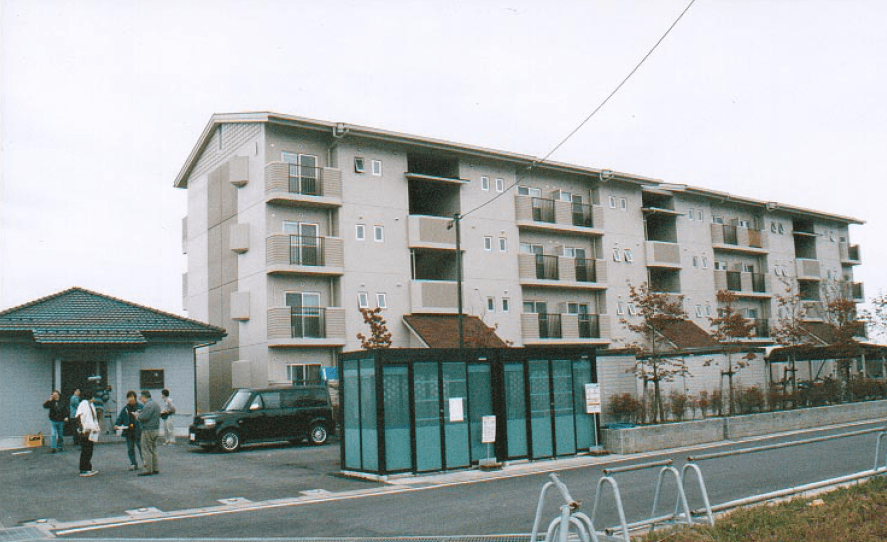
The apartment building at the center of the case is a four-story municipal housing complex built in 1999 in the southern part of the settlement, housing 24 families.【3】 The building consists of apartments numbered along an east-west axis, surrounded by rice paddies, small groves, and low-rise residences. Approximately 250 meters to the north lies the local Nagaragawa railway line, which has low service frequency and does not operate at night. About 200 meters to the south, within a wooded area, is a factory operating only during daytime hours.

The Apartment and Its Surroundings (Hideyuki Kokubo)
A communication company’s parabolic antenna tower is visible on the southern horizon; however, its surface does not face the building.【4】 The absence of high-rise structures near the building indicates that the area has an open and low-noise electromagnetic and acoustic background. In contrast, the railway line, the daytime industrial facility, and meteorological variables are considered potential environmental influences.
New residents initially struggled to distinguish everyday apartment noises from the unusual experiences they reported; as repetition and pattern recognition increased over time, complaints became more pronounced. The residents’ association appealed to local authorities for action, but their expectations were not fully met. Some families chose to temporarily vacate their apartments.
Following media coverage, the building quickly attracted widespread attention. National and local press outlets published detailed reports; television crews arrived on site for filming. Some productions brought in mediums to conduct “remote viewing” or “purification” attempts; others encouraged scientific measurements. During this period, the building and its surroundings became a destination for curious visitors; nighttime trespassing groups and unauthorized rituals affected residents’ sense of privacy and daily routine. Occasional reports indicated that religious or sect groups from across the country arrived en masse to perform their own rituals.

Media Personnel Interviewing Residents (Hideyuki Kokubo)
As interaction within the community intensified, information sharing and narrative reinforcement altered perceptual thresholds.【5】 While some residents associated the events with a supernatural source, others emphasized infrastructural or acoustic explanations; this multiplicity of interpretations directly influenced daily communal decisions—such as nighttime activity, children’s room arrangements, guest接待 habits, and door/window routines. The residents’ association sought to coordinate external interventions, restrict unauthorized access, and maintain order in common areas to reduce mounting tensions.
During this period of increased media visibility, a purification ritual led by a medium was conducted at the request of residents, and it was reported that incidents in the eastern wing had decreased; however, it was also claimed that the focus of phenomena shifted toward the middle and upper floors. Shortly thereafter, between 15 and 17 November 2000, a scientific team conducted measurements on site.
On the night of 15 November, following the resident’s report that “an invisible entity had touched the door handle and moved through the corridor and child’s room toward the veranda,” the measurement setup was positioned in the child’s room to cover this trajectory. Official recording began at 22:24, and the first unusual electrical signal was recorded at approximately 22:30, followed by two additional signals around 23:10.
Comments on the Case in a Podcast (BusanKevin)
No anomalies were detected in background radiation during measurements on the same day and subsequent days; no unusual recordings were made in low-frequency magnetic fields. On the night of 17 November, at the invitation of the residents’ association, senior Buddhist clergy conducted a collective “Joh-rei” (spiritual purification) ritual in the association’s hall. Attendance was broad, and feedback indicated a gradual decline in complaints after the ritual. Debates over whether this effect was a placebo persisted for a long time.
After November 2000, the cycle of events visibly subsided and daily life in the building returned to normal. In subsequent years, a brief observational visit was made on 14 December 2003; during this visit, it was noted that approaching the site closely was difficult and no significant results were obtained from brief random number generator (RNG) measurements conducted inside a vehicle.
A significant portion of the reported phenomena in the building involved sounds. In the eastern wing (units 101–402) and upper floors, noises resembling “footsteps” or “running” were described, occurring periodically in localized areas. Sounds recorded by a television crew in the western stairwell were said to resemble “submarine sonar.” These sounds were not isolated incidents easily confused with ordinary neighborly noise but were instead reported as clusters with a sense of recurrence, drawing noticeable attention in some apartments and disrupting daily routines.
Spontaneous object movements and appliance anomalies varied by unit. In Unit 101, the curtain was reported to move on its own; in Unit 304, an unidentified box was said to “fly” into the room. In Unit 305, a fan reportedly operated without electrical connection, and the shower system exhibited irregular behavior. During measurements on 15 November, two unusual electrical signals were recorded on the circuit, aligned with the alleged path of the phenomenon.
In Unit 403, residents reported feeling the door handle turn and the shoe cabinet lid open spontaneously. In Unit 404, claims included a rice bowl emerging from a cupboard and transforming into an “unusually notched” shape, the cupboard door opening on its own, the television channel changing without intervention, and the gas stove igniting spontaneously. In Unit 405, frequent appliance malfunctions were reported, including a hair dryer said to operate without power, a compass needle rotating, and cameras failing to function at specific locations. It was also noted that independent observers and media personnel reported similar compass anomalies and camera failures at certain points.
Visual sightings clustered spatially at several locations. Descriptions of a “male figure” were repeated around Units 403 and 405; an account of seeing “a woman and man together” was also reported for Unit 403. The resident of Unit 304 stated having seen a figure on the exterior wall of Unit 404; additionally, a report from late 1998 during construction recorded a sighting of a figure inside Unit 404. When evaluating these accounts, factors such as line of sight, lighting conditions, reflections or refractions from glass and varnished surfaces, external light sources, and contextual perceptual effects were considered.
In addition, repeated complaints were made about flowers on the balconies of Units 304, 403, and 405 “withering easily”; factors such as microclimate differences (wind tunnel effect, shading), maintenance routines, watering practices, and growing conditions were discussed. The overall pattern emphasized that initial intensity was most prominent in the eastern wing, followed by a shift of the focal area toward the middle and upper floors, and a gradual reduction in reported incidents after the ritual. This pattern has been examined through a broad spectrum of explanations, ranging from physical processes like water hammer and plumbing acoustics to electrical interference, static buildup, user misattribution, group psychology, and expectation effects, and has been debated for many years.
As belief in a supernatural cause gained traction among residents following media exposure, an initial purification ritual was conducted by summoning a medium. It was reported that incidents in the eastern wing (Units 101–402) decreased afterward; however, claims persisted that the phenomena were not fully eliminated and that the focus had shifted toward the middle and upper floors.
At the conclusion of the field measurement days, at the invitation of the residents’ association, senior Buddhist clergy conducted a collective “Joh-rei” (spiritual purification) ceremony in the association hall. Locally, this ritual was defined as aiming “to bring peace and tranquility to restless spirits and guide them toward the other realm.”
Attendance was high; only a few residents who had temporarily left their apartments due to a child’s sudden fever were unable to attend. The ritual’s structured, communal nature and its high local legitimacy contrasted sharply with the uncontrolled nighttime rituals previously performed by unauthorized religious groups, reinforcing a sense of restored order within the community.

Sketch of the Alleged Ghost (Hideyuki Kokubo)
Interviews and research conducted after the ceremony described a marked sense of calm and control among residents.【6】 Feedback in the following days and weeks indicated a gradual decline in complaints. One resident living in a focal unit noted that disturbing events became increasingly rare and that their life had returned to normal; the president of the residents’ association confirmed the downward trend in reports. As the case cycle visibly subsided after November 2000, Joh-rei became embedded in the settlement’s collective memory as a “turning point.”
While this subsidence alone does not provide causal evidence, the immediate withdrawal of media and unauthorized visitors, the reduction in nighttime activity, and the strengthening of community solidarity significantly calmed the daily environmental climate. A brief visit years later also recorded no significant new findings.
The field study was conducted between 15 and 17 November 2000 with the approval of residents and in coordination with the residents’ association. The focus of measurements was to record the continuity and fluctuation characteristics of the ambient magnetic field in the most frequently reported units, screen background radiation, and monitor basic climatic variables. For this purpose, two different magnetometers were used: one Hall-effect sensor and one three-axis flux-gate magnetometer. The Hall-effect system was selected for its wide-band response (from direct current up to kilohertz frequencies), capturing high-frequency components, while the flux-gate was chosen to cover the low-frequency band (from direct current up to tens of hertz).
The recording architecture followed a “dual recording” principle: magnetometer outputs were fed simultaneously into a DAT tape recorder and a second channel via a universal interface unit and analog-to-digital converter connected to a computer. This allowed two independent recordings from a single sensor, aiming to isolate potential errors in the measurement chain. Ambient conditions—temperature and relative humidity—were monitored using a data logger recording every five seconds; background radiation was scanned using a portable spectrometer.
The setup was installed in the child’s room of Unit 305, taking into account the reported paths of phenomena. After the resident reported sensing an invisible entity touching the door handle and moving through the corridor and child’s room toward the veranda, sensor axes were aligned to cover this direction, with the “Y” axis of the three-axis flux-gate oriented toward the approximate southern exit. Approximately one hour of equilibrium measurement was conducted before official recording began; during this time, no urban noise was detected, the area was quiet, and magnetic field components remained stable.
Stability was confirmed by steady values on all axes at the tens of thousands of nanoTesla level. Continuous recording began at 22:24. The first anomalous signal appeared on the Y-axis graph at approximately 22:30; a second cluster of two distinct signals was recorded on the same axis around 23:10. The sensor placement was not altered between these two events. Immediately after the second cluster, to rule out a channel malfunction, the sensor block was rotated 90 degrees horizontally so that the X-axis faced the same direction; however, no similar signal was observed for the remainder of the night. During this session, room temperature remained constant at approximately 22 °C and relative humidity at approximately 72%; the night was rain-free and windless.
Background radiation scans during measurements yielded no anomalies. No unexpected anomalies were detected in the low-frequency magnetic field band. However, it became clear that the unusual signals recorded in Unit 305 were not magnetic but electrical in nature, appearing on the computer line but absent from the DAT recording.
Post-measurement, the recording chain was reconstructed under laboratory conditions and subjected to long-term tests; no similar pattern was spontaneously generated, indicating the event was not a repeated artifact of ordinary equipment cycling. Nevertheless, the exact source could not be definitively identified. Overall, the setup provided a multi-layered data foundation for a short-term field study through its single-sensor dual-recording approach, complementary frequency band coverage, and simultaneous monitoring of environmental variables.
The field study lasted only three days, which is limiting for statistically capturing rare and unpredictable events. The primary instrument used was the three-axis flux-gate magnetometer sensitive to low frequencies; although the Hall-effect system had the capability to capture upper-band frequencies up to kilohertz levels, it was not activated during the critical session. Therefore, any potential influence occurring above 20 Hz may have been missed.
The dual-recording architecture failed to reflect the two anomalous signals detected on the computer line onto the DAT tape, indicating the signals were internal to the circuit rather than magnetic. However, it was not definitively determined whether individual components of the recording chain (cables, interface, ADC, grounding) generated artifacts. Short-term laboratory repetitions failed to reproduce the pattern; yet, the complex electrical environment of the site could not be fully replicated in the lab, necessitating cautious interpretation.
Similarly, no simultaneous pressure, flow, or vibration measurements were conducted to assess engineering-originated processes such as plumbing acoustics, water hammer, or structural vibrations. Independent verification of event moments through synchronized audiovisual recordings remained limited. The influence of social interactions and media presence on perception and reports was not quantitatively isolated.
Following a 13 October 2000 report in the Chunichi Shimbun, numerous television networks and magazines, including TV Asahi’s “News Station,” filmed on-site. Nighttime shoots, bright lights around the building, interviews, and even overnight stays in some units transformed the case into a “center of curiosity.” During this time, many mediums and religious groups, some offering free services and others demanding high fees, conducted multiple “purification” or “exorcism” attempts daily. The explanations proposed by mediums ranged widely: “the curse of a stillborn baby,” “the curse of Oda Nobunaga’s son,” “the spirits of livestock and pigs that died of cholera,” “the grudge of a swordsmith and a Portuguese missionary,” among competing narratives.
During this period, a monument was erected at the building’s entrance, based on a medium’s claim that “a woman hanged herself here approximately 30 years ago.” In later years, citing the reason that it “attracted evil spirits,” the monument was removed and replaced with a dogwood tree. Local residents who witnessed the era recall the noise and environmental pollution caused by media influxes and unauthorized rituals as a “disturbance to the entire region”; yet, other testimonies, such as children claiming to play with an “invisible old man” in the same neighborhood, were also recorded.
Trailer of the Film Inspired by the Case (SDP MOVIE)
Over the following fifteen to twenty years, the case resurfaced in written and visual culture. Journalist and author Yoshida Yūki, in 2016, toured the site and collected retrospective testimonies, presenting a panorama of the case that highlighted both its “paranormal” and “chaos/disturbance” dimensions. The narrative also illustrates the fading of local memory through details such as the monument’s removal, new buildings added to the complex, and the fact that most current residents are unaware of the events. The most prominent popular culture adaptation directly inspired by the case is the horror film Bldg. N (N号棟, 2022), written and directed by Yōsuke Gotō.
The film uses the 2000 poltergeist reports from a Gifu apartment as its starting point, recreating cinematic elements such as trembling cutlery and spontaneously changing TV channels. Critics, however, note that the film increasingly approaches the atmosphere of “irrational ghost stories told around a campfire” by blending the real events with ritual and sect themes.
In addition, manga and horror anthologies have made references to this case under the theme of the “haunted housing complex,” emphasizing how local topography (nearby ancient graves, rural shrines) and the resurgence of “spiritual” discourse in early 2000s Japan fueled these reinterpretations. Overall, the Tomika-chō case is now primarily recognized in contemporary popular culture through Bldg. N, and in local press, site narratives, and cultural writings, it is remembered less as a “paranormal event” and more as a brief social upheaval at the intersection of media, community, and belief practices.
BusanKevin. "Supernatural Japan – Episode 12: The Gifu Poltergeist and Spooky Tales with Phillip Jackson." YouTube. Accessed October 4, 2025. https://www.youtube.com/watch?v=9ayLlMCsm8I.
Hirukawa, Tatsu. *Institute for Informatics of Consciousness.* Accessed October 4, 2025. https://www.isc.meiji.ac.jp/~hirukawa/iic/.
Kokubo, Hideyuki, Mikio Yamamoto, and Tatsu Hirukawa. *Case Report on Anomalous Electro-Magnetic Signals: Research of “Poltergeist” Incident in Gifu, Japan.* 2nd PSI Meeting: Reflections on the Future of Parapsychology, April 2004. Meiji University. Accessed October 4, 2025. https://www.isc.meiji.ac.jp/~hirukawa/paper/tomika.pdf.
Kokubo, Hideyuki. *Methodology of Case Study on Poltergeist Incident 1.* Lecture note, March 8, 2023; Date Published March 22, 2023. Accessed October 4, 2025. https://www.researchgate.net/publication/369450502_Methodology_of_Case_Study_on_Poltergeist_Incident_1.
Kokubo, Hideyuki. *Recent Case Study for Poltergeist in Japan (近年における国内のポルターガイスト事例調査).* Chōshinri Gakuken, Volume 10, no. 1–2 (2005). Accessed October 4, 2025. https://kokubo.cool.coocan.jp/Poltergeist2005.pdf.
Kokubo, Hideyuki; Martina Blašková; Dominika Tumová; Rudolf Blaško. *Historical and International Comparisons of Paranormal Experiences and Geomagnetism: Focusing on Data from Japan and Slovakia.* 人体科学, Volume 30, no. 1 (2021): 56–69. Accessed October 4, 2025. https://www.researchgate.net/publication/353879595_Historical_and_International_Comparisons_of_Paranormal_Experiences_and_Geomagnetism_-Focusing_on_Data_from_Japan_and_Slovakia_-.
SDP MOVIE. "4月29日公開“考察型”恐怖体験ホラー映画『N号棟』本予告." YouTube. Accessed October 4, 2025. https://www.youtube.com/watch?v=xH5i9f5BKUI.
Schilling, Mark. "Bldg. N’: Paranormal Scares Turn Plain Silly." The Japan Times, April 30, 2022. Accessed October 4, 2025. https://www.japantimes.co.jp/culture/2022/04/30/films/film-reviews/bldg-n/.
Yoshida, Yūki. *vol. 2 岐阜ポルターガイスト団地に「来た」もの――吉田悠軌の異類捜索記.* 晶文社, 2020. Accessed October 4, 2025. https://note.com/shobunsha/n/n97a17584322b.
[1]
Poltergeist kelimesinin tercih edilmesinin sebebi olaya dair akademik makalelerde varlığın / varlıkların bu şekilde isimlendirilmiş olmasıdır. Japonlar ise bunun yerine Yurei veya Shinrei ifadesini kullanmaktadır. Türkçe "Hayalet" kelimesinin seçilmemesinin sebebi ise tam olarak "Yurei" ya da "Poltergeist" ifadesini karşılayamamasındandır. Bu kelimeler belli özelliklere sahip hayaletleri ifade etmektedir.
[2]
Kokubo, Hideyuki. Methodology of Case Study on Poltergeist Incident 1. Lecture note, 8 Mart 2023; yayımlanma tarihi 22 Mart 2023. s. 32.
[3]
Hideyuki Kokubo. Methodology of Case Study. 2023, s. 24.
[4]
Hideyuki Kokubo. Methodology of Case Study. 2023, s. 24.
[5]
Hideyuki Kokubo. Methodology of Case Study. 2023, s. 21.
[6]
Hideyuki Kokubo. Methodology of Case Study. 2023, s. 28.

Name(s) | Tomika-chō (Gifu) Poltergeist Case | ||||||||
|---|---|---|---|---|---|---|---|---|---|
Type(s) | Paranormal Case | ||||||||
Place | Japan Gifu Prefecture Tomika-chō | ||||||||
Date(s) | 1999–2000 | ||||||||
Space | Four-story apartment building | ||||||||
Events Experienced | cameras failing to function at specific locations compass deviations plants wilting faster than normal ghostly apparitions around the building male and female figures plates and bowls being thrown cabinet doors opening gas stoves igniting on their own faucets and showers turning on spontaneously electrical appliances turning on by themselves Recurring unusual sounds | ||||||||
Researchers | Tatsu Hirukawa Mikio Yamamoto Hideyuki Kokubo | ||||||||
Results | after which the phenomena visibly diminished from late 2000 Joh-rei (spiritual purification) ritual | ||||||||
No Discussion Added Yet
Start discussion for "Tomika-chō (Gifu) Poltergeist Case" article
Geographical and Physical Environment
Chronology of Events (1999–2000)
Phenomenon Typology and Explainability Spectrum
Ritual Intervention (Joh-rei)
Scientific Investigation: Design and Measurement Setup
Methodological Limitations
Contemporary Media and Popular Culture Reflections