


This article was automatically translated from the original Turkish version.
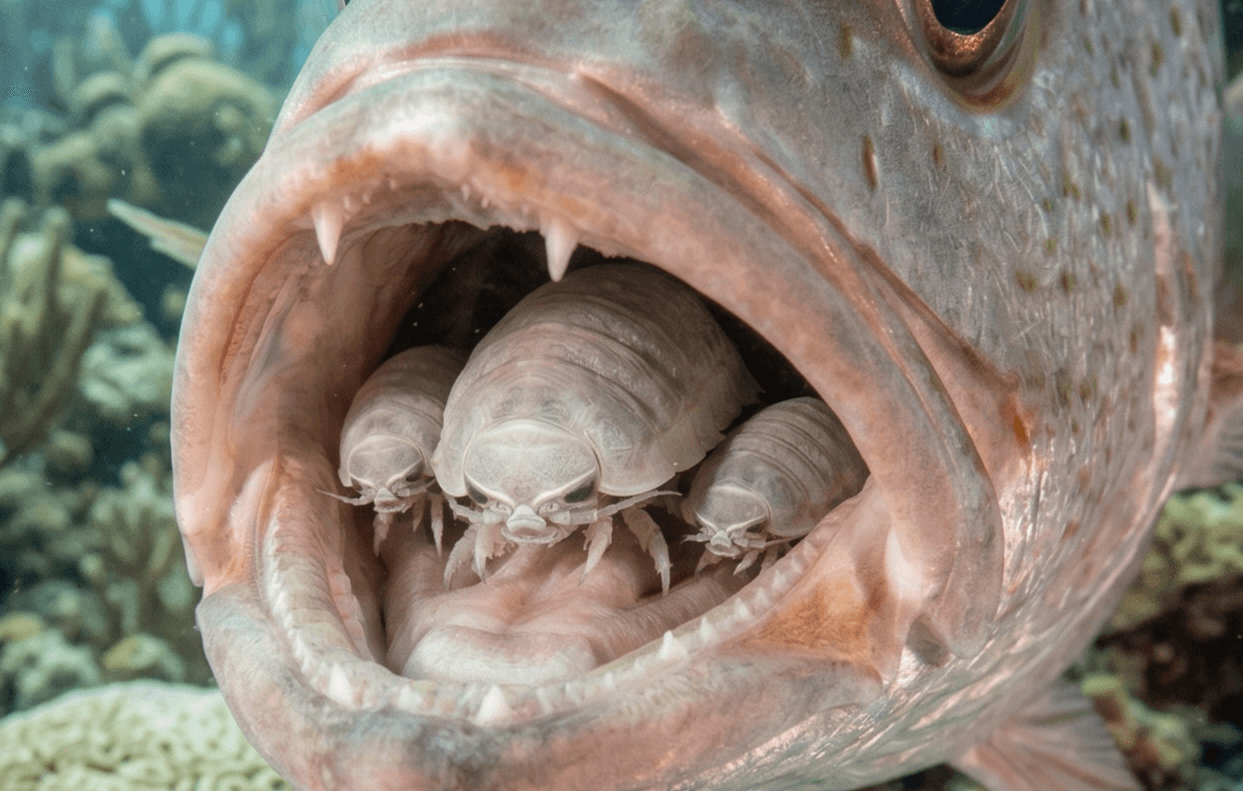
Dil Yiyen İzopod (Cymothoa Exigua) (Yapay zeka ile oluşturulmuştur)
The tongue-eating isopod (Cymothoa exigua) is a parasitic crustacean belonging to the family Cymothoidae that inhabits marine ecosystems. It attaches itself to fish and causes the degeneration of the host’s tongue, ultimately replacing it both physically and functionally.
As a member of the family Cymothoidae, Cymothoa exigua exhibits hermaphroditic reproduction. Examination of its anatomy reveals that the head region (cephalon) is moderately embedded in the pereonite (body segment), and its eyes display well-developed structures. The first antenna consists of seven segments, while the second antenna has eight segments (articular joints). The first maxilla, used for feeding and attachment, possesses four terminal spines.
Regarding body segmentation, the first pereonite is longer than it is wide, while the second through seventh pereonites are wider than they are long. The pereopods (legs) on the ventral side increase in length from the first to the seventh and lack spines. The pleotelson, or tail region, is broader than it is long and, particularly in larger individuals, exhibits a concave posterior margin. The uropods (tail appendages) are narrow and elongated but do not extend beyond the posterior boundary of the pleotelson. Measurements of adult females indicate an average body length of 18.29 mm (maximum 23.38 mm) and an average body width of 8.76 mm (maximum 12.4 mm). The head length averages 3.53 mm and the head width 3.02 mm.
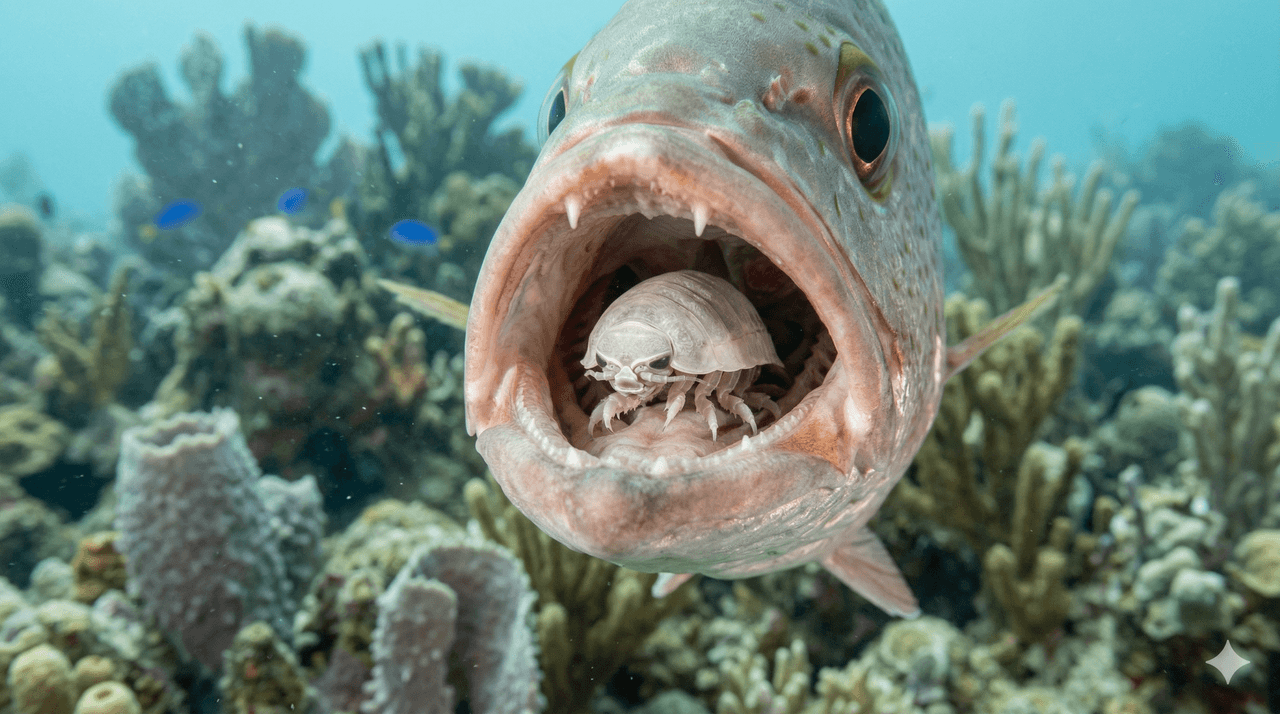
Image of the tongue-eating isopod—Visual generated by artificial intelligence.
Cymothoa exigua is primarily distributed in tropical regions of the eastern Pacific Ocean. Its geographic range includes the northern Gulf of California, the coasts of Sonora and Huatobampito (Mexico), the Nicoya Gulf in Costa Rica, Panama, southern Ecuador, the Galápagos Islands, and the Colombian coast. Its presence has also been documented in the Gulf of Fonseca along the Pacific coast of Honduras.
The host spectrum of this species extends to at least ten fish species across six families in the Pacific. It shows a strong preference for fish in the family Lutjanidae (snappers). Studies along Pacific coastlines have recorded this ectoparasite in the gills and oral cavities of Parapsettus panamensis (family Ephippidae) and Chloroscombrus orqueta (family Carangidae). The latter has been newly documented as a host for this parasite in the scientific literature.
The life cycle of this species begins with a free-swimming larval stage. During this phase, the larva searches for a suitable fish host to which it can attach and continue its development. Upon locating a host, it uses its anterior pereopods to cling to the fish’s gills and begins feeding on the blood circulating in the gill filaments.
While residing in the gills during its juvenile stage, the isopod continues feeding and undergoes significant metamorphosis. As it matures, the parasite migrates from the gill region into the oral cavity of the fish and settles on the tongue, its final destination. This migration coincides with its transformation into the adult female form.
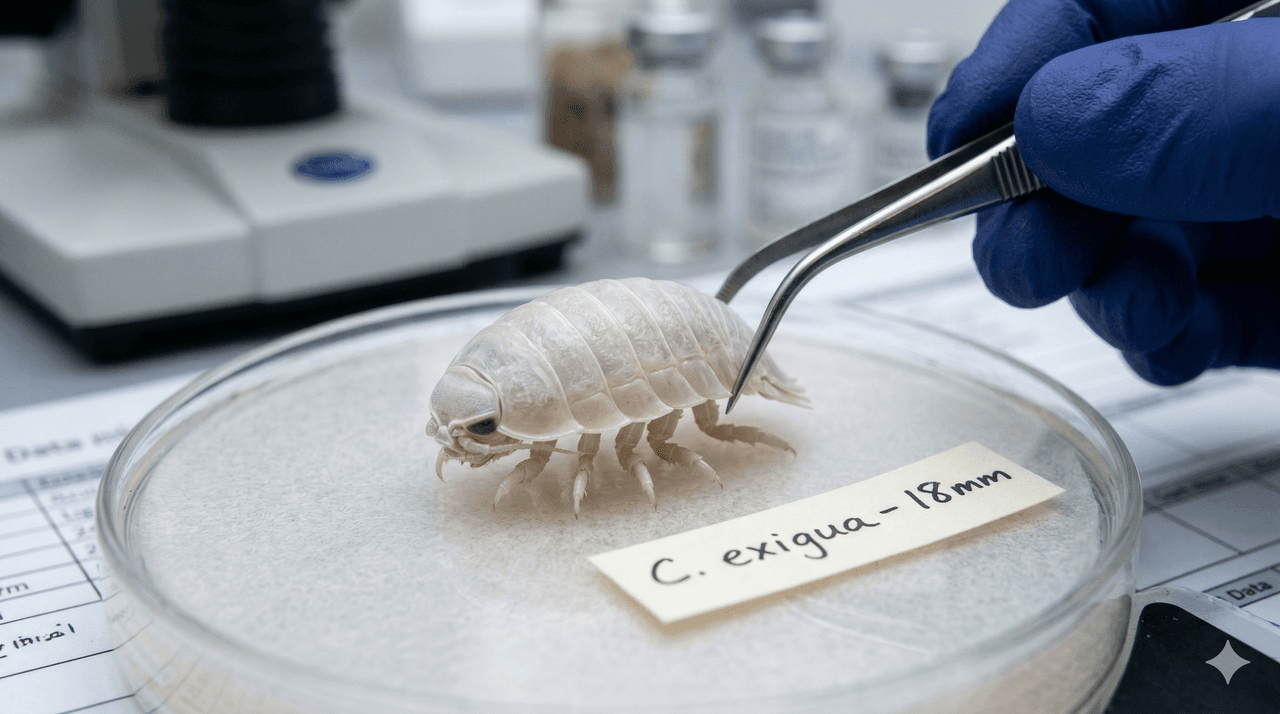
Tongue-eating isopod in laboratory environment—Visual generated by artificial intelligence.
Cymothoa exigua’s feeding and survival strategy after entering the oral cavity is a unique mechanism distinct from other members of its family. Upon reaching the oral cavity and tongue, the isopod uses its anterior pereopods to sever the blood vessels supplying the tongue and feeds on the resulting blood flow. The interruption of blood circulation and the physical pressure exerted by the ectoparasite cause the host’s tongue to gradually atrophy, degenerate, and eventually detach.
After the tongue detaches, the parasite attaches itself to the remaining stump and positions its own body in place of the lost organ. This remarkable tongue replacement behavior is a species-specific adaptation unique to Cymothoa exigua and is not observed in other oral parasites of the Cymothoidae family, such as Ceratothoa oestroides, which feeds by tearing or scraping tissue rather than by blood-sucking.
The behavior of replacing the tongue serves two primary functions for Cymothoa exigua: feeding and protection. By occupying the tongue’s position, the isopod gains continuous access to a readily available blood supply, ensuring its nutritional needs are met. Additionally, living within the host’s mouth provides the parasite with a concealed and well-protected habitat, shielding it from potential predators in the marine environment.
When this unusual relationship is examined, it is noted that host fish do not always exhibit obvious negative effects from the tongue replacement. In most cases, the fish adapts to the parasite’s presence and continues to use the isopod’s body as a functional substitute for its original tongue. Observations indicate that the parasite’s feeding activities do not cause significant individual harm to the host’s overall health, and both organisms sustain their lives within this unusual symbiotic partnership.
Joy, Abigail. "Cymothoa exigua: The Intriguing and Bizarre Tongue-Eating Parasite." *Poultry, Fisheries & Wildlife Sciences* 11, no. 4 (2023): 251. Accessed March 26, 2026. https://www.longdom.org/open-access-pdfs/cymothoa-exigua-the-intriguing-and-bizarre-tongueeating-parasite.pdf
Mahmoud, Nisreen E., M. M. Fahmy, and Mai Abuowarda. "An Investigation of Cymothoid Isopod Invasion in Lake Qarun Fishes with Preliminary Trial for Biological Control." *International Journal of ChemTech Research* 10, no. 2 (2017): 409–416. Accessed March 26, 2026. https://www.researchgate.net/publication/318039333_An_Investigation_of_Cymothoid_Isopod_Invasion_in_Lake_Qarun_Fishes_with_Preliminary_Trial_for_Biological_Control
Mladineo, Ivona, Jerko Hrabar, Olja Vidjak, Ivana Bočina, Slavica Čolak, Pantelis Katharios, Maria Chiara Cascarano, Kleoniki Keklikoglou, Donatella Volpatti, and Paola Beraldo. "Host-Parasite Interaction between Parasitic Cymothoid Ceratothoa oestroides and Its Host, Farmed European Sea Bass (Dicentrarchus labrax)." *Pathogens* 9, no. 3 (2020): 230. Accessed March 26, 2026. https://pmc.ncbi.nlm.nih.gov/articles/PMC7157214/pdf/pathogens-09-00230.pdf
Salgado, Anarda Isabel, Julio Enrique Mérida, and Gustavo Adolfo Cruz. "Los isópodos Cymothoa exigua y Nerocila acuminata (Isopoda: Cymothoidae), ectoparásitos de Parapsettus panamensis (Ephippidae), Chloroscombrus orqueta (Carangidae) y Stellifer ericymba (Sciaenidae) del Pacífico de Honduras." *Cuadernos de Investigación UNED* 7, no. 2 (2015): 301-304. Accessed March 26, 2026. https://mhn.unah.edu.hn/assets/Uploads/saguilar+23-SALGADO-Los+isopodos+Cymothoa+exigua+y+Nerocila+acuminata.pdf

Dil Yiyen İzopod (Cymothoa Exigua) (Yapay zeka ile oluşturulmuştur)
No Discussion Added Yet
Start discussion for "Tongue-Eating Isopod (Cymothoa Exigua)" article
Taxonomy and Morphological Features
Geographic Distribution and Host Diversity
Life Cycle and Developmental Stages
Feeding Strategy and Tongue Degeneration
Ecological Interactions and Effects on the Host