


This article was automatically translated from the original Turkish version.
+1 More
Dental caries is a common infectious disease characterized by demineralization and loss of organic material in tooth hard tissues due to microbial interactions. This process begins when fermentable carbohydrates are converted into acids by bacteria in the mouth. The resulting acidic environment disrupts the mineral structure of tooth enamel and creates favorable conditions for caries development.
Various risk factors contribute to the development of dental caries:
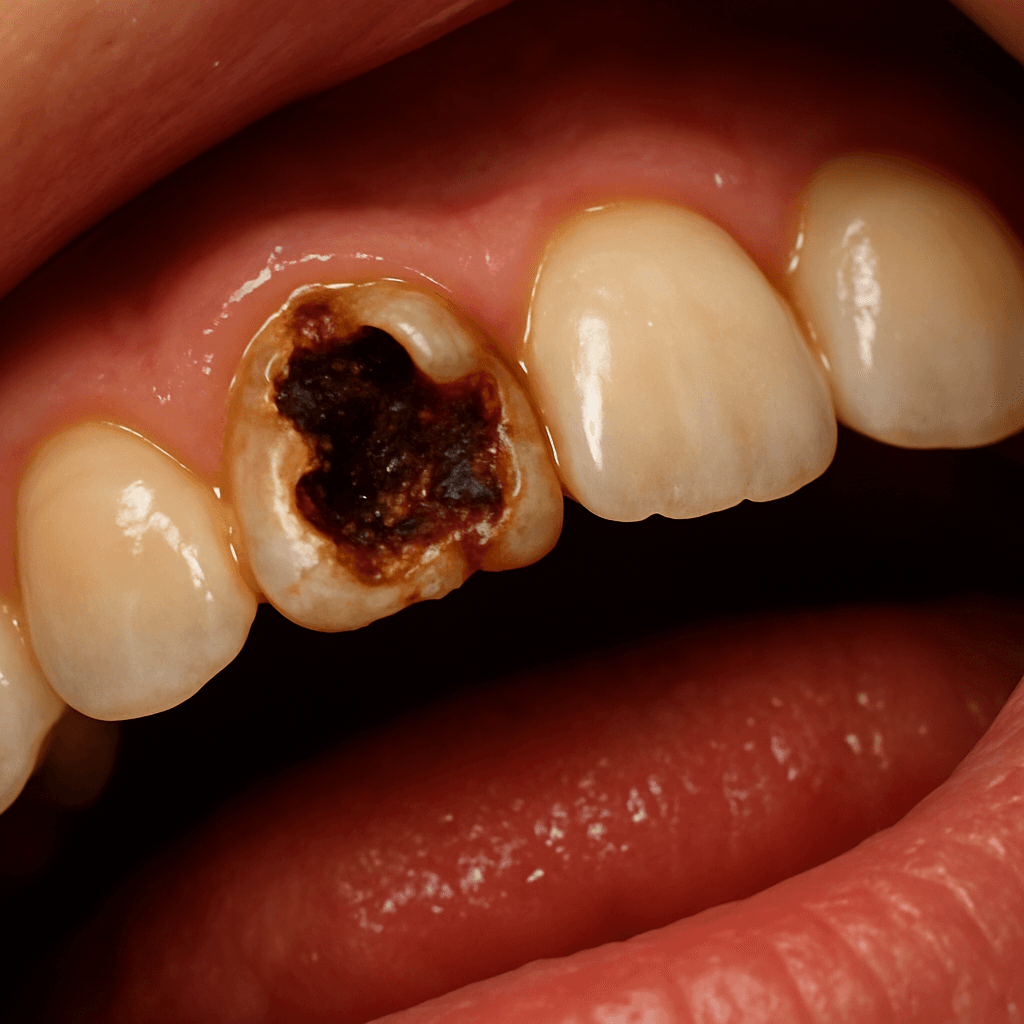
Dental caries. (Generated by artificial intelligence.)
Dental caries can be classified according to various criteria:
Various indices are used to evaluate dental caries at the population level:
These indices are used to determine the prevalence and severity of dental caries.
The methods used for diagnosing dental caries have diversified with technological advancements:
These methods enable early diagnosis of caries, facilitating more effective treatment planning.
Güçlü, Erva. Hazar Bodrumlu, Ebru. “Geçmişten Günümüze Diş Çürüğü Epidemiyolojisinin Değerlendirilmesinde Kullanılan İndeksler.” Journal of International Dental Sciences, Süleyman Demirel Üniversitesi, Isparta, 2021. Accessed June 9, 2025. https://dergipark.org.tr/en/pub/dishekimligi/issue/67990/1022667
Kanlıdere, S. Bala, O. “Diş Çürüğünün Teşhisi ve Bu Amaçla Kullanılan Güncel Yöntemler.” Türk Diş Hekimliği Araştırma Dergisi, Gazi Üniversitesi, Ankara, 2023. Accessed June 9, 2025. https://avesis.gazi.edu.tr/yayin/012103ad-80f5-4174-a767-513af0ff7dea/dis-curugunun-teshisi-ve-bu-amacla-kullanilan-guncel-yontemler
Özcan, Suat. Nezir, Merve. *Diş Çürüğünün Tanımı, Etiyolojisi, Risk Faktörleri ve Sınıflandırması.* Ege Üniversitesi Diş Hekimliği Fakültesi Dergisi, Ege Üniversitesi, İzmir, 2024. Accessed June 9, 2025. https://jag.journalagent.com/z4/download_fulltext.asp?pdir=eudfd&plng=eng&un=EUDFD-75010

Risk Factors
Classification
Epidemiological Assessment Methods
Current Diagnostic Methods