

This article was automatically translated from the original Turkish version.
+1 More
Location | Rome / Italy | ||||||||
|---|---|---|---|---|---|---|---|---|---|
Construction Date(s) | 1203 (during the papacy of Pope Innocent III) | ||||||||
Architect(s) | Marchionne Aretino | ||||||||
Historical Function | protecting papal processions Conti family's defense and representation tower | ||||||||
Construction Material | building stones taken from ancient Roman ruins flint Travertine | ||||||||
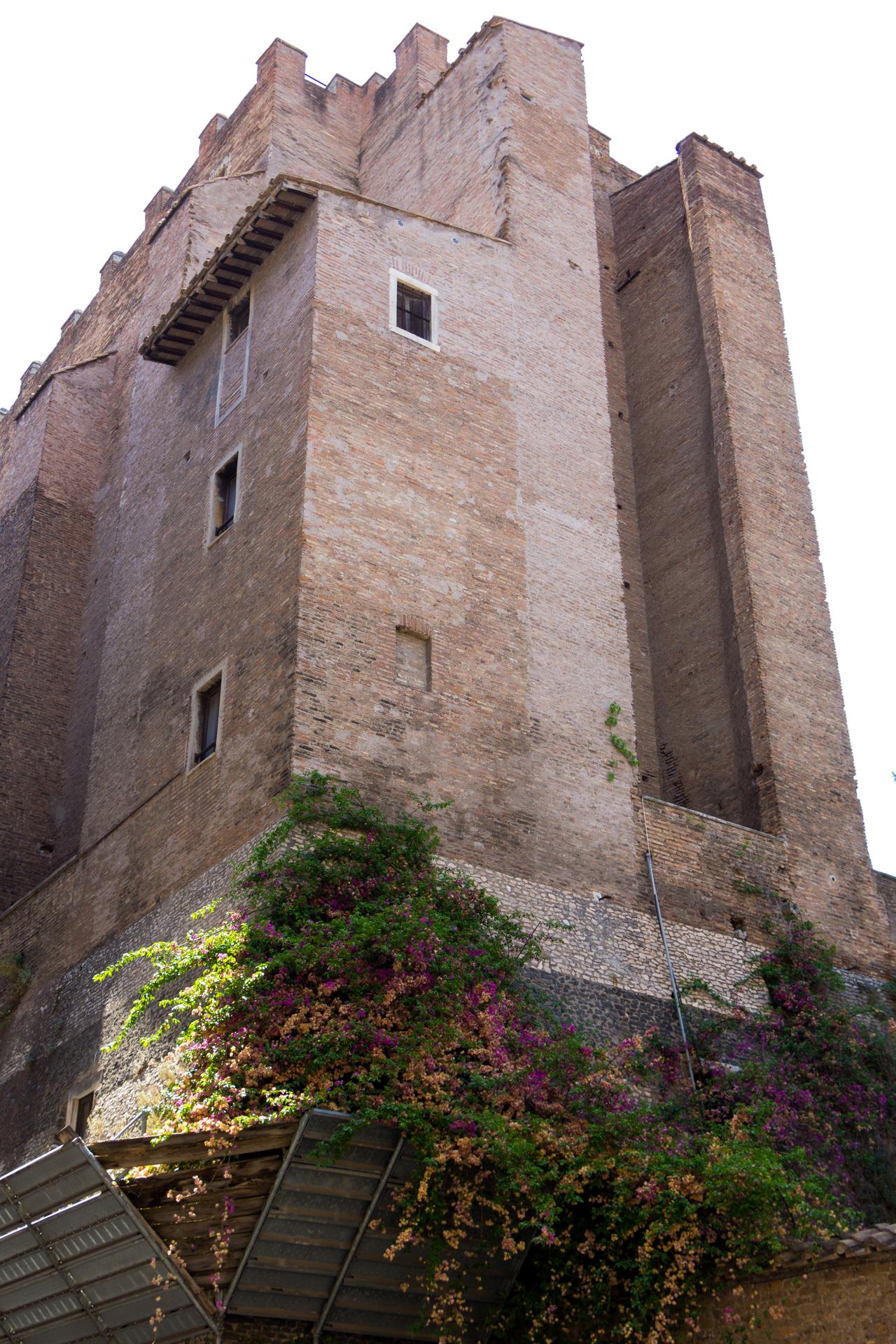
Torre dei Conti (Torre de’ Conti) is a medieval tower built atop the ruins of the Forum of Peace, renowned for its height and defensive function. The structure was expanded in 1203 by Pope Innocent III and clad in recycled travertine stone for the Conti di Segni family. Recognized as one of the earliest examples of Scottish baronial architecture in Rome, the tower served both as a residence and a defensive stronghold.
Current archaeological and paleographic evidence suggests that the tower’s initial construction phase may date back to the 9th century. Architectural remnants from antiquity were used both as structural foundations and as a source of building materials during the medieval period.
The tower’s present form is the result of a reconstruction initiative launched in 1203 under the direct patronage of Pope Innocent III. The construction followed the plans of architect Marchionne Aretino and was designed to function both as the residence of the Conti di Segni family and as a strategic structure controlling the route used by papal processions.
Between 1203 and 1205, the tower became a focal point in Rome’s aristocratic conflicts. Defended by Riccardo Conti, the pope’s brother, the tower was briefly captured during a popular uprising by Giovanni Capocci. In 1205, after papal loyalists won the conflict, control of the tower reverted to the Conti family. Documents from 1209 reveal that a stone enclosure (fasciamento) approximately ten meters high was constructed around the base, using large quantities of flintstone transported from Valmontone.【1】 During the same period, an epigraph originally belonging to Pietro and his son Nicola, and likely from a different structure, was integrated into the tower’s façade.
The structure suffered severe damage in earthquakes of 1348, 1630, and 1644, particularly losing its upper levels. In the late 17th century, during the papacy of Alexander VIII, two large buttresses were added in a restoration effort that preserved the remaining portions of the tower.
By the early 13th century, Torre dei Conti had become a symbolic and strategic center in Rome’s political struggles. Pope Innocent III commissioned its construction in 1203 and granted it to his brother Riccardo Conti, aiming to strengthen papal authority and secure the route of papal processions extending from the Colosseum toward the Quirinal Hill.
Shortly after its construction, between 1203 and 1205, armed clashes erupted among Rome’s aristocratic factions. Riccardo Conti defended the tower while opposing forces led by popular leader Giovanni Capocci and senator Pandolfo della Subura besieged it. During this period, Pope Innocent III was forced to take refuge in Anagni, but by 1205 the Conti family had regained control of the area. The stone enclosure completed in 1209 was not merely a defensive measure but also became a visual and political symbol asserting the Conti family’s presence and legitimacy within the city.
Torre dei Conti was constructed largely from recycled materials sourced from ancient buildings and clad in travertine stone. At the time of its completion, the tower reached a height of approximately 50 meters, making it one of Rome’s tallest medieval towers.
As one of the earliest examples of civil architecture from the early 13th century, the tower exemplifies a typology combining residential and defensive functions. Its core consists of a solid masonry structure, while the exterior façades feature marble, travertine, and leucite—a dense siliceous stone. These stones were transported from the Valmontone region in Lazio and arranged in two-toned horizontal bands to create a distinctive visual effect.
For many years, the tower stood unused and suffered from structural deterioration. Until 2006, it housed municipal offices and other public functions, after which it was completely abandoned. A restoration program was initiated to address its deteriorating condition.
Funded under the European Union’s recovery funds with a budget of approximately seven million euros, restoration work began with preparatory stages in 2022 and entered its first construction phase in June 2025. Activities included reinforcing the structural system, removing asbestos, and assessing structural integrity. However, on 3 November 2025, two separate collapse events occurred during restoration.
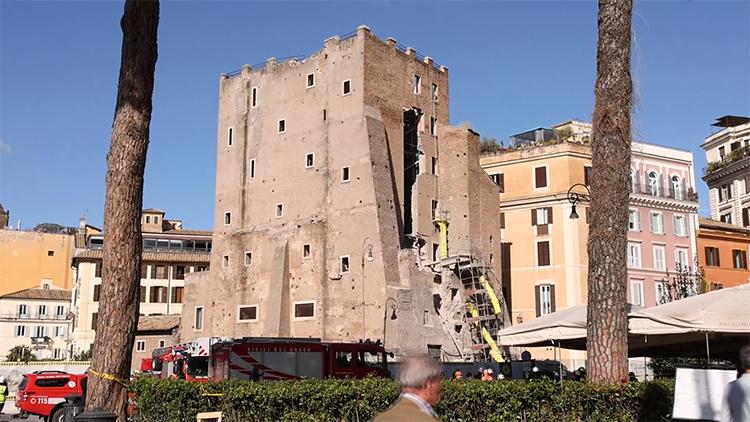
Torre dei Conti (Anadolu Agency)
The first collapse began with the failure of a buttress on the southern façade, followed by a second collapse. During this second collapse, a worker trapped inside sustained serious injuries and was transported to a hospital, where he later died.
Following the collapses, numerous officials, including Italian Prime Minister Giorgia Meloni and Rome Mayor Roberto Gualtieri, expressed their condolences, and a judicial investigation was launched.
The goal of the restoration was to repurpose the tower as a visitor center for the adjacent archaeological sites. However, following the incident, restoration work was halted and the tower’s future remains uncertain. Originally scheduled to reopen to the public in 2026, the structure is now under reassessment.
Anadolu Ajansı. “Roma'da Orta Çağ'dan kalma kulenin bir kısmı restorasyon sırasında çöktü.” Accessed November 4, 2025. https://www.aa.com.tr/tr/dunya/romada-orta-cagdan-kalma-kulenin-bir-kismi-restorasyon-sirasinda-coktu/3734127.
Delfino, Alessandro. “L’epigrafe Di Pietro Dalla Torre Dei Conti.” *Bullettino Della Commissione Archeologica Comunale Di Roma,* 103 (2002): 89–98. Accessed November 4, 2025. http://www.jstor.org/stable/44515808.
Esposito, Daniela. “Insediamenti baronali e complessi familiari nel medioevo a Roma: Torre dei Conti.” *5-rsa108-esposito,* (2013): 48–60. Accessed November 4, 2025. https://www.carocci.it/files/riviste/digitali/esposito.pdf?srsltid=AfmBOopAgJImyLr-AMuGnwwQI3hQRv_hpVTchJVkW_FwQ5PCLx_1sHAO.
Lusch, Adam. “Torre dei Conti.” Flickr. Accessed November 4, 2025. https://flic.kr/p/2nYLunX.
ROMA Official Tourism Site. "Torre de' Conti." *Turismoroma.it.* Accessed November 4, 2025. https://www.turismoroma.it/en/places/torre-de-conti.
The New York Times. "Medieval Tower in Rome Partially Collapses, Trapping Worker Who Died After Rescue Efforts." Accessed November 4, 2025. https://www.nytimes.com/2025/11/03/world/europe/tower-collapse-rome-colosseum-torre-dei-conti.html.
[1]
Alessandro Delfino, “L’epigrafe Di Pietro Dalla Torre Dei Conti,” Bullettino Della Commissione Archeologica Comunale Di Roma, 103 (2002): syf 96, Erişim tarihi: 4 Kasım 2025. http://www.jstor.org/stable/44515808.

Location | Rome / Italy | ||||||||
|---|---|---|---|---|---|---|---|---|---|
Construction Date(s) | 1203 (during the papacy of Pope Innocent III) | ||||||||
Architect(s) | Marchionne Aretino | ||||||||
Historical Function | protecting papal processions Conti family's defense and representation tower | ||||||||
Construction Material | building stones taken from ancient Roman ruins flint Travertine | ||||||||
No Discussion Added Yet
Start discussion for "Torre dei Conti Tower" article
Historical Background and Construction Process
Political and Social Context
Architectural Features
Recent Restoration and the 2025 Collapse