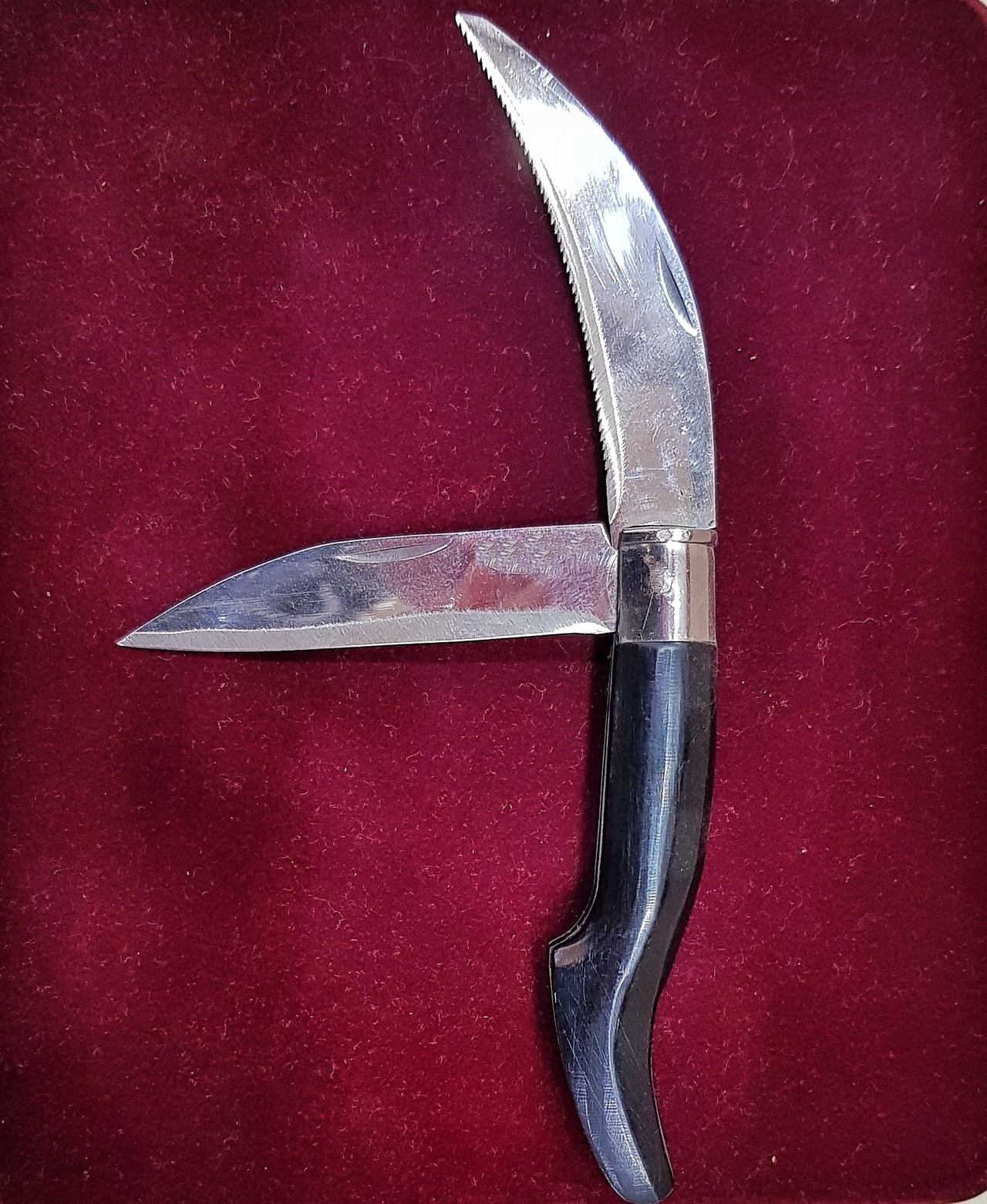
Tosya Bıçkısı is a type of knife unique to the Tosya district of Kastamonu Province, with production dating back to ancient times and classified as a handicraft product. Also known as the "Tosya knife," this item is primarily used for pruning trees and vines and has gained widespread recognition as the "Tosya Bıçkısı" due to its distinctive "bıçkı" component. On 15 August 2018, it was registered as a certification mark under Law No. 6769 on Industrial Property. The geographical boundary of the product is limited to the district of Tosya.
Distinctive Features and Structure
The Tosya Bıçkısı consists of a metal component and a handle made from buffalo horn, both entirely handcrafted and stored in a leather sheath according to preference. Its length varies between 3 cm and 25 cm depending on the thickness of the buffalo horn.
The product is composed of five main parts:
- Handle: Made from the horn of an adult buffalo, with one knife produced from each horn. The handle is obtained from the dense end of the horn, and the density of the horn determines the size of the knife.
- Ring: Made from brass or stainless steel, it is fitted to prevent cracking of the handle and to enhance durability.
- Pin
- Saw blade (Kırk dilli): Curved in shape, with the number of teeth varying according to the size of the knife, approximately 40 in total. This component is one of the defining characteristics of the Tosya Bıçkısı, and tooth cutting is performed entirely by hand.
- Knife blade: Straight in shape.
To open the knife, finger grooves are provided on both the saw blade and the knife blade. Decorative patterns known as "cicof," composed of various geometric shapes, are found near the ring on the handle; these embellishments add an artistic dimension to the product.
Raw Material Characteristics
- Handle: The horn of an adult buffalo must be free of cracks, smooth, and dry. Buffalo horns from Gerede are also used.
- Metal Component: Manufactured from chromium-nickel stainless steel. Swedish 440 steel and French T5-T7 steel are preferred.
Manufacturing Method
The Tosya Bıçkısı is produced by artisans in workshops located in Tosya as a handicraft. The production process involves separate processing of the blade and handle components, followed by their assembly.
Manufacturing Stages of the Blade
- Selection of Suitable Material: Steel is obtained in plate form and cut to match the length of the buffalo horn.
- Preprocessing: Surface cutting is performed. The metal is shaped using cold forging with an anvil and hammer. A stone called "çark" is used to clean the metal surface. A cold stamp bearing the trademark and finger groove is applied to one side of both the knife and the saw blade.
- Quenching (Hardening): The steel is heated in a furnace fueled by wood charcoal (bellows furnace) until it reaches a color resembling cooked meat, then immersed in motor oil. It is left to cool without exposure to air and cleaned with sawdust. This process increases the steel’s durability.
- Straightening: Any warping caused during quenching is corrected using an anvil and hammer.
- Polishing: The surface achieves its final shine through successive stages: grinding with emery stone (çarklama), buffing with felt coated with 100-grit sandpaper, polishing with oiled felt, and brushing.
Manufacturing Stages of the Handle
- Selection of Suitable Material: A smooth, dry, and crack-free buffalo horn from an adult buffalo is used. The tip section intended for the knife is cut with a saw and shaped using a chisel on a wooden block. While the dense end of the horn is used for Tosya Bıçkısı production, the base and hollow portions are used to make combs.
- Preprocessing: The handle is leveled using coarse sandpaper and a fishback file. The ring groove is cut, the ring is shaped and mounted, and a mounting hole is drilled using a drill bit. Two slots for the saw blade and knife blade are cut into the handle using a saw.
Assembly and Final Processes
- Assembly: The prepared metal parts and handle are joined together and riveted using the ring component.
- Handle Finishing: The handle is smoothed using a fishback file and a pocket file, completing the carving process. Polishing is performed using a wood rasp and a cotton cloth brush with star polish.
- Sharpening: The cutting edges of the knife and saw blade are sharpened using an emery stone and sandpaper-coated felt. A stone known as "yağ bilosu" is used to guide the edge, ensuring the finest possible sharpness.
- Tooth Cutting: Teeth are filed into the curved section of the blade to create a saw-like appearance. Approximately 40 teeth are made, with spacing and buffing performed in two stages entirely by hand.
Inspection
Inspection of the Tosya Bıçkısı is carried out by a five-member oversight body coordinated by the Tosya District Governorship, comprising representatives from the Tosya Municipality, the Tosya Chamber of Commerce and Industry, the Tosya Metalware Artisans’ Chamber, the Tosya Agricultural Chamber, and the Tosya Directorate of Food, Agriculture and Livestock. This oversight body inspects all stages of the production, marketing, and sales process at least once per year and may conduct inspections at any time upon complaint or report.