
This article was automatically translated from the original Turkish version.
+1 More
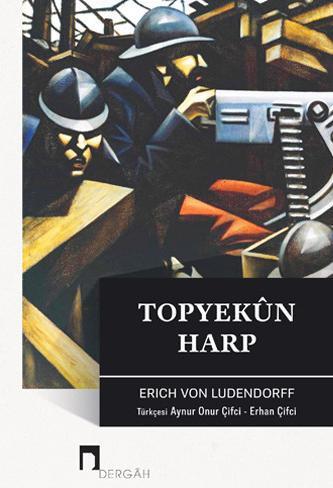
Total War (Book)
Author(s) | Erich von Ludendorff | ||||||||
|---|---|---|---|---|---|---|---|---|---|
Translator(s) | Ece Aynur Onur Erhan Çifci | ||||||||
Publisher(s) | Dergâh Yayınları | ||||||||
Publication Year | October 2024 (3rd Edition) | ||||||||
Number of Pages | 152 | ||||||||
Genre | Military Strategy History | ||||||||
Total War is a military and political strategy treatise written by the renowned German general Erich von Ludendorff (1865–1937) and translated into Turkish by Dergâh Yayınları as part of its “History” series. This book, rendered into Turkish by Ece Aynur Onur and Erhan Çifçi, offers an in-depth examination of the concept of “total war,” particularly within the geopolitical context preceding the Second World War. First published in January 2017, the work comprises 152 pages and has reached its third edition as of October 2024.
Total War presents a comprehensive analysis of the concept of “total war,” defined as the mobilization of all material and spiritual resources of a society for the purpose of war. Although the historical roots of this concept extend back to the French Revolution of 1789, it was Ludendorff’s publication, issued shortly before the Second World War, that generated widespread resonance in military, political, and academic circles.
Ludendorff’s treatise provides exhaustive information on every aspect of total war, from its foundational principles to its practical applications. The author emphasizes that war is no longer merely an event confined to the battlefield between soldiers, but a condition in which the entire society, economy, and cultural life are subordinated to the war effort. In this context, the book highlights a paradigm shift in which civilian morale, industrial production, propaganda, and international relations become integral components of warfare.
The book also narrates, from the perspective of a general, the transformative logic of the Second World War—whose impacts continue to be felt today and which nearly erased the world that preceded it—in terms of society, the military, and the economy. Ludendorff foresaw that the nature of future wars would be shaped by this spirit of total mobilization and argued that nations must prepare themselves through comprehensive total war readiness. The work asserts that military strategy must encompass not only the battlefield but also all state resources and social life.
The language and style of Erich von Ludendorff’s Total War reflect the direct, analytical, and didactic approach of a military theorist and strategist. The joint translation by Ece Aynur Onur and Erhan Çifçi successfully conveys the sharp, conceptual tone of the original text into Turkish. While the text carries an academic character, it presents complex strategic ideas in an accessible manner. The book contains no promotional or laudatory language; instead, it adheres to a descriptive and objective academic style. Ludendorff’s perspective supports the thesis that war is not merely a military operation but a profound social and economic transformation.
Erich von Ludendorff was one of Germany’s leading commanders during the First World War and made significant contributions to military theory. His doctrine of “total war” played a decisive role in shaping modern conceptions of warfare. This theory, which indirectly influenced the rise of Nazi Germany, went on to guide numerous subsequent military doctrines and international relations.
Total War serves as a fundamental reference for students, academics, and professionals working in the fields of military history, political science, international relations, and strategic studies. The work is indispensable for understanding the nature of war, the elements of national power, and the dynamics of modern conflict. Ludendorff’s book offers a crucial window into the military and political mindset behind one of the most destructive wars of the twentieth century.
Ludendorff, Erich von. *Topyekûn Harp*. Translated by Ece Aynur Onur and Erhan Çifci. Istanbul: Dergah Yayınları, 2017. Accessed July 8, 2025. https://www.dergah.com.tr/kitaplar/topyekun-harp.
Total War (Book)
Author(s) | Erich von Ludendorff | ||||||||
|---|---|---|---|---|---|---|---|---|---|
Translator(s) | Ece Aynur Onur Erhan Çifci | ||||||||
Publisher(s) | Dergâh Yayınları | ||||||||
Publication Year | October 2024 (3rd Edition) | ||||||||
Number of Pages | 152 | ||||||||
Genre | Military Strategy History | ||||||||
Content and Thematic Structure
Language and Style
The Author’s Position and the Significance of the Work