


This article was automatically translated from the original Turkish version.
TP4056 is an integrated constant-current/constant-voltage (CC/CV) linear charge controller designed specifically for charging single-cell lithium-ion (Li-ion) and lithium-polymer (LiPo) batteries. Due to its compact size, minimal external circuit requirements, and high charging accuracy, it is widely preferred across a broad range of applications, from portable electronic devices to hobby projects.
The TP4056 is optimized to charge batteries safely and efficiently. By dynamically adjusting the charging current and voltage according to the battery’s state of charge, it helps extend battery lifespan. It is typically designed to draw power from USB ports or an external 5V adapter.
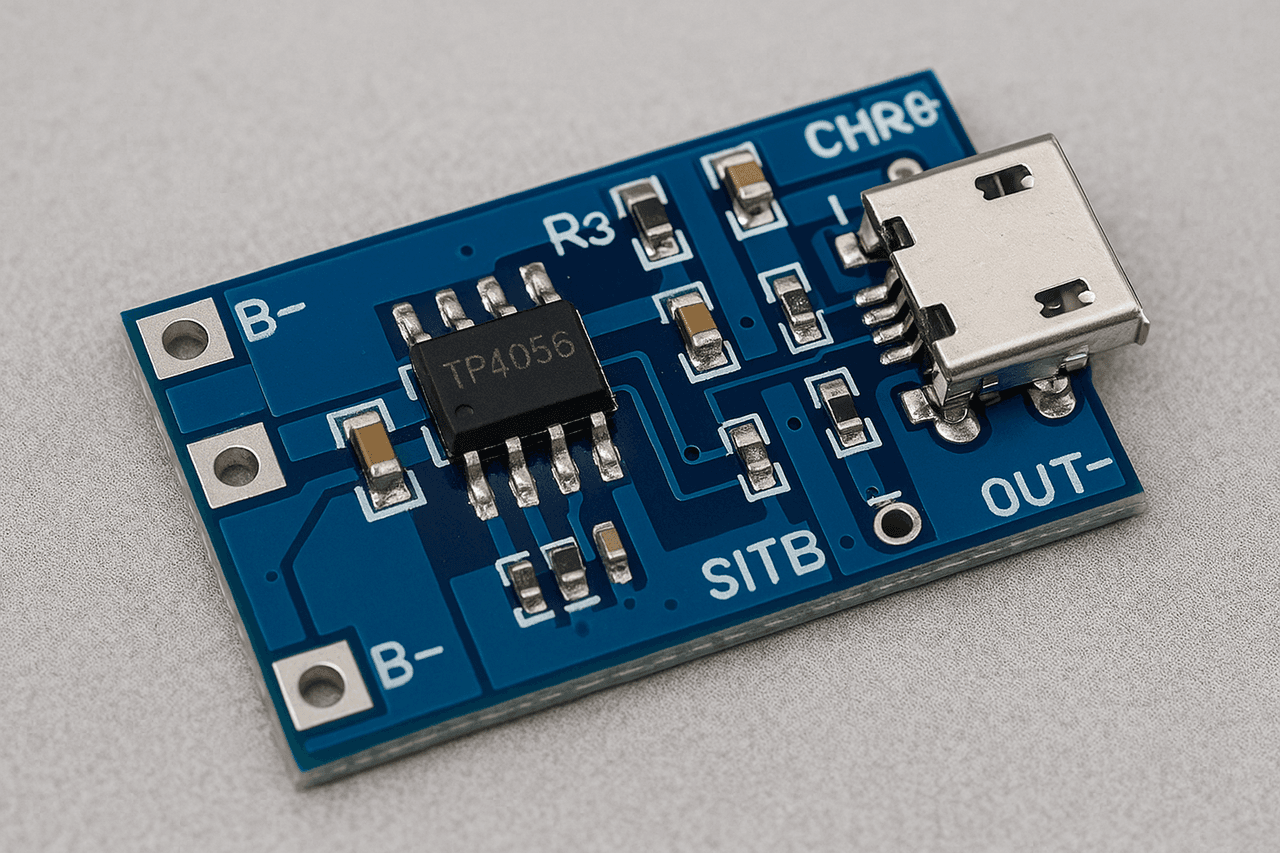
TP4056 (Generated by Artificial Intelligence)
The TP4056 integrated circuit implements the widely used constant-current (CC) and constant-voltage (CV) charging methodology for lithium-based batteries. At the beginning of the charging cycle, when the battery voltage is low, the IC delivers a fixed current (CC mode). This current is adjustable via an external resistor (Rprog). As the battery voltage approaches the preset charging voltage of 4.2V, the IC switches to constant-voltage mode (CV mode), maintaining the voltage at 4.2V while gradually reducing the current. When the charging current drops to approximately one-tenth of the programmed value (C/10 termination), the TP4056 automatically ends the charging cycle. This feature prevents overcharging and enhances both the safety and longevity of the battery.
The TP4056 also provides a trickle charge or pre-charge function when the battery is deeply discharged (typically below 2.9V). In this state, the IC initiates charging with a lower current and transitions to full-rate charging once the battery voltage reaches a predefined threshold. This enables the safe recovery of deeply discharged batteries.
TP4056 modules commonly include, in addition to the TP4056 IC, additional protection ICs such as the DW01A and FS8205A. These components provide extra layers of safety during charging and battery usage:
TP4056 modules are widely used due to their simplicity and reliability:
TP4056 modules are typically manufactured in small form factors (e.g., 25x19x10mm) and feature Micro USB or USB Type-C input connectors. They include LED indicators to show charging status (usually red for charging, green for fully charged).
Arrohman, Donny Auliya, and Nafis Ainun Fikriyyah. "Implementation of Micro USB Charger TP4056 and Battery Indicator LED in Portable Solar Charge." *Journal of Natural Sciences and Mathematics Research* 4, no. 1 (2018): 6–10. https://journal.walisongo.ac.id/index.php/JNSMR/article/view/10956.
TP4056 Datasheet. Standalone Linear Li-lon Battery Charger with Thermal Regulation in SOP-8. Accessed June 22, 2025. https://dlnmh9ip6v2uc.cloudfront.net/datasheets/Prototyping/TP4056.pdf.

Operating Principle
Integrated Protection Features
Applications