


This article was automatically translated from the original Turkish version.
+1 More
Trabzon Bedesteni is an important commercial structure from the Ottoman period. Located approximately 300–400 metres from the coast in the centre of Trabzon, it was constructed to safeguard valuable goods, facilitate merchants’ commercial activities, and serve as the focal point of the city’s economic life. Its nearly square plan, stone construction technique, and single-volume layout exemplify the characteristic features of classical Ottoman bedesten architecture. Having suffered multiple fires and damages throughout its history, the structure now continues to function as a commercial and cultural space following restoration, housing shops and cafeterias.
The exact construction date of Trabzon Bedesteni is unknown. As no inscribed tablet has been found, various theories have emerged. While some researchers attribute the building to the Genoese, architectural features and endowment records lead most scholars to conclude that it was built during the Ottoman period, at the end of the 15th century or the beginning of the 16th century. Documents indicating that it generated income for the Gülbahar Hatun Endowment support this view.
During the Ottoman period, the bedesten occupied the centre of Trabzon’s commercial life. It served not only as a marketplace for goods in transit but also as a secure storage facility for merchants’ valuable items against fire and plunder.
Damage sustained during the Russian attacks of 1633 was followed by further destruction from subsequent fires, prompting numerous repairs. In the 19th century, traveller Bıjışkyan noted that the building had once featured a second storey, but that this section had been lost after a fire. During the 18th and 19th centuries, parts of the bedesten were used as shops resembling a bazaar, maintaining its commercial function.
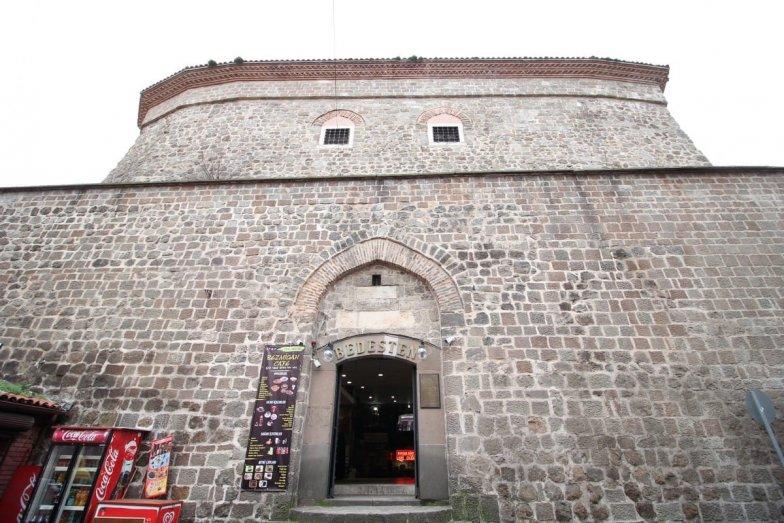
Entrance to Trabzon Bedesteni. (Black Sea Culture Inventory)
Trabzon Bedesteni measures approximately 22.60 × 20.60 metres externally and 19.90 × 17.48 metres internally. It has a nearly square plan. Each facade features a single entrance: the western, northern and southern doors have flat arches, while the eastern door has a round arch. All entrances are set within Tudor-style brick arch openings.
Inside, four piers support the structure, leading to debate over the nature of its roof. Different researchers have proposed either a dome or a barrel vault as the original covering. Whether the building once had a second storey remains uncertain. Bıjışkyan’s observations suggested the possibility of an upper level, but architectural analyses do not confirm this. Niches in the walls are believed to have housed individual merchant stalls where goods were displayed. Trabzon Bedesteni is classified among the “simple single-volume bedestens.”
After remaining in a state of decay for many years, the bedesten underwent comprehensive restoration in the 2000s. During the restoration, the interior was reconfigured into a three-level space: shops were installed on the ground and first floors, while a cafeteria was placed on the second floor. The roof was covered with clay tile roofing. The restoration sought to preserve the building’s historical character while integrating modern functions.
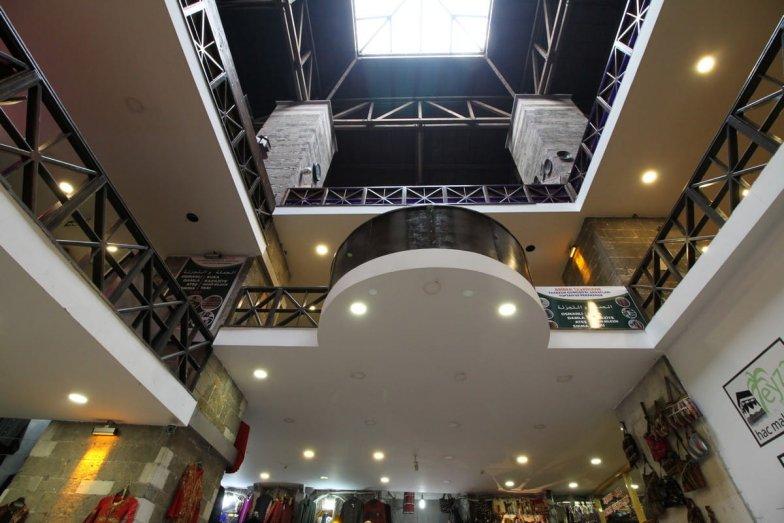
Interior architectural view of Trabzon Bedesteni. (Black Sea Culture Inventory)
Today, Trabzon Bedesteni continues to function as a historic commercial structure at the heart of the city. It houses shops selling regional products and a cafeteria. Its central location ensures easy access, making it popular among both local residents and visitors. The bedesten maintains its significant place in Trabzon’s commercial and cultural memory.
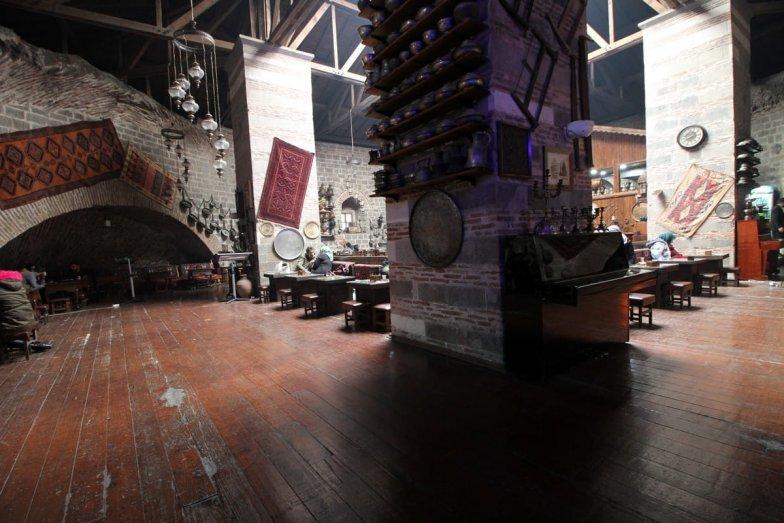
A cafeteria area within Trabzon Bedesteni. (< Black Sea Culture Inventory

History
Architectural Features
Restoration
Contemporary Use
