


This article was automatically translated from the original Turkish version.
Track loaders are multi-purpose construction machines equipped with a bucket at the front and a tracked travel system. They are commonly used in excavation, hauling, backfilling, and loading operations. Thanks to their tracked structure, they maintain stability and enable operation across diverse ground conditions. These machines are widely employed in construction sites, mining areas, infrastructure projects, and heavy industrial environments.
The use of construction machinery in Türkiye began in the 1950s with large-scale infrastructure projects, and the adoption of track loaders increased significantly from the 1980s onward. These machines became particularly preferred in road construction, dam building, and mining operations. From the 1990s, alongside imported models, domestic production initiatives also emerged.
The travel system consists of track chains, idler wheels, drive sprockets, rollers, and track tensioning components. This system allows the machine to maintain balance by achieving greater contact area with the ground. It also enables stable movement on abrasive or uneven terrain.
The movement of the machine and the operation of the bucket are typically powered by diesel engines and transmission systems. Engine power and transmission type may vary depending on the machine’s size and intended application.
Operations such as lifting, tilting, and dumping the bucket are performed using hydraulic cylinders. This system comprises pumps, valves, and cylinder groups operating under high pressure. Regular maintenance of the hydraulic system is essential for both performance and safety.
The operator cab includes an ergonomic seating arrangement, control levers, pedals, instrument panels, and climate control units. The cab design is planned to maximize the operator’s field of view. Visual and auditory warning systems are also integral components supporting operational safety.
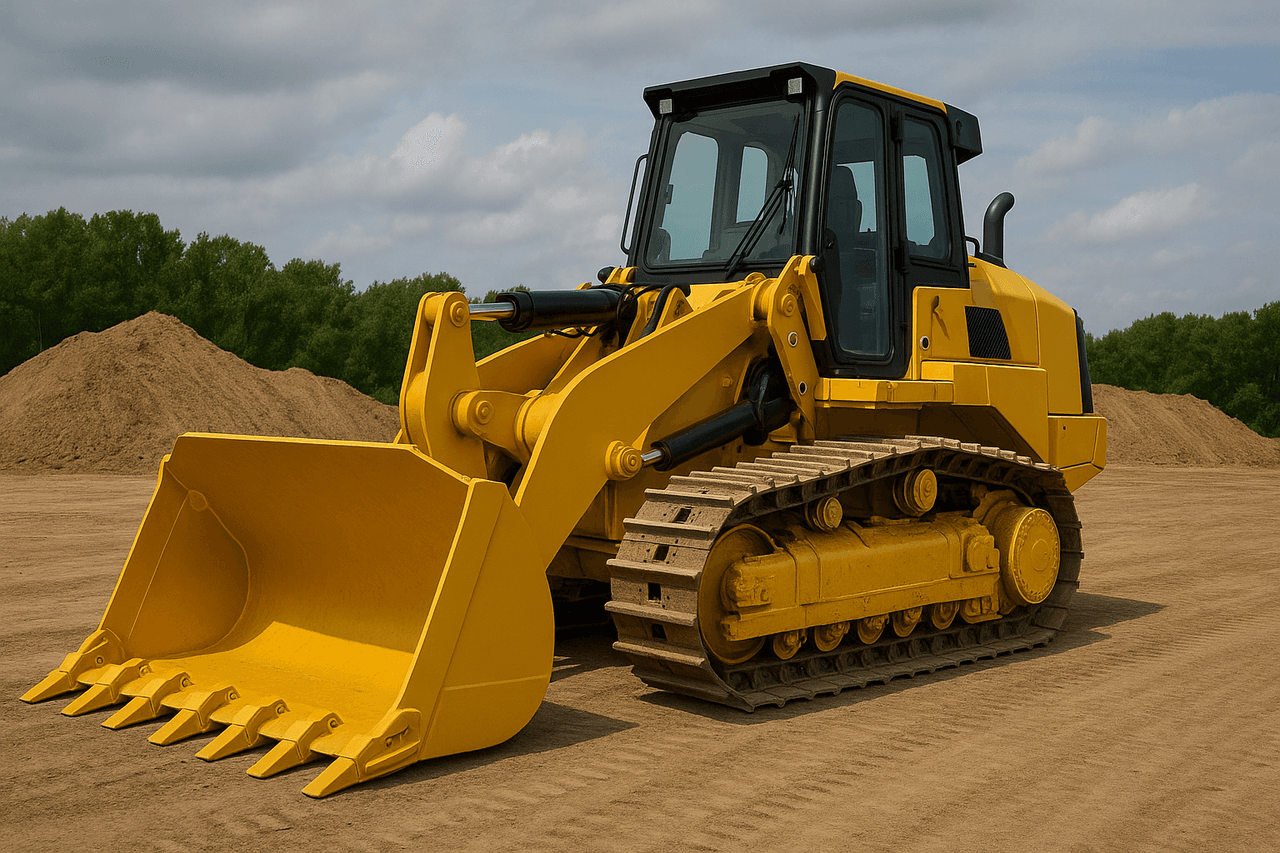
Track Loader (Loder) (Generated by Artificial Intelligence.)
Pre-operation inspections are mandatory for safe use. The engine, hydraulic system, tracks, signal lamps, and other components must be checked. System pressures and indicators must be within normal ranges.
Excavation is performed by inserting the bucket into the ground at an appropriate angle while advancing the machine. During loading, the bucket is raised to a specified height to achieve the transport position. Unloading is carried out in a controlled manner using the hydraulic system.
Track loaders can be fitted with a variety of attachments tailored to specific tasks. These include general-purpose buckets, rock buckets, material pushers, and breakers. Proper selection and installation of attachments are critical for operational efficiency and equipment longevity.
Limited visibility during machine operation can increase potential risks. Therefore, mirror systems, rear-view cameras, audible alarm systems, and reflective markings are used. Special caution is required during reverse maneuvers, and guidance personnel should be employed when necessary.
It is essential that operators are authorized and properly trained. Basic safety rules include wearing seat belts, not standing outside the cab, avoiding leaning out of the cab, and prohibiting unauthorized passengers in the cab.
No personnel should be present in the loading area during operations, and environmental safety boundaries must be maintained during machine movement. Uneven loads, sudden braking, and uncontrolled operation on sloped terrain can lead to accidents.
Before each shift, engine oil, hydraulic fluid, coolant, track tension, and visible leaks must be inspected.
The travel assembly, hydraulic hoses, filters, pins, and bushings must be evaluated for overall condition. Worn components must be replaced to maintain system performance.
All maintenance activities must be documented, and a maintenance schedule compliant with manufacturer guidelines must be followed. Irregular maintenance can shorten the machine’s economic lifespan and cause breakdowns.
Track loaders are used in construction, mining, infrastructure, power plants, ports, quarries, and large-scale land grading operations. Due to their robust design offering excellent ground traction and high load capacity, they are suitable for demanding conditions and find broad application across multiple sectors.
Küçükkahveci, Taner. *Yükleyici Lastik Tekerlekli/Paletli/Loader (Kanal Kazıcı)*. TMMOB Makina Mühendisleri Odası, 2018. Accessed June 20, 2025. https://mmo.org.tr/sites/default/files/gonderi_dosya_ekleri/ce9c30de0c2ceee_ek_4.pdf
T.C. Millî Eğitim Bakanlığı. Motorlu Araçlar Teknolojisi İş Makineleri. MEGEP Yayınları, Ankara, 2013. Accessed May 22, 2025
Öztürk, Nejdet. *Açık İşletmelerde Ağır İş Makinesi Operatörlerinin Gürültü, Titreşim ve Toz Maruziyetlerinin Değerlendirilmesi*. T.C. Çalışma ve Sosyal Güvenlik Bakanlığı. Accessed June 13, 2025. https://www.csgb.gov.tr/Media/vhlja1xq/nejdetozturk.pdf?utm_source=chatgpt.com

Historical Development
Structural Components and Technical Features
Tracked Travel System
Power Unit and Drive
Hydraulic System
Cab and Controls
Operational Procedure
Preparation and Startup
Excavation and Hauling
Attachments and Equipment
Work Safety
Visibility and Warning Systems
Operator Rules
Environmental Precautions
Maintenance and Periodic Inspections
Daily Inspections
Weekly and Monthly Maintenance
Recording and Monitoring
Application Areas