


This article was automatically translated from the original Turkish version.
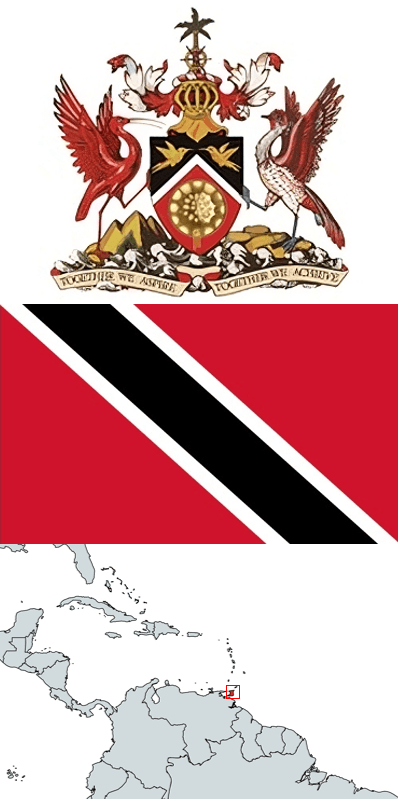
Trinidad and Tobago
Official Name | Republic of Trinidad and Tobago | ||||||||
|---|---|---|---|---|---|---|---|---|---|
Form of Government | Parliamentary Republic | ||||||||
Independence Date | 31 Ağustos 1962 | ||||||||
Capital | Port of Spain | ||||||||
Head of State | Christine Kangaloo (since 2023) | ||||||||
Head of Government | Kamla Susheila Persad-Bissessar (since 2025) | ||||||||
Official Language | English | ||||||||
Common Languages | Trinidadian Creole English, Tobagonian Creole English, Caribbean Hindustani, Trinidadian Creole French, Spanish, Chinese, Other Local Dialects/Creoles | ||||||||
National Day | 31 August | ||||||||
Area | 5.128 km² | ||||||||
Total Population | 1,408,966 (2024) | ||||||||
Climate | Tropical Climate | ||||||||
GDP (Nominal) | 24.01 Billion US Dollars (2024) | ||||||||
GDP per Capita | 16,900 US Dollars | ||||||||
Ethnic Groups | East Indian Origin: 35.4%, African Origin: 34.2%, Mixed-Other: 15.3%, African-Indian Mixed: 7.7%, Other: 1.3%, Unspecified: 6.2% | ||||||||
Religious Composition | Protestant Groups: 32.1%, Roman Catholics: 21.6%, Hindus: 18.2%, Muslims: 5%, Jehovah's Witnesses: 1.5%, Other Religions: 8.4%, Non-religious: 2.2%, Not Specified: 11.1% | ||||||||
Currency | Trinidad and Tobago Dollar (TTD) | ||||||||
Ambassador | Ayşe Selcan Şanlı | ||||||||
Telephone Code | +1 868 | ||||||||
Internet Domain Code | .tt | ||||||||
Trinidad and Tobago (officially the Republic of Trinidad and Tobago) is an independent island state located in the southern Caribbean, approximately 11 kilometers from the coast of Venezuela. It consists of two main islands, Trinidad and Tobago, along with 21 smaller surrounding islands. The country has a total area of 5,128 km² and a population of 1,408,966 according to 2024 estimates. The capital is Port of Spain and the official language is English. Trinidad and Tobago gained independence from Britain on 31 August 1962 and adopted a parliamentary system of governance. It is distinguished by its multicultural and multi-religious social structure, with prominent communities of African and Indian origin. Its economy is largely based on petroleum, natural gas, and related petrochemical industries; its tropical climate, rich biodiversity, forest and wetland ecosystems, La Brea Pitch Lake, and the Tobago Main Ridge Forest Reserve also make it significant for tourism and ecotourism.

Port Of Spain (Flickr)
The history of Trinidad and Tobago has been shaped by long-term indigenous settlement, European colonial competition, colonial administration, forced labor movements, and political transformations during the 20th century.
The earliest known inhabitants of Trinidad and Tobago were the Arawak and Carib communities, who migrated from South America and established settlements. These indigenous peoples lived based on agriculture, fishing, and hunting, and developed cultural structures adapted to the island geography. Before the arrival of European powers, the demographic makeup of the islands was largely defined by these native populations.
In 1498, Christopher Columbus’s arrival in Trinidad is recorded as the first major external contact experienced by the indigenous peoples. This encounter marked the beginning of the colonial processes that would rapidly intensify on the islands.
Trinidad came under Spanish control after Christopher Columbus reached the island in 1498. This period marked the beginning of the island’s first sustained contact with European powers.
Spanish administration lasted from the 16th century until the late 18th century, during which Trinidad was governed as a Spanish colony. Throughout this period, the island hosted only a limited number of settlers and maintained a low population density.
The fundamental characteristic of colonial administration was the limited economic and demographic development of the island despite its formal annexation by Spain. The indigenous population was subjected to the impacts of European colonial presence during this period.
Trinidad came under British control in 1797. This political shift resulted in the island being incorporated into the British Empire, ending Spanish rule. Subsequently, Trinidad’s transfer to Britain was formally recognized internationally through the Treaty of Amiens in 1802.
During the British period, the social and demographic structure of the island changed significantly. Historical records indicate that populations of African origin were brought to the island during this time. This population movement occurred as part of Britain’s colonial labor system. During the era of slavery, these communities brought from Africa became a prominent component of the island’s population.
After the abolition of slavery, the British administration began importing indentured laborers from India to address the labor shortage. As a result, the Indian-origin population became one of the structural components of Trinidad’s society.

Cocoa Farming in Trinidad (Library of Congress)
Tobago followed a different historical trajectory; for a long time, the island changed hands between Spain, Britain, the Netherlands, and France. This competition among colonial powers led to Tobago coming under the administration of various states at different times. Eventually, the island was incorporated into British rule, and its governance structure was reorganized accordingly.
Under British administrative reforms, Trinidad and Tobago were merged into a single colonial unit in 1889. This union created a shared administrative structure and laid the foundation for the political developments that followed.

Engraving of Port Of Spain, 1912, Frank Weston Benson (Look And Learn) and Photograph of Port Of Spain, 1915 (Library of Congress)
Throughout the 20th century, Trinidad and Tobago underwent various constitutional and administrative reforms under British rule. Historical records document steps taken to develop self-governance mechanisms, increase local political representation, and restructure administrative institutions. These reforms formed the foundation for strengthening the islands’ political institutions.
These transformations during British rule contributed to shaping the political environment that eventually led to independence. By the mid-20th century, reforms aimed at expanding political representation and enhancing local governance laid the groundwork for the islands’ departure from colonial administration.

Port Of Spain Settlement Area (Library of Congress) and Street Scene (Library of Congress)
These administrative and political transformations created the essential foundation that enabled the transition from colonial rule. As a result, Trinidad and Tobago emerged as an independent state on 31 August 1962.
After independence, the country adopted a parliamentary system of governance and began to assume its status as a sovereign state on the international stage. Trinidad and Tobago participates in international organizations as an independent nation.
In the modern era, the fundamental characteristics of Trinidad and Tobago’s social structure include its multicultural and multiethnic population, formed by diverse communities brought to the islands throughout history. African-origin communities and Indian-origin indentured laborers brought during the British period remain prominent elements of the country’s demographic diversity after independence.
Islam was established in the country, particularly following migration movements from the 19th century onward, and continues to be one of the minority faiths in modern society.
Trinidad and Tobago’s national anthem was composed and written in 1962 by Patrick S. Castagne. The anthem, titled “Forged From the Love of Liberty,” reflects an understanding that emphasizes the character of the nation’s people, their will to live in unity, and their collective identity despite differences. Castagne’s composition has become a symbol embodying the spirit of independence and highlighting the courage of the nation.
National Anthem of Trinidad and Tobago (VocalNationalAnthems)
Trinidad and Tobago’s national flag was selected in 1962 from designs prepared by the Independence Committee. The red, white, and black colors used on the flag represent the philosophy of the new nation, the principle of unity and harmony, the country’s goals, and the shared spirit underlying its cultural diversity. The colors also symbolize fire, water, and earth.
Black represents the determination and strength of the people in unity, and the richness of the country. Red symbolizes the element of fire, the dynamism of the nation, the energy of the sun, and the courage of the people. White represents the sea surrounding the islands, the national heritage, pure ideals, and the principle of equality. The flag’s colors and meanings collectively reflect the nation’s past, present, and shared values for the future.
Trinidad and Tobago’s other national symbols include the national coat of arms, national bird, national flower, and national instrument.
Trinidad and Tobago’s coat of arms was prepared by a committee established in 1962, with design contributions from Carlisle Chang and George Bailey. The design was approved by the College of Arms in 1962.
The birds on either side of the coat of arms are the scarlet ibis and the cocrico, representing native species of the country. The three peaks motif originates from early British colonial seals of Trinidad and is associated with the three hills Columbus used to name the island. The coconut palm is derived from Tobago’s former colonial seals.
The national motto “Together we aspire, Together we achieve” appears on the coat of arms. The emblem is used as the official seal on all official documents and requires a license for reproduction. It may only be displayed in full color, gold, silver, bronze, or black and white.
Trinidad and Tobago has two official national birds: the Scarlet Ibis (Eudocimus ruber) and the Cocrico (Ortalis ruficauda). Both species are recognized as national symbols and officially designated as national birds in official sources.
Scarlet Ibis (Eudocimus ruber): The Scarlet Ibis is Trinidad’s national bird. The species is characterized by its distinctive red plumage and black-tipped wings. It measures 53–69 cm in length with a wingspan of approximately 97 cm. This species is found primarily in wetlands in western and southern Trinidad. Key habitats include Caroni, Carli Bay, Roussillac, South Oropouche, Icacos, and Los Blanquizales. The Scarlet Ibis was declared the national bird in 1962 following independence.
The Scarlet Ibis is one of the birds representing Trinidad’s national identity and is one of the three birds featured on the national coat of arms.
Its presence on the coat of arms signifies its role as a symbol of the nation’s natural heritage and local fauna.

Scarlet Ibis (Flickr)
Cocrico (Ortalis ruficauda): The Cocrico is Tobago’s national bird. It belongs to the order Galliformes and the family Cracidae. The species is described as a medium-sized bird capable of short-distance flight. Its tail feathers are dark brown and reddish; its weight ranges from approximately 800 grams to 1.3 kilograms, and sex cannot be determined by external appearance. The Cocrico is found in Tobago, Bequia, and certain regions of Central and South America. It is a tree-dwelling species that inhabits both forest interiors and edges, often moving in groups. Its diet consists of fruits, vegetables, and seeds; therefore, despite being a national symbol, it is also considered a pest due to damage to agricultural crops. The species is protected under Trinidad and Tobago’s “Conservation of Wildlife Act (1958).”
The Cocrico is one of the three birds on the national coat of arms and serves as a symbol representing Tobago’s local natural heritage. Historically, the earliest recorded name for the bird was “Cockerrico” in 1683; in subsequent centuries, it was also known as “Cockricko,” “Cockrico,” and “Tobago Pheasant.”
Trinidad and Tobago’s national flower is the Chaconia (Wursewiczia coccinea), a plant species native to the country and recognized as an official national symbol. The plant is commonly found in the country’s Lower Montane Rain Forest and Seasonal Evergreen Forest regions. The flower’s distinctive feature is that its visible “flower” is actually composed of two rows of bright red petaloid sepals. Chaconia is a species often found in forest clearings alongside vines and epiphytes. Its recognition as the national flower demonstrates its significant role in both the natural vegetation and the official identity of the nation.

Chaconia (Flickr)
The steelpan (steel drum) is recognized as Trinidad and Tobago’s national instrument. Developed on oil drums in the 1940s, the instrument became widespread after the establishment of steel orchestras in 1951 and was used as a regional representative at the United Nations’ 50th anniversary celebrations in 1995. The United Nations (UN) acknowledges the steelpan as an instrument originating in Trinidad and Tobago. The UN notes that the steelpan is linked to cultural, social, and economic development and can be utilized in tourism, culture, and education. Based on the importance of the steelpan, the UN has designated 11 August as World Steelpan Day.

Steelpan (Flickr)
Trinidad and Tobago is located in the southern Caribbean, between the Caribbean Sea and the Atlantic Ocean, very close to the coast of Venezuela. The country’s topography is shaped by the Northern Range mountainous area in Trinidad, the Caroni Plain to its south, the Central Range, and the Southern Range; the highest point is El Cerro del Aripo. Tobago is defined by the Main Ridge mountainous area in the north and limestone plateaus in the southwest.
The climate is tropical; the country is influenced by both the Caribbean Sea and the Atlantic Ocean. The seas are enriched by nutrient-laden waters from the Amazon, Essequibo, and Orinoco rivers. The country’s rich biodiversity, forest habitats, wetlands, and nutrient-rich marine environment are defined as the fundamental elements of its natural environment.
The country’s area is 5,128 km², with a coastline of 362 km. The capital is Port of Spain. Other important cities in Trinidad are Arima, Chaguanas, Point Fortin, and San Fernando; in Tobago, it is Scarborough.
Trinidad and Tobago is an island state located in the southern Caribbean, between the Caribbean Sea and the Atlantic Ocean. The country is situated very close to the northeast coast of Venezuela and is among the Caribbean nations nearest to the South American continent. The country lies between 10°–11° North latitudes and 60°–61° West longitudes.

Map of Trinidad and Tobago (CIA The World Factbook)
As an island state, Trinidad and Tobago has no land borders.
Its neighbors are defined by maritime boundaries:
The country’s only prominent neighbor is Venezuela, and all other directions are bordered by the Caribbean Sea and the Atlantic Ocean.
The topography of Trinidad and Tobago varies due to the differing geological origins of the two islands. Trinidad Island is considered an extension of the northeastern part of the South American continent, and its topography is defined by three main mountain ranges and the broad plains between them. Tobago Island is geologically distinct from Trinidad and has a different geological structure similar to the ABC Islands. Both islands are surrounded by the Caribbean Sea and the Atlantic Ocean, and their coastlines present diverse topographical features.

Tobago (Pexels)
Northern Trinidad is defined by the Northern Range, considered the eastern extension of the Andes Mountains of South America. This mountain range, composed of approximately 150 million-year-old metamorphic rocks, contains the country’s highest point, El Cerro del Aripo (940 m), and El Tucuche. This mountainous region has been shaped by the erosive effects of fast-flowing small rivers. South of the Northern Range lie the Central Range elevations, which have a lower and more undulating topography. At the southernmost tip of Trinidad is the Southern Range, which consists mostly of steep hills. Additionally, isolated elevations such as Anaparima (San Fernando) Hill and Tamana Hill demonstrate the region’s geological diversity; Tamana Hill is a remnant of an ancient large coral reef.
Tobago’s topography is defined by two features: the limestone plateau in the southwest and the volcanic Main Ridge, which covers two-thirds of the island. The island’s highest point, Pigeon Peak (550 m), is located on the Main Ridge.

Map of Trinidad Island Elevations, 1700 (Picryl) and Map of Tobago Island Elevations, 1799 (Look And Learn)
South of the Northern Range lies the extensive Caroni Plain, one of Trinidad’s most prominent flatland areas. To the south of this plain is the Central Range, and further south lies the more rugged Southern Range. In addition to Caroni, smaller coastal plains are found in the eastern regions of the island.
Drainage valleys extending from the southern slopes of the Northern Range toward the Caroni Plain are among the island’s primary topographical features.
Trinidad has extensive drainage systems along its western and eastern coasts. Large swamps and wetlands such as Nariva and Caroni are part of coastal ecosystems connected to river systems. Most of the country’s significant wetlands are linked to river systems. Trinidad’s Caroni Swamp is the country’s largest brackish wetland; the Nariva Swamp is the largest freshwater wetland and the region with the richest biodiversity.
In Tobago, the Buccoo Reef is an important coastal ecosystem and forms an ecological unity with the Buccoo Lagoon.
Main water sources in Trinidad:
Main water sources in Tobago:
Trinidad and Tobago lies between the Caribbean Sea and the Atlantic Ocean and is exposed to the influence of both water bodies. The seas around the country are enriched by nutrient-laden currents from the Amazon, Essequibo, and Orinoco rivers.

Trinidad and Tobago (Pexels)
Trinidad’s coasts feature extensive swamps, tidal mudflats, and coastal plains. Tobago’s coasts consist of steep and rugged shores in the north and lower and broader coastal strips in the south. On both islands, coastal areas are integral parts of important marine habitats, including reefs and tidal flats.
Located near 10° North latitude, Trinidad and Tobago has a distinct tropical climate characterized by year-round warmth and humidity, with clearly defined dry and rainy seasons.
The country’s vegetation consists of diverse tropical habitats, including montane rainforests, seasonal deciduous forests, mangroves, swamps, and reef-associated coastal ecosystems.
Trinidad and Tobago has a distinct tropical climate with very low annual temperature variations. This location causes the islands to remain under a consistently warm and humid atmosphere throughout the year.
High mountainous areas play a significant role in the climate. Trinidad’s Northern Range and Tobago’s Main Ridge uplift tropical air currents, increasing convective rainfall; rainfall amounts increase with elevation.
Rainfall in the country is fed by different atmospheric systems, including the Northeast Trade Winds and tropical waves and low-pressure systems from the Atlantic, due to its geographical position. The Northeast Trade Winds make the eastern coasts more humid, the western coasts drier, and the central regions the wettest. These systems are especially influential during the rainy season.
Seasonal Rainfall Pattern: Trinidad and Tobago’s rainfall regime is clearly divided into two seasons. The dry season runs from January to May, and the rainy season from June to December. Approximately 80% of rainfall occurs during the rainy season.
Rainfall Amounts: There is a clear relationship between topography and rainfall amounts.
Trinidad:
Tobago:
Hurricane Impacts: Although Trinidad and Tobago lies south of the official hurricane belt, it has occasionally been affected by hurricanes. Significant hurricanes experienced in the country include:
Tobago has also experienced two tropical storms in the past century, often affected by the southern bands of hurricanes originating to the north.
These systems can produce meters of rainfall in a single day, causing particularly dangerous excessive rainfall and landslides.
Trinidad and Tobago’s vegetation consists of diverse habitats shaped by elevation differences, climate characteristics, and geological history. The country is home to over two thousand plant species, with habitat diversity extending from mountain forests to coastal swamps.
Vegetation in Mountainous Areas: Around the highest points, El Cerro del Aripo and El Tucuche, lies the Elfin Woodland, a perpetually moist and cloud-covered forest type. Annual rainfall here exceeds four meters; tree trunks are short (less than 10 m), and epiphytes, ferns, mosses, and palms are common. Below 900 meters, Upper Montane Rain Forest is found, where trees reach 25 meters in height, and palms and ferns are widespread. Between 750 and 150 meters, Lower Montane Rain Forest develops. This habitat is found throughout Trinidad’s mountain ranges and in Tobago’s Main Ridge region; it is characterized by trees exceeding 50 meters in height, high biodiversity, climbing bamboos (Arthrostylidium spp.), and numerous epiphyte species.
Forests at Medium and Low Elevations: Lower elevations are covered by Seasonal Evergreen Forest. These forests are partially deciduous due to the annual dry season. Prominent species in this habitat include crappo (Carapa guianensis) and guatecare (Eschweilera subglandulosa). Additionally, bromeliads, aroids, orchids, ferns, and the national flower, Chaconia (Warsewiczia coccinea), are common in these areas. At the lowest elevations near the coast, Semi-evergreen Seasonal Forest is found. This region contains the largest tree species on the island; kapok (Ceiba pentandra) and sandbox (Hura crepitans) are prominent examples of this forest type.
Wetlands and Savannas: Trinidad and Tobago contains many types of wetlands. The Caroni Swamp is the country’s largest brackish wetland; the Nariva Swamp is the largest freshwater wetland and exhibits high biodiversity. Tobago’s Buccoo Lagoon forms an ecological unity with the Buccoo Reef. Savanna areas (Aripo and Erin savannas) contain only plant species unique to these habitats and are notable for their adapted species. Wetlands also include Marsh Forest, Palm Marsh Forest, and widespread mangrove swamps.
Coastal and Marine-Related Vegetation: Coastal ecosystems are associated with swamps, tidal mudflats, and coral reefs. The vegetation extends not only on land but also into marine-connected areas.
Due to its geographical location and diverse geological origins, Trinidad and Tobago is one of the most biodiverse countries in the Caribbean. Together, the two islands host over two thousand plant species, hundreds of animal species, and numerous endemic organisms.【2】
Plant Diversity: Trinidad has over 300 tree species, and Tobago has over 160.【3】
The richness of the vegetation is explained by the islands’ proximity to the South American continent and their historical geographical connection to Caribbean island ecosystems. The country contains numerous habitat types, including elfin woodland, montane rainforests, seasonal deciduous forests, mangroves, palm swamps, savannas, and coastal plant communities. In these habitats, epiphytes, bromeliads, ferns, palm species, orchid species, and mangrove plants are common.
Animal Diversity: The country’s fauna diversity is very high due to its proximity to the South American continent. Sources indicate:
Large wetlands such as Caroni and Nariva are important habitats for both bird species and freshwater organisms. Buccoo Lagoon and Buccoo Reef are areas where coastal and marine species are concentrated in Tobago.

Green Parrot in Trinidad and Tobago (Pexels)
National Species and Ecological Importance: The country’s two national birds, the Scarlet Ibis (Eudocimus ruber) and the Cocrico (Ortalis ruficauda), are important components of natural diversity, both in terms of their distribution and conservation status.
Additionally, species such as the pawi (Trinidad piping-guan) found in Trinidad are considered critically important within the native fauna.
Wetland and Coastal Ecosystems: Trinidad’s Nariva Swamp is the country’s largest freshwater wetland and stands out for its high species diversity. The Caroni Swamp is one of the main coastal wetlands. Tobago’s Buccoo Lagoon has coastal ecosystems connected to reefs.
Mangroves, seagrasses, and coastal plants play a vital role in sustaining the country’s coastal fauna and flora.
Determinants of Ecological Diversity: The main determinants of biodiversity in the country are:
Trinidad and Tobago’s natural resources are categorized into two main groups: underground resources and hydrocarbons, and economic minerals.
The country’s main natural resources are listed as petroleum, natural gas, and asphalt. Trinidad and Tobago has been producing petroleum and natural gas for over a century, achieving cumulative petroleum production of over three billion barrels, and hosts some of the largest natural gas processing facilities in the Western Hemisphere.【4】
Phoenix Park Gas Processors Ltd. has an annual production capacity of 70,000 barrels of natural gas liquids (NGL) and is a significant component of the country’s hydrocarbon chain.【5】
The country is also one of the world’s largest exporters of ammonia and producers of methanol; this production is directly based on natural gas reserves.
The minerals extracted in the country include:
Most of these minerals are of sedimentary origin, with limestone and sandstone being heavily used as construction materials, and porcelainite extracted as a cement alternative.
Alkins-Koo, Mary, Floyd Lucas, Lorraine Maharaj, Shobha Maharaj, Dawn Phillip, Wayne Rostant, and Sharda Surujdeo-Maharaj. "Water Resources And Aquatic Biodiversity Conservation: A Role For Ecological Assessment Of Rivers In Trinidad And Tobago." Caribbean Environmental Forum-2, Paper. Port of Spain (June 2004). Accessed November 22, 2025.https://www.researchgate.net/publication/228771568_Water_resources_and_aquatic_biodiversity_conservation_a_role_for_ecological_assessment_of_rivers_in_Trinidad_and_Tobago
Alphonsus Ragbir. "Port of Spain and Environs." Flickr. Accessed November 26, 2025.https://www.flickr.com/photos/alphonsusragbir/50358397248/in/photostream/
Alphonsus Ragbir. "Port of Spain." Flickr. Accessed November 26, 2025.https://www.flickr.com/photos/alphonsusragbir/50358399198/in/photostream/
Anadolu Ajansı. "Filistin Devleti'ni tanıyan BM üyesi ülkelerin sayısı 157'ye çıktı." Accessed November 26, 2025.https://www.aa.com.tr/tr/dunya/filistin-devletini-taniyan-bm-uyesi-ulkelerin-sayisi-157ye-cikti/3695956
Avcı, Meral, and Rıza Kurtuluş. "Trinidad ve Tobago." *TDV İslâm Ansiklopedisi*, Volume 41, Istanbul (2012): 312-314. Accessed November 20, 2025.https://islamansiklopedisi.org.tr/trinidad-ve-tobago
Bernard DUPONT. "Scarlet Ibis (Eudocimus ruber) captive specimen." Flickr. Accessed November 20, 2025.https://www.flickr.com/photos/berniedup/50199070783/
CARICOM (Caribbean Community). "Our Culture." caricom.org. Accessed November 26, 2025.https://caricom.org/our-community/who-we-are/our-culture/
Central Intelligence Agency (CIA). "Trinidad and Tobago." *cia.gov*. Accessed November 26, 2025.https://www.cia.gov/the-world-factbook/countries/trinidad-and-tobago/map/
Central Intelligence Agency (CIA). "Trinidad and Tobago." cia.gov. Accessed November 20, 2025.https://www.cia.gov/the-world-factbook/countries/trinidad-and-tobago/
David Stanley. "National Academy for the Performing Arts Centre." Flickr. Accessed November 30, 2025.https://www.flickr.com/photos/davidstanleytravel/13380620295/in/photostream/
Dominik Gryzbon. "Scenic View of Trinidad and Tobago Coastal Village." Pexels. Accessed November 22, 2025.https://www.pexels.com/photo/scenic-view-of-trinidad-and-tobago-coastal-village-30826607/
Dominik Gryzbon. "Vibrant Green Parrot in Trinidad and Tobago." Pexels. Accessed November 19, 2025.https://www.pexels.com/photo/vibrant-green-parrot-in-trinidad-and-tobago-30817513/
Dominik Gryzbon. "fotograf/30826590/." Pexels. Accessed November 22, 2025.https://www.pexels.com/tr-tr/fotograf/30826590/
Formulanone. "Port-of-Spain Morning." Flickr. Accessed November 26, 2025.https://www.flickr.com/photos/30552029@N00/16642256697
Ganesh Ramsumair. "fotograf/deniz-doga-plaj-orman." Pexels. Accessed November 22, 2025.https://www.pexels.com/tr-tr/fotograf/deniz-doga-plaj-orman-16528439/
Garcia, Gary Wayne, Anil Roopchand, Jalaludin Khan, Romano A. Mac Farlane, et al. *The National Birds and an Endangered Bird of Trinidad and Tobago: The Cocrico [Ortalis ruficauda], The Scarlet Ibis [Eudocimus ruber], The Green Hermit/ Guy’s Hermit/ White Tailed Hermit/ [Phaethornis guy guy] and The Pawi [Aburria pipile/Pipile pipile]. Wildlife Book* 3. GWG Publications. Champs Fleurs, 2014. Accessed November 20, 2025.https://uwispace.sta.uwi.edu/items/3daa7742-f0d6-4307-be57-5ef70993e4ec/full
Institute of Marine Affairs. "Beaches and Bays of Trinidad and Tobago." ima.gov.tt. Accessed November 30, 2025.https://www.ima.gov.tt/beaches-bays-of-trinidad-and-tobago/
Leach, Melissa and James Fairhead. "Science, Policy and National Parks in Trinidad and Tobago." Forest Science and Forest Policy: Knowledge, Institutions and Policy Processes Project Report. Changing Perspectives on Forests: Ecology, People and Science/Policy Processes in West Africa and theCaribbean Çalıştayı. March 26–27, 2001. Accessed November 30, 2025.https://www.ids.ac.uk/download.php?file=files/TrinidadNationalParks.pdf
Library of Congress. "Trinidad-Port of Spain-Public domain portrait photograph." LOC's Public Domain Archive. Accessed November 30, 2025.https://loc.getarchive.net/media/trinidad-port-of-spain-c17e04
Library of Congress. "Trinidad-sorting cocoa beans plantation." LOC's Public Domain Archive. Accessed November 26, 2025.https://loc.getarchive.net/media/trinidad-sorting-cocoa-beans-plantation
Library of Congress. "[Street scene, Port of Spain, Trinidad and Tobago]." LOC's Public Domain Archive. Accessed November 30, 2025.https://loc.getarchive.net/media/street-scene-port-of-spain-trinidad-and-tobago
Library of Congress. "[Three British(?) boys standing on a sidewalk in a residential neighborhood, Port of Spain, Trinidad and Tobago]." LOC's Public Domain Archive. Accessed November 30, 2025.https://loc.getarchive.net/media/three-british-boys-standing-on-a-sidewalk-in-a-residential-neighborhood-port
Look And Learn. "1 dollar banknote, Central Bank of Trinidad and Tobago, Trinidad & Tobago, 2006." History Picture Archive. Accessed November 26, 2025.https://www.lookandlearn.com/history-images/YNK1006405/1-dollar-banknote-Central-Bank-of-Trinidad-and-Tobago-Trinidad-Tobago-2006?t=1&q=trinidad+and+tobago&n=21
Look And Learn. "Map of the island of Tobago for the History of the West Indies." History Picture Archive. Accessed November 26, 2025.https://www.lookandlearn.com/history-images/YB0040756/Map-of-the-island-of-Tobago-for-the-History-of-the-West-Indies?t=1&q=trinidad+and+tobago&n=11
Look And Learn. "Port Of Spain." History Picture Archive. Accessed November 26, 2025.https://www.lookandlearn.com/history-images/YB0003960/Port-of-Spain?t=1&q=trinidad+and+tobago&n=4
Mapchart. "Trinidad ve Tobago Haritası." mapchart.net/world.html. Accessed November 19, 2025.
Meg Stewart. "Steel Pan Lessons." Flickr. Accessed November 20, 2025.https://www.flickr.com/photos/megstewart/4101466111/
Milwaukee Public Museum. "History of Trinidad." mpm.edu. Accessed November 20, 2025.https://www.mpm.edu/research-collections/anthropology/online-collections-research/east-indians-trinidad/history
Ministry Of Education. "Agencies."Government OfRepublic OfTrinidad And Tobago. Accessed November 22, 2025.https://moe.gov.tt/agencies/#tertiary
Ministry Of Education. "Anasayfa." Government Of Republic Of Trinidad And Tobago. Accessed November 22, 2025.https://www.moe.gov.tt/
Ministry Of Education. "Part-Time Programme of Continuing Education and Training for Adults (PTPCE) 2024-2025." Government Of Republic Of Trinidad And Tobago. Accessed November 22, 2025.https://www.moe.gov.tt/ptpce-2024-2025/
Ministry Of Education. "The Nursing Education Unit (NEU)." Government Of Republic Of Trinidad And Tobago. Accessed November 22, 2025.https://www.moe.gov.tt/the-nursing-education-unit-neu/
Ministry of Culture and Community Development. "La Vigie Paramin Lookout." Government Of Republic Of Trinidad And Tobago. Accessed November 30, 2025.https://mtca.gov.tt/tourism_facilities/la-vigie-paramin-lookout/
Ministry of Culture and Community Development. "National Academy for the Performing Arts – Lord Kitchener Auditorium (NAPA)." Government Of Republic Of Trinidad And Tobago. Accessed November 30, 2025.https://mtca.gov.tt/tourism_facilities/national-academy-for-the-performing-arts-lord-kitchener-auditorium-napa/
Ministry of Energy and Energy Industries. "Economic Minerals." Government Of Republic Of Trinidad And Tobago. Accessed November 22, 2025.https://www.energy.gov.tt/our-business/aggregates/economic-minerals/
Ministry of Energy and Energy Industries. "Electric Power." Government Of Republic Of Trinidad And Tobago. Accessed November 22, 2025.https://www.energy.gov.tt/our-business/electric-power/
Ministry of Energy and Energy Industries. "Oil and Gas industry." Government Of Republic Of Trinidad And Tobago. Accessed November 22, 2025.https://www.energy.gov.tt/our-business/oil-and-gas-industry/
Ministry of Energy and Energy Industries. "Ports and Industrial Estates." Government Of Republic Of Trinidad And Tobago. Accessed November 22, 2025.https://www.energy.gov.tt/our-business/projects/infrastructural-development/ports-and-industrial-estates/
Ministry of Foreign and CARICOM Affairs. "Coat of Arms." Government Of Republic Of Trinidad And Tobago. Accessed November 20, 2025.https://foreign.gov.tt/about/trinidad-tobago/coat-arms/
Ministry of Foreign and CARICOM Affairs. "Foreign Policy." Government Of Republic Of Trinidad And Tobago. Accessed November 26, 2025.https://foreign.gov.tt/foreign-policy/
Ministry of Foreign and CARICOM Affairs. "National Anthem." Government Of Republic Of Trinidad And Tobago. Accessed November 20, 2025.https://foreign.gov.tt/about/trinidad-tobago/national-symbols/national-anthem/
Ministry of Foreign and CARICOM Affairs. "National Bird." Government Of Republic Of Trinidad And Tobago. Accessed November 20, 2025.https://foreign.gov.tt/about/trinidad-tobago/national-symbols/national-bird/
Ministry of Foreign and CARICOM Affairs. "National Flag." Government Of Republic Of Trinidad And Tobago. Accessed November 20, 2025.https://foreign.gov.tt/about/trinidad-tobago/national-symbols/national-flag/
Ministry of Foreign and CARICOM Affairs. "National Flower." Government Of Republic Of Trinidad And Tobago. Accessed November 20, 2025.https://foreign.gov.tt/about/trinidad-tobago/national-symbols/national-flower/
Ministry of Foreign and CARICOM Affairs. "National Instrument." Government Of Republic Of Trinidad And Tobago. Accessed November 20, 2025.https://foreign.gov.tt/about/trinidad-tobago/national-symbols/national-instrument/
Ministry of Foreign and CARICOM Affairs. "National Symbols." Government Of Republic Of Trinidad And Tobago. Accessed November 20, 2025.https://foreign.gov.tt/about/trinidad-tobago/national-symbols/
Ministry of Foreign and CARICOM Affairs. "Trinidad & Tobago." Government Of Republic Of Trinidad And Tobago. Accessed November 22, 2025.https://foreign.gov.tt/about/trinidad-tobago/
Ministry of Foreign and CARICOM Affairs. "Trinidad and Tobago secures funding from the Government of the People's Republic of China." Government Of Republic Of Trinidad And Tobago. Accessed November 26, 2025.https://foreign.gov.tt/resources/news/trinidad-and-tobago-secures-funding-from-the-government-of-the-peoples-republic-of-china/
Ministry of Tourism, Culture and the Arts. *National Tourism Policy Trinidad & Tobago.* Accessed November 30, 2025.https://mtca.gov.tt/wp-content/uploads/2022/06/National-Tourism-Policy-Linked-Web-1.pdf
Ministry of the Attorney General and Legal Affairs. *Tourism Development Act Chapter 87:22*. Updated: December 31, 2016. Accessed November 30, 2025.https://mtca.gov.tt/wp-content/uploads/2022/06/A.Tourism-Development-Act.pdf
Picryl. "[Map showing Trinidad Island and adjacent coast of Venezuela]." Accessed November 26, 2025.https://picryl.com/media/map-showing-trinidad-island-and-adjacent-coast-of-venezuela
Rooks, Courtenay, and Gregor Barclay. "Natural History of Trinidad and Tobago." Edited by B. R. Reid. *Caribbean Heritage*. University Press of the West Indies, 2012, pp. 220-235. Accessed November 20, 2025.https://www.researchgate.net/publication/233379246_Natural_History_of_Trinidad_and_Tobago
Scot Nelson. "Warszewiczia coccinea (Double chaconia)." Flickr. Accessed November 20, 2025.https://www.flickr.com/photos/scotnelson/9169993340/
T.C. Embassy of Port of Spain. "Embassy History and Our Former Ambassadors." portofspain-be.mfa.gov. Accessed November 30, 2025.https://portofspain-be.mfa.gov.tr/Mission/MissionChiefHistory
The African Heritage Centre. "Trinidad and Tobago." africanheritagecentre.org. Accessed November 26, 2025.https://africanheritagecentre.org/trinidad-and-tobago-2/
The Embassy of the Russian Federation in the Cooperative Republic of Guyana. "Russia – Trinidad and Tobago." guyana.mid.ru. Accessed November 26, 2025.https://guyana.mid.ru/en/countries/rossiya_trinidad_i_tobago/
The UN Refugee Agency (UNHCR). "Trinidad and Tobago Country Overview." help.unhcr. Accessed November 22, 2025.https://help.unhcr.org/trinidadandtobago/about-trinidad-and-tobago/country-information/
Thruston Benny. "green trees near body of water during daytime." Unsplash. Accessed November 30, 2025.https://unsplash.com/photos/green-trees-near-body-of-water-during-daytime-hoM_Cgwmnw8
Trinidad and Tobago Defence Force. "About Us." ttdf.mil.tt. Accessed November 30, 2025.https://ttdf.mil.tt/about-us/
Trinidad and Tobago Defence Force. "Air Guard." ttdf.mil.tt. Accessed November 30, 2025.https://ttdf.mil.tt/ttag/
Trinidad and Tobago Defence Force. "Coast Guard." ttdf.mil.tt. Accessed November 30, 2025.https://ttdf.mil.tt/ttcg/
Trinidad and Tobago Defence Force. "Regiment." ttdf.mil.tt. Accessed November 30, 2025.https://ttdf.mil.tt/ttr/
Trinidad and Tobago Defence Force. "Reserves." ttdf.mil.tt. Accessed November 30, 2025.https://ttdf.mil.tt/ttdfr/
Türkiye Cumhuriyeti Dışişleri Bakanlığı. "Trinidad ve Tobago'nun Ekonomisi." mfa.gov. Accessed November 22, 2025.https://www.mfa.gov.tr/trinidad-ekonomisi.tr.mfa
Türkiye Cumhuriyeti Dışişleri Bakanlığı. "Trinidad ve Tobago'nun Siyasi Görünümü." mfa.gov. Accessed November 26, 2025.https://www.mfa.gov.tr/trinidad-siyasi-gorunumu.tr.mfa
Türkiye Cumhuriyeti Ministry of Foreign Affairs. "Turkey - Trinidad andTobago Siyasi Relations." *mfa.gov*. Accessed November 26, 2025.https://www.mfa.gov.tr/turkiye-trinidad-siyasi-iliskileri.tr.mfa
U.S. Embassy In Trinidad & Tobago. "The United States and Trinidad and Tobago Strengthen Strategic Partnership on Security Cooperation." tt.usembassy.gov. Accessed November 26, 2025.https://tt.usembassy.gov/the-united-states-and-trinidad-and-tobago-strengthen-strategic-partnership-on-security-cooperation/
U.S.Department Of State. "U.S. Relations With Trinidad and Tobago." 2021-2025.state.gov. Accessed November 26, 2025.https://2021-2025.state.gov/u-s-relations-with-trinidad-and-tobago/
UNESCO World Heritage Convention. "Banwari Trace Archaeological Site." whc.unesco.org. Accessed November 30, 2025.https://whc.unesco.org/en/tentativelists/5644/#:~:text=The%20Banwari%20Trace%20deposit%20is,which%20rises%20above%20the%20swamp.
UNESCO World Heritage Convention. "La Brea Pitch Lake." whc.unesco.org. Accessed November 30, 2025.https://whc.unesco.org/en/tentativelists/5645/
UNESCO World Heritage Convention. "Tobago Main Ridge Forest Reserve." whc.unesco.org. Accessed November 30, 2025.https://whc.unesco.org/en/tentativelists/5646/
UNHCR (The UN Refugee Agency). "Living in Trinidad and Tobago." help.unhcr.org. Accessed November 26, 2025.https://help.unhcr.org/trinidadandtobago/about-trinidad-and-tobago/living-in-trinidad-and-tobago/
United Nations. "Resolution adopted by the General Assembly on 24 July 2023." General Assembly (A/RES/77/316). Accessed November 20, 2025.https://docs.un.org/en/A/RES/77/316
United Nations. "World Steelpan Day 11 August." un.org. Accessed November 20, 2025.https://www.un.org/en/observances/steelpan-day
VocalNationalAnthems. "Trinidad and Tobago National anthem Vocal." YouTube Video, 1:12. Accessed November 20, 2025.https://www.youtube.com/watch?v=wEanw8JzH7o
İNSAMER. "Trinidad ve Tobago." insamer. Accessed November 22, 2025.https://www.insamer.com/tr/ulke-profili-trinidad-ve-tobago/
[2]
Rooks, Courtenay ve Gregor Barclay. "Natural History of Trinidad and Tobago." ed. B. R. Reid. Caribbean Heritage. University Press of the West Indies. 2012. s. 220. Erişim Tarihi: 20 Kasım 2025. https://www.researchgate.net/publication/233379246_Natural_History_of_Trinidad_and_Tobago
[3]
Rooks, Courtenay ve Gregor Barclay. "Natural History of Trinidad and Tobago." ed. B. R. Reid. Caribbean Heritage. University Press of the West Indies. 2012. s. 225. Erişim Tarihi: 20 Kasım 2025. https://www.researchgate.net/publication/233379246_Natural_History_of_Trinidad_and_Tobago
[4]
Ministry of Energy and Energy Industries. "Oil and Gas industry
Overview." Government Of Republic Of Trinidad And Tobago. Erişim Tarihi: 22 Kasım 2025. https://www.energy.gov.tt/our-business/oil-and-gas-industry/
[5]
Ministry of Energy and Energy Industries. "Oil and Gas industry
Overview." Government Of Republic Of Trinidad And Tobago. Erişim Tarihi: 22 Kasım 2025. https://www.energy.gov.tt/our-business/oil-and-gas-industry/


Trinidad and Tobago
Official Name | Republic of Trinidad and Tobago | ||||||||
|---|---|---|---|---|---|---|---|---|---|
Form of Government | Parliamentary Republic | ||||||||
Independence Date | 31 Ağustos 1962 | ||||||||
Capital | Port of Spain | ||||||||
Head of State | Christine Kangaloo (since 2023) | ||||||||
Head of Government | Kamla Susheila Persad-Bissessar (since 2025) | ||||||||
Official Language | English | ||||||||
Common Languages | Trinidadian Creole English, Tobagonian Creole English, Caribbean Hindustani, Trinidadian Creole French, Spanish, Chinese, Other Local Dialects/Creoles | ||||||||
National Day | 31 August | ||||||||
Area | 5.128 km² | ||||||||
Total Population | 1,408,966 (2024) | ||||||||
Climate | Tropical Climate | ||||||||
GDP (Nominal) | 24.01 Billion US Dollars (2024) | ||||||||
GDP per Capita | 16,900 US Dollars | ||||||||
Ethnic Groups | East Indian Origin: 35.4%, African Origin: 34.2%, Mixed-Other: 15.3%, African-Indian Mixed: 7.7%, Other: 1.3%, Unspecified: 6.2% | ||||||||
Religious Composition | Protestant Groups: 32.1%, Roman Catholics: 21.6%, Hindus: 18.2%, Muslims: 5%, Jehovah's Witnesses: 1.5%, Other Religions: 8.4%, Non-religious: 2.2%, Not Specified: 11.1% | ||||||||
Currency | Trinidad and Tobago Dollar (TTD) | ||||||||
Ambassador | Ayşe Selcan Şanlı | ||||||||
Telephone Code | +1 868 | ||||||||
Internet Domain Code | .tt | ||||||||
No Discussion Added Yet
Start discussion for "Trinidad and Tobago" article
History
Early Period and First Settlements
Spanish Rule (1498–1797)
British Era (1797–1962)
Independence (1962)
Post-Independence and Modern Era (1962–Present)
National Anthem
Flag
Other National Symbols
National Coat of Arms
National Birds
National Flower
National Instrument
Geography
Location
Borders and Neighbors
Topography
Mountains
Plains and Valleys
Rivers and Lakes
Seas and Coasts
Climate, Vegetation, and Biodiversity
Climate
Vegetation
Biodiversity
Natural Resources
Subsurface (Hydrocarbon) Resources
Economic Minerals
Energy and