


 Recently Added:
This article was automatically translated from the original Turkish version.
A strategic partnership agreement has been signed between Türksat and Es'hailSat, a satellite operator based in Qatar, to enhance cooperation in the field of space and satellite technologies between Türkiye and Qatar. The agreement, signed in Doha, anticipates long-term capacity sharing, joint commercial growth, and the development of satellite communication services between the two companies.
The partnership aims to extend the existing strategic relations between the two countries into the domain of space technology and is regarded as a significant step toward enhancing competitiveness in the regional and global satellite markets.
At the core of this collaboration is the Es'hail-3/Türksat-Biruni satellite, planned as a high-data-capacity Ka-band communication satellite. Under the project, the satellite will operate at the 50° East orbital position, with its capacity jointly utilized by Türksat and Es'hailSat.
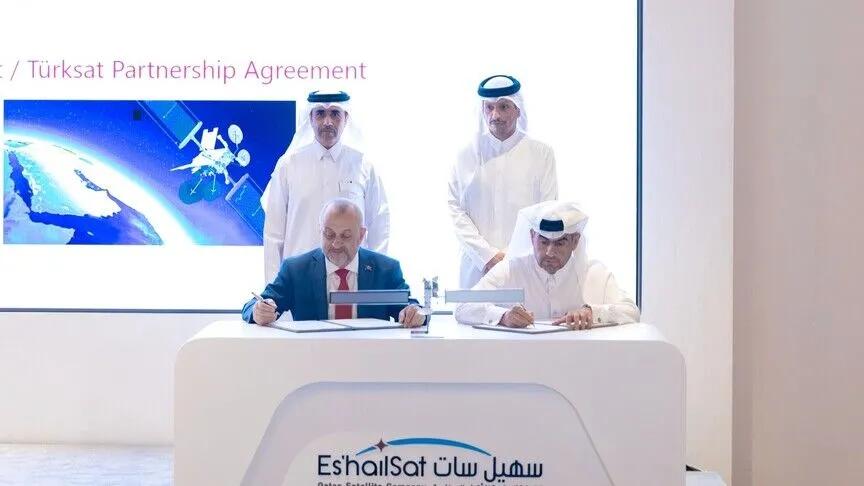
Signing of Agreements between Türkiye and Qatar, 30 June 2026 (Anadolu Agency)
The next-generation communication satellite is designed to deliver high-speed broadband internet access, corporate data communication, public sector communications, and mobile satellite services for the aviation and maritime sectors. Upon completion, the project aims to add a high-capacity new satellite to Türksat’s fleet and strengthen its existing satellite infrastructure.
The project will be financed by Qatar, with both parties jointly evaluating satellite capacity, ground stations, distribution networks, and customer portfolios. This model seeks to share infrastructure investments, optimize capacity utilization, and enhance commercial efficiency.
The capacity allocated to Türksat is projected to reach up to 50 Gbps, enabling the development of a next-generation communication infrastructure capable of meeting Türkiye’s growing data transmission demands.
The agreement confirms that Türkiye’s internationally recognized orbital and frequency rights will be preserved. The rights at the 50° East orbital position will be maintained in Türkiye’s name, and no transfer of orbital or frequency allocations will be carried out.
The satellite to be launched will be registered under Türksat’s name with the International Telecommunication Union (ITU), contributing to the protection of Türkiye’s international satellite rights. This ensures the continuity of existing rights while adding a new generation high-capacity communication satellite to the fleet.
The service area of the Es'hail-3/Türksat-Biruni satellite is planned to cover the Middle East, North Africa, Europe, Central Asia, and Sub-Saharan Africa.
Services delivered via the satellite will include high-capacity broadband internet, corporate data communication, public sector communication infrastructure, and mobile satellite services for aviation and maritime sectors. By integrating the technical infrastructure and regional operational capabilities of both companies, the goal is to offer commercial services across a broader geographic region.
The project represents the extension of the strategic cooperation that has developed in recent years between Türkiye and Qatar in energy, defense, transportation, and investment into the domain of space technology. The two countries aim to deepen collaboration in high-tech sectors by developing a joint investment model in communication satellites and digital infrastructure.
Through the Es'hail-3/Türksat-Biruni partnership, Türkiye seeks to enhance its effectiveness in the global satellite market, while Qatar aims to support its space and digital infrastructure goals. The project constitutes a long-term technological partnership designed to expand the commercial satellite communication capacity of both nations and strengthen their competitiveness in international markets.
AGBI. "Qatar to fund joint satellite project with Turkey." Accessed July 1, 2026. https://www.agbi.com/space/2026/07/qatar-to-fund-joint-satellite-project-with-turkey/
Anadolu Ajansı. "Türkiye ile Katar arasında stratejik ortaklık anlaşması imzalandı." Accessed July 1, 2026. https://www.aa.com.tr/tr/ekonomi/turkiye-ile-katar-arasinda-stratejik-ortaklik-anlasmasi-imzalandi/3982269
Bloomberg HT. "Türkiye ve Katar'dan uzay teknolojilerinde stratejik işbirliği." Accessed July 1, 2026. https://www.bloomberght.com/turkiye-ve-katar-dan-uzay-teknolojilerinde-stratejik-isbirligi-3781597

Türkiye and Qatar signed a strategic partnership agreement under the Es'hail-3/Türksat-Biruni satellite project. The new-generation communications satellite, to be developed with Qatari funding, is expected to enhance Türksat's capacity, provide services at 50 degrees east orbital position, and strengthen the communication infrastructure across a broad region extending from the Middle East to Africa.
No Discussion Added Yet
Start discussion for "Türkiye-Qatar Satellite Cooperation and Es'hail-3/Türksat-Biruni Strategic Partnership" article
July 1, 2026
Es'hail-3/Türksat-Biruni Satellite Project
July 1, 2026
Financing and Joint Operating Model
July 1, 2026
Türkiye’s Satellite Rights and Technical Structure
July 1, 2026
Service Scope and Regional Impact
July 1, 2026
Contribution to Türkiye-Qatar Relations