
This article was automatically translated from the original Turkish version.
+1 More
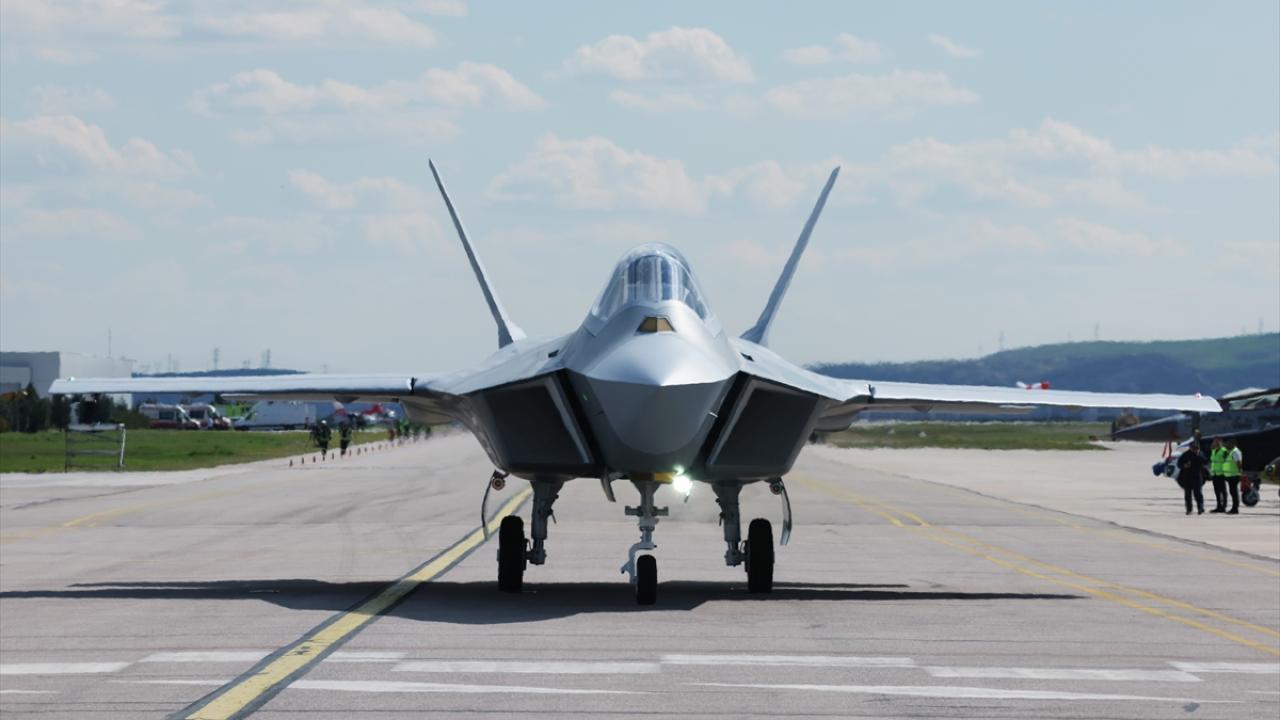
KAAN - National Combat Aircraft (NCA)
Country | Türkiye | ||||||||
|---|---|---|---|---|---|---|---|---|---|
Designing and Producing Organization | Turkish Aerospace Industries Inc. (TUSAŞ) | ||||||||
Project Coordination | Presidency of Defense Industries (SSB) | ||||||||
First Flight Date | 21 February 2024 | ||||||||
First Flight Duration | 13 minutes | ||||||||
Altitude Reached During First Flight | 8,000 feet | ||||||||
Speed Reached During First Flight | 230 knots | ||||||||
Second Test Flight | 6 May 2024; 10,000 feet altitude and 230 knots speed for 14 minutes | ||||||||
Aircraft Type(s) | Fifth-generation supersonic fighter aircraft twin-engine | ||||||||
Length(s) | Approximately 21 meters | ||||||||
Wingspan | 14 meters | ||||||||
Height(s) | 6 meters | ||||||||
Maximum Speed | Mach 1.8 (approximately 2,205 km/h) | ||||||||
Service Ceiling | 55,000 ft (approximately 16,764 meters) | ||||||||
Propulsion System | General Electric F110 engines in the first prototypes | ||||||||
Maximum G-Force | +9 G | ||||||||
Weapon Load Capacity | High capacity for carrying munitions via internal and external weapons stations | ||||||||
Stealth | Low radar cross-section (RCS) | ||||||||
Cockpit | Digital cockpit (glass cockpit) with touchscreen displays | ||||||||
Network-Centric Warfare | Mission systems enabling real-time data sharing | ||||||||
Artificial Intelligence | AI-supported systems in task analysis | ||||||||
Autonomous System Compatibility | Infrastructure for coordinated operations with UAV vehicles | ||||||||
The National Combat Aircraft (MMU), officially named KAAN, is a national defense industry project initiated by the Republic of Türkiye to develop a fifth-generation fighter aircraft. The project is led by Turkish Aerospace Industries Inc. (TUSAŞ), coordinated by the Presidency of Defense Industries (SSB), and involves contributions from various domestic subcontractors. The MMU project was launched with the aim of replacing the F-16 aircraft planned for retirement from the Turkish Air Forces inventory and holds significant importance in reducing Türkiye’s external dependency in the defense sector.
The MMU project was initiated to develop a domestic and national fighter aircraft to replace the F-16s in the Turkish Air Forces inventory. The project’s first prototype completed its maiden flight on 21 February 2024 at Mürted Airfield in Ankara. During this flight, KAAN remained airborne for 13 minutes, reaching an altitude of 8,000 feet and a speed of 230 knots.

KAAN National Combat Aircraft (Turkish Aerospace Industries Inc.)
KAAN is designed as a fifth-generation fighter aircraft. To this end, it is equipped with advanced low radar observability (stealth), network-enabled operations capability, high maneuverability, digital twin technology, internal weapons bays, sensor fusion, and AI-assisted mission systems. The aircraft’s maximum altitude is 55,000 feet, its maximum speed is Mach 1.8, its length is 21 meters, and its wingspan is 14 meters. The first prototype of the MMU successfully completed its maiden flight on 21 February 2024. The aircraft’s twin-engine configuration ensures high performance and reliability.

KAAN National Combat Aircraft (Turkish Aerospace Industries Inc.)
The KAAN’s airframe is designed to minimize radar cross-section. The cockpit design features an ergonomic and user-friendly structure aimed at reducing pilot workload and enhancing situational awareness. Additionally, the aircraft’s avionics architecture is planned modularly to accommodate future technological advancements.
The project prioritizes domestic and national solutions; critical subsystems of the MMU are developed with contributions from local industry institutions. In this context, TÜBİTAK BİLGEM has played an active role in developing sensitive components such as life support systems. Simultaneously, R&D efforts are ongoing to produce locally the electronic warfare systems, composite structure technologies, and avionics equipment used on the aircraft.
TUSAŞ employs Digital Twin Technology in the MMU’s digital development process. Through this technology, all structural, mechanical, and electronic components of the aircraft are simulated in a digital environment and validated against real flight data. This system offers advantages in both design optimization and predictive maintenance.
The MMU project is regarded as a strategic component of Türkiye’s “National Technology Initiative” and “Türkiye Century” vision. This project aims to enhance Türkiye’s capacity to offer high-tech products in the international defense market and contributes to building technological expertise in multiple fields including advanced engineering, artificial intelligence, and cybersecurity.
Under the MMU project, emphasis is placed on developing the aircraft’s critical subsystems using domestic and national capabilities. In this regard, infrastructure has been established in collaboration with TÜBİTAK BİLGEM for radar cross-section testing. Additionally, virtual testing of the aircraft is conducted using digital twin technology.
Avionics systems are the collective electronic components that enhance a fighter aircraft’s mission effectiveness. The avionics systems on the MMU–KAAN consist of a multi-functional suite including a mission computer, flight control system, advanced radar systems, electronic warfare capabilities, Identification Friend or Foe (IFF), situational awareness displays, sensor fusion, digital cockpit, data-link communications, and integrated logistics support systems.
According to data released by TUSAŞ, the KAAN’s avionics architecture is configured based on an open systems architecture. This structure facilitates easier future upgrades and modernization and enables integration of domestic software and hardware. Furthermore, multi-sensor fusion enhances pilot situational awareness, while an advanced mission management system allows effective planning of complex missions.
The National Combat Aircraft KAAN has been developed to meet fifth-generation fighter aircraft requirements.
• Maximum Speed: Mach 1.8 (approximately 2,205 km/h)
• Maximum G Force: +9 G
• Maneuverability: Advanced thrust-vectoring control is targeted in later stages
• Stealth Design:
• Slanted and angled structure to reduce radar cross-section (RCS)
• Internal weapons bays
• Electromagnetic signature-reducing surface coatings
• Material Composition:
• Extensive use of composite materials
• Radar-absorbent material (RAM) applications
• Heat-resistant exterior surfaces
• Digital cockpit (glass cockpit)
• Wide touch-screen displays
• Compatible with helmet-mounted display systems (HMD)
• Voice alerts and intelligent flight assistant
• Flight data analysis modules
• Real-time data sharing
• Integration with other air and defense assets via tactical link systems
• Mission planning and in-flight data processing
• Threat analysis and prioritization algorithms
• AESA radar
• IRST (Infrared Search and Track)
• Laser targeting and countermeasure systems
• Infrastructure to operate alongside UAVs
• Satellite-supported command and control integration
• The aircraft is pre-simulated through digital modeling
• AI-based maintenance and lifespan monitoring systems are under development
These features enable KAAN to deliver multirole combat capabilities, providing flexible operational use in both air-to-air and air-to-ground missions.

KAAN National Combat Aircraft (Defense Industry Magazine)
The first official statement by the Presidency regarding the National Combat Aircraft (MMU) project was made on 1 May 2023 during the program titled “The Century of the Future” held at the Turkish Aerospace Industries Inc. (TUSAŞ) facilities in Ankara-Kahramankazan. Official announcements by the Presidency highlighted the progress achieved in the development phase and announced that the platform’s official name is “KAAN.”
On the same day, during the ceremony, President Recep Tayyip Erdoğan affixed his signature to the MMU prototype’s airframe. This moment was documented through visual materials released by various media outlets and the Presidency’s Communication Directorate.

President Recep Tayyip Erdoğan (Republic of Türkiye Communication Directorate)

President Recep Tayyip Erdoğan (TRT)
The Presidency has also communicated through social media and press releases that the aircraft will be equipped with domestic and national systems, and that critical subsystems such as radar, weapons, and mission computers will be entirely developed using Turkish technologies.
In this context, the Presidency demonstrates not only political support but also institutional-level strategic ownership of the MMU–KAAN project. The statements focus primarily on the strategic importance and symbolic value attributed to the project rather than technical details.
According to an announcement by President Recep Tayyip Erdoğan on 11 June 2025, a comprehensive export agreement regarding the National Combat Aircraft (MMU) KAAN has been signed between Türkiye and Indonesia. Under the agreement, a total of 48 KAAN aircraft will be produced in Türkiye and exported to Indonesia. In his social media statement, President Erdoğan said: “Under the agreement signed with our friendly and brotherly Indonesia, 48 KAAN aircraft will be produced in Türkiye and exported to Indonesia.”
President Erdoğan emphasized that local capabilities in Indonesia will also be utilized during the KAAN production process. He further highlighted the role of Indonesian President Prabowo Subianto in the signing of the agreement, underscoring cooperation between the two countries. Erdoğan congratulated all institutions and organizations involved in the export process, including the Presidency of Defense Industries (SSB) and TUSAŞ.

President Recep Tayyip Erdoğan (TRT)
On the same date, Defense Industries President Haluk Görgün stated regarding the agreement: “This project will be one of the most concrete examples of joint production, technology sharing, and strategic cooperation.”
The commercial contract signing ceremony for the sale of 48 KAAN aircraft to Indonesia was held on 26 July 2025 during the 17th International Defense Industry Fair (IDEF 2025) in Istanbul. This agreement, recorded as the largest export contract ever signed by Türkiye’s defense industry, was conducted under the leadership of the Presidency of Defense Industries.
The signing ceremony was attended by Prof. Dr. Haluk Görgün, President of the Presidency of Defense Industries of the Republic of Türkiye; Sjafrie Sjamsoeddin, Minister of Defense of Indonesia; Prof. Dr. Ömer Cihad Vardan, Chairman of the TUSAŞ Board of Directors; Deputy Minister of National Defense and Vice Chairman of the TUSAŞ Board of Directors Şuay Alpay; and Dr. Mehmet Demiroğlu, General Manager of TUSAŞ.
Following the signing ceremony at IDEF 2025, Defense Industries President Prof. Dr. Haluk Görgün described the development as “a historic moment in history.” Görgün stated: “We are proud to have successfully implemented this cooperation, which has blossomed thanks to the leadership and strong will of our President Recep Tayyip Erdoğan and Indonesian President Prabowo Subianto.”
Görgün noted that the technical annexes of the commercial contract, prepared under the “Government-to-Government (G2G)” supply agreement signed with the Indonesian Ministry of Defense on 11 June 2025, have been completed. He emphasized that the local industrial infrastructure to be established in Indonesia will be supported and that cooperation in production and engineering will be expanded. He also thanked Indonesian stakeholders such as PT RAD and PTDI involved in the project.

Signing ceremony at IDEF 2025, 26 July 2025 - (GDH Defence)
The National Combat Aircraft (MMU) – KAAN is positioned as a strategic platform within the context of Türkiye’s long-term defense, technology, and foreign policy objectives.
Since the 2000s, Türkiye has adopted a comprehensive indigenization strategy to reduce external dependency in the defense industry. As the first fifth-generation fighter aircraft developed under this strategy, KAAN is planned as the domestic replacement for the F-16 platforms in the air forces inventory.
The development of KAAN enhances Türkiye’s capabilities in multidisciplinary fields such as aircraft system integration, materials science, artificial intelligence, electronic warfare, software engineering, and digital twin technology.

KAAN National Combat Aircraft (Turkish Aerospace Industries Inc.)
Designed with Türkiye’s NATO membership obligations in mind, KAAN is engineered to ensure interoperability with allied forces; however, through full data control and software sovereignty, it provides a defense platform that is immune to external interference and fully integrated into national decision-making processes.
KAAN not only meets Türkiye’s domestic security and defense needs but also aims to create economic and diplomatic influence through defense exports. Regions such as the Middle East, South Asia, and the Turkic Republics, which include Türkiye’s current and potential defense industry customers, are considered strategic export targets for KAAN. In this regard, the aircraft also emerges as a tool for geopolitical influence projection.
KAAN makes its first flight. (turkishaerospace)
Strategic value refers to the importance of a technological system or platform in contributing to long-term national security, economic sustainability, political independence, and international competitiveness across multiple dimensions.
The strategic value of KAAN is manifested in the following areas:
Anadolu Ajansı. "Cumhurbaşkanı Erdoğan: 48 Adet KAAN Türkiye’de Üretilerek Endonezya’ya İhraç Edilecek." Accessed June 11, 2025. https://www.aa.com.tr/tr/gundem/cumhurbaskani-erdogan-48-adet-kaan-turkiyede-uretilerek-endonezyaya-ihrac-edilecek/3593934#
Anadolu Ajansı. "Cumhurbaşkanı Erdoğan’dan KAAN Paylaşımı." Anadolu Ajansı, May 1, 2023. https://www.aa.com.tr/tr/gundem/cumhurbaskani-erdogandan-kaan-paylasimi/2886474.
Defense Industries Presidency. *Defense Industry 2023 Activity Report*. Ankara:SSB Yayınları, 2023. https://www.ssb.gov.tr/Images/Uploads/MyContents/F_20231106165507582242.pdf.
Defense Industries Presidency. *KAAN: National Fighter Aircraft Promotion File*. Ankara: SSB, 2023. Accessed April 19, 2025. https://www.ssb.gov.tr/Images/Uploads/MyContents/F_20231106165507582242.pdf.
Presidency of the Republic of Turkey, Communication Directorate. "President Erdoğan: The National Fighter Aircraft (MMU) Has Been Named KAAN." Communication Directorate. Accessed April 19, 2025. https://www.iletisim.gov.tr/turkce/haberler/detay/cumhurbaskani-erdogan-milli-muharip-ucagin-mmu-adinin-kaan-oldugunu-acikladi.
Savunma Sanayii Dergilik. "KAAN Tasarımı." Accessed May 11, 2025. https://savunmasanayiidergilik.com/images/uploads/Tasarim/29_156229_ssdergilik-kaan.jpg.
Savunma Sanayii Dergilik. "Milli Muharip Uçak’ın (MMU) İsmi KAAN Olarak Açıklandı." Accessed April 19, 2025. https://savunmasanayiidergilik.com/tr/HaberDergilik/Milli-Muharip-Ucak-in-MMU-ismi-KAAN-olarak-aciklandi.
TRT Haber. "KAAN Uçağından Görseller." TRT Haber. Accessed May 11, 2025. https://trthaberstatic.cdn.wp.trt.com.tr/resimler/2036000/2037966.jpg.
TRT Haber. “KAAN Pistte.” TRT Haber. Accessed May 11, 2025. https://trthaberstatic.cdn.wp.trt.com.tr/resimler/2036000/2037922.jpg.
TRT Haber. “Milli Muharip Uçak KAAN’a Erdoğan’dan İmza.” Accessed April 19, 2025. https://www.trthaber.com/foto-galeri/milli-muharip-ucak-kaana-erdogandan-imza/56084/sayfa-1.html.
TRT Haber. “Milli Muharip Uçak KAAN’a Erdoğan’dan İmza.” TRT Haber, May 1, 2023. https://www.trthaber.com/foto-galeri/milli-muharip-ucak-kaana-erdogandan-imza/56084.html.
TUBA (TÜBİTAK BİLGEM). "BTE Devam Eden Projeler." bilgem.tubitak.gov.tr. Accessed April 2025. https://bilgem.tubitak.gov.tr/projeler-ve-programlar/bte-devam-eden-projeler.
TUSAŞ (Türk Havacılık ve Uzay Sanayii A.Ş.). "KAAN Görseli." TUSAŞ. Accessed May 11, 2025. https://www.tusas.com/content/images/uploads/originals/kaan,2783.png.
TUSAŞ (Türk Havacılık ve Uzay Sanayii A.Ş.). "KAAN." *tusas.com*. Accessed April 2025. https://www.tusas.com/urunler/ucak/ozgun-gelistirme/kaan.
TUSAŞ (Türk Havacılık ve Uzay Sanayii A.Ş.). "MMU Görsel 1." TUSAŞ. Accessed May 11, 2025. https://www.tusas.com/content/images/uploads/originals/mmu-d1,554.png.
TUSAŞ (Türk Havacılık ve Uzay Sanayii A.Ş.). "MMU Görsel 2." TUSAŞ. Accessed May 11, 2025. https://www.tusas.com/content/images/uploads/originals/mmu-d3,556.png.
TUSAŞ (Türk Havacılık ve Uzay Sanayii A.Ş.). "Milli Muharip Uçak KAAN İlk Uçuşunu Gerçekleştirdi." *tusas.com*, February 21, 2024. https://www.tusas.com/medya-merkezi/haberler/milli-muharip-ucak-kaan-ilk-ucusunu-gerceklestirdi.
TUSAŞ (Türk Havacılık ve Uzay Sanayii A.Ş.). “KAAN Teknik Özellikler Tanıtım Dosyası.” Ankara: TUSAŞ, 2023. Accessed April 19, 2025. .
TUSAŞ (Türk Havacılık ve Uzay Sanayii A.Ş.). “MMU için Dijital İkiz Çalışmalarına Başlandı.” *tusas.com*, 2023. https://www.tusas.com/medya-merkezi/haberler/mmu-icin-dijital-ikiz-calismalarina-baslandi.
YouTube. "KAAN – Milli Muharip Uçak Tanıtım Videosu." YouTube. Accessed May 11, 2025. https://www.youtube.com/watch?v=ZhgCXY1E5vs.


KAAN - National Combat Aircraft (NCA)
Country | Türkiye | ||||||||
|---|---|---|---|---|---|---|---|---|---|
Designing and Producing Organization | Turkish Aerospace Industries Inc. (TUSAŞ) | ||||||||
Project Coordination | Presidency of Defense Industries (SSB) | ||||||||
First Flight Date | 21 February 2024 | ||||||||
First Flight Duration | 13 minutes | ||||||||
Altitude Reached During First Flight | 8,000 feet | ||||||||
Speed Reached During First Flight | 230 knots | ||||||||
Second Test Flight | 6 May 2024; 10,000 feet altitude and 230 knots speed for 14 minutes | ||||||||
Aircraft Type(s) | Fifth-generation supersonic fighter aircraft twin-engine | ||||||||
Length(s) | Approximately 21 meters | ||||||||
Wingspan | 14 meters | ||||||||
Height(s) | 6 meters | ||||||||
Maximum Speed | Mach 1.8 (approximately 2,205 km/h) | ||||||||
Service Ceiling | 55,000 ft (approximately 16,764 meters) | ||||||||
Propulsion System | General Electric F110 engines in the first prototypes | ||||||||
Maximum G-Force | +9 G | ||||||||
Weapon Load Capacity | High capacity for carrying munitions via internal and external weapons stations | ||||||||
Stealth | Low radar cross-section (RCS) | ||||||||
Cockpit | Digital cockpit (glass cockpit) with touchscreen displays | ||||||||
Network-Centric Warfare | Mission systems enabling real-time data sharing | ||||||||
Artificial Intelligence | AI-supported systems in task analysis | ||||||||
Autonomous System Compatibility | Infrastructure for coordinated operations with UAV vehicles | ||||||||
History and Development Process
Design
Structural Features
Development Process and Collaborations
Digital Twin and Simulation Infrastructure
Role in the Türkiye Century Vision
Subsystems and Domestic Contributions
Avionics Systems
Technical Specifications
Features/Features
New Generation Avionics / New Generation Avionics
General Information
Aircraft Type
Physical Characteristics
Speed and Flight Performance
Airframe and Material Properties
Propulsion and Engine Systems
Avionics and System Features
Weapons and Munitions Capacity
Cockpit and Pilot Interface
Mission Systems and Avionics
Autonomy and Advanced Integration
Production and Development Infrastructure
Development Process and Future Planning
Presidency’s Statements on the National Combat Aircraft (MMU) – KAAN Project
Export Agreement with Indonesia (2025)
IDEF 2025Signing Ceremony
Strategic Position of KAAN from Türkiye’s Perspective
Strategic Autonomy in Defense Industry
High-Tech Production Capability
NATO-Compatible but Autonomous System Architecture
Export Potential and Regional Influence
Strategic Value