


This article was automatically translated from the original Turkish version.
+1 More
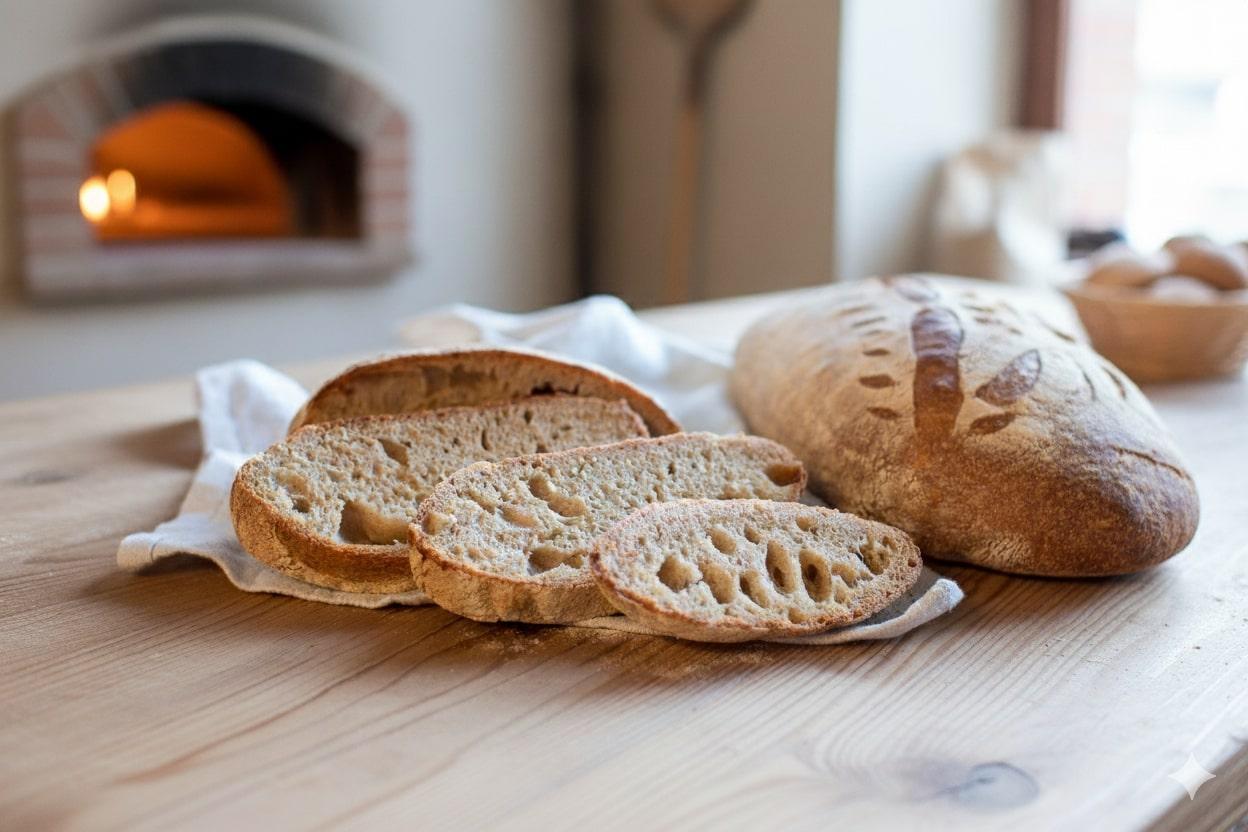
Tuscan Bread (Generated by Artificial Intelligence.)
Name(s) | Pane Toscano | ||||||||
|---|---|---|---|---|---|---|---|---|---|
Production Region | Tuscany Region | ||||||||
Main Ingredients | Soft Wheat Flour Containing Water, Sour Yeast, and Wheat Seeds | ||||||||
Control Authority | CSQA Certificazioni Srl | ||||||||
Tuscan bread (originally known as Pane Toscano) is a traditional bread unique to Italy’s Tuscany region, recognized for its distinctive production method and unsalted (sciocco) flavor. Its historical origins trace back to periods when salt was expensive and primarily used for preserving pork.
The unsalted nature of Tuscan bread is a phenomenon rooted in Tuscany’s historical development and distinguishes it from breads produced in other Italian regions. The earliest written evidence of this “sciocco” (unsalted) bread production was provided by Pierandrea Mattioli in the sixteenth century. In a 1765 text, Saverio Manetti documented the regional tradition of omitting salt during bread preparation. Manetti also noted the use of natural yeast (lievito naturale), known locally as “Formento,” which consists of sourdough naturally present in the flour. Evidence from the nineteenth century indicates that unsalted bread played a role in the diet of Tuscan laborers. The primary reason for this preference was that salt, due to its high cost, was reserved almost exclusively for pork preservation.【1】
The traditional production system of Tuscan bread involves only three basic ingredients: water, sourdough starter (lievito madre/pasta acida), and soft wheat flour made from wheat grains (type “0”, “1”, or “2”). The wheat varieties used—for example, Centauro, Verna, Mieti, and Mec—must be grown, stored, and milled within the geographic area where the bread is produced. A specific blend of red and white kernel varieties is required during flour preparation. Milling for type “0” flour is carried out using a roller system, while type “1” and “2” flours may be milled using either roller or stone mills. During milling, the temperature must not exceed 40 degrees Celsius for type “0” flour and 35 degrees Celsius for type “1” and “2” flours. The addition of any food additives to the flour is prohibited. One distinguishing feature of Tuscan bread is the inclusion of wheat grains, which are not found in general-purpose bread flours; this enhances both nutritional value and fermentation processes. The use of sourdough starter facilitates lactic acid fermentation, imparting distinctive flavor and aroma to the bread.
About Tuscan Bread (I cook therefore I am)
When presented for consumption, Tuscan bread must exhibit the following characteristics:
The designated geographical area for the production and packaging of Tuscan bread encompasses the entire administrative territory of the Tuscany region. The climatic and geological features of this area—particularly the barrier formed by the Apennine Mountains and its openness to the west—have enabled the development of unique ecotypes of wheat cultivation, forming the foundation of the bread’s distinctive characteristics.
Cucino dunque Sono. "Pane Toscano sciocco." YouTube. Accessed October 20, 2025.
MASAF – Ministry of Agriculture, Food and Forestry Policies. "Pane Toscano (DOP)." MASAF. Accessed October 20, 2025. https://www.masaf.gov.it/flex/cm/pages/ServeAttachment.php/L/IT/D/1%252F7%252F2%252FD.7d47f4b4ad65bb04e5b6/P/BLOB%3AID%3D3347/E/pdf?mode=download
[1]
MASAF – Tarım, Gıda ve Orman Politikaları Bakanlığı, “Pane Toscano (DOP)” sayfa 3, MASAF, erişim tarihi: 20 Ekim 2025, https://www.masaf.gov.it/flex/cm/pages/ServeAttachment.php/L/IT/D/1%252F7%252F2%252FD.7d47f4b4ad65bb04e5b6/P/BLOB%3AID%3D3347/E/pdf?mode=download

Tuscan Bread (Generated by Artificial Intelligence.)
Name(s) | Pane Toscano | ||||||||
|---|---|---|---|---|---|---|---|---|---|
Production Region | Tuscany Region | ||||||||
Main Ingredients | Soft Wheat Flour Containing Water, Sour Yeast, and Wheat Seeds | ||||||||
Control Authority | CSQA Certificazioni Srl | ||||||||
Historical Origins
Main Ingredients and Preparation
Product Characteristics
Production Area