This article was automatically translated from the original Turkish version.
+2 More
Dimension(s) | 100.4 x 80.9 cm | ||||||||
|---|---|---|---|---|---|---|---|---|---|
Location | USA Chicago Art Institute of Chicago | ||||||||
Signature | Renoir. 81. (in blue paint) | ||||||||
Technique | Oil on canvas | ||||||||
Year of Creation | 1881 | ||||||||
Artist | Pierre-Auguste Renoir | ||||||||
Original Title | Femme sur une terrasse au bord de la Seine | ||||||||
Title of the Work | Two Sisters (On the Terrace) | ||||||||
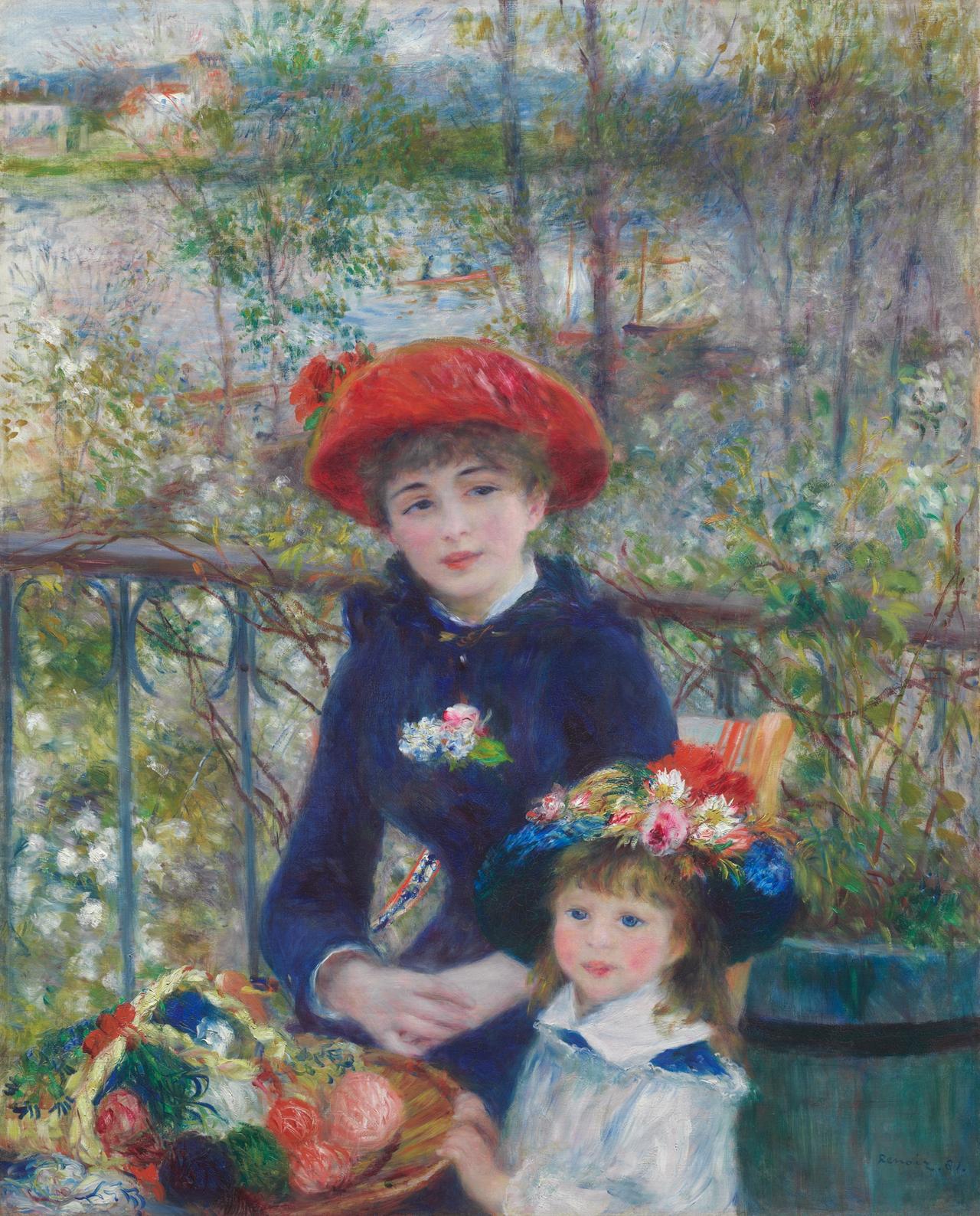
Two Sisters (On the Terrace) (originally titled Femme sur une terrasse au bord de la Seine) is an oil painting completed by Pierre-Auguste Renoir in 1881. The work is a figural composition depicting two young girls seated side by side in an open space resembling a terrace. Painted in Chatou near Paris, the piece is now part of the collection of the Art Institute of Chicago.
The work is considered part of Renoir’s series of open-air compositions linked to the Seine River and particularly the Restaurant Fournaise in Chatou. In a letter dated late summer 1880 to the collector Georges de Bellio, the artist described Chatou as one of the most striking rural areas around Paris and invited him to visit.【1】
In another letter dated 18 April 1881, Renoir stated that he was occupied with flowering trees women and children and expressed his intention to postpone his planned trip to England. This statement underscores the decisive role of direct observation of nature and seasonal atmosphere in the painting’s creation.
Shortly after completion the painting was purchased by the art dealer Paul Durand-Ruel for 1500 francs under the title Femme sur une terrasse au bord de la Seine. By the end of 1881 the work was reproduced in color in the magazine L’art de la mode . In the seventh Impressionist exhibition held in March 1882 it was exhibited under the title Les deux soeurs.
Since Renoir did not participate in the exhibition Durand-Ruel included twenty-five of his works from his own collection. The painting was later re-exhibited under the title Femme sur une terrasse (Chatou) and in 1892 it was featured by Georges Lecomte in a publication on Durand-Ruel’s private collection as one of the exemplary works of Impressionist art.
The painting was subsequently shown under a different title in another exhibition and remained in the Durand-Ruel family’s possession for approximately forty-five years. After Paul Durand-Ruel’s death in June 1922 the painting was sold to Mrs Lewis Larned Coburn of Chicago.
Although the title “Two Sisters” was used in the 1882 exhibition the figures are not biological sisters. The seated young woman is identified as Eugénie Marie Darlaud (Jeanne Darlaud) who was eighteen years old and aspiring to become an actress. The identity of the younger girl remains undetermined.
In 1923 Paul Durand-Ruel mistakenly recalled the young woman as Anne Darlaud the younger sister of Jeanne Darlaud (stage name Jane Demarsy); later the art historian François Daulte confirmed that the model was Jeanne Darlaud. Jeanne Darlaud was admitted to the Conservatoire in August 1882 pursued a career on the French stage and died in 1914.
Jeanne Darlaud is noted to have embodied the type of a “canotière” or female rower associated with the leisure culture along the Seine and linked to characters in Guy de Maupassant’s novel Yvette (1884).【2】
The work is executed in oil on canvas and measures approximately 100.4 by 80.9 cm.
It was painted on a commercially prepared fine-weave linen canvas with a white ground layer partially filling the weave. X-ray and infrared examinations reveal changes in the positions of the heads and arms indicating that the artist corrected certain compositional choices using the scraping technique.【3】 A technical distinction is evident between the treatment of the figures and the landscape elements with particular emphasis on color application in the background.
The figures are rendered with a denser and more controlled application of paint. Skin tones were created through careful blending of red and white pigments; the child’s figure prominently features dense lead white. In the young woman’s dark blue dress layers of red lake were used to create depth in the shadows while fine yellow layers suggest reflections of light on the chest. The strong color contrast between the red hat and the dark blue dress reflects a deliberate chromatic composition.
The painting is signed and dated in blue paint in the lower right corner as “Renoir. 81.”
The background features natural landscape elements with newly blooming leaves and flowers establishing the seasonal atmosphere. The background is painted with loose and light-sensitive brushstrokes; dense blue and white accents are layered over delicate pink and blue tones to suggest reflections on the water’s surface. Infrared examinations reveal that some figures originally present in the background were later removed and decorative elements on the balcony railing were eliminated.
Two Sisters features a balanced composition centered on the two figures in the foreground. The figures are positioned on a plane very close to the viewer and rendered nearly life-size. The seated young woman is placed at the center of the composition while the younger girl is positioned close to her as if newly entering the scene.
The painting is arranged from an elevated viewpoint. Behind the balcony railing the Seine River boats and the opposite bank appear; this arrangement transforms the background into an atmospheric space perceived as a stage set. Through thin and transparent layers of paint the background is visually lightened creating a clear contrast with the figures.
The pronounced technical distinction between the background and the figures has been interpreted as a deliberate departure from Renoir’s “pantheistic” brushwork of the 1870s. While the figures are rendered with a sculptural effect the background acquires a more atmospheric and translucent quality.
The wool basket in the foreground serves as a compositional element that adds color and volume filling the space before the figures and reinforcing spatial depth. Thus the composition is constructed upon a deliberate contrast between the solid dense figures in the foreground and the light atmospheric landscape in the background.
The combined treatment of the adult and child figures has been evaluated in relation to other figural compositions exhibited at the seventh Impressionist exhibition held in the same year.
Art Institute of Chicago. “Renoir: Paintings and Drawings at the Art Institute of Chicago.” *Art Institute of Chicago*. Accessed February 13, 2026. https://publications.artic.edu/renoir/reader/paintingsanddrawings/section/135639
Art Institute of Chicago. “Two Sisters (On the Terrace).” Art Institute of Chicago. Accessed February 13, 2026. https://www.artic.edu/artworks/14655/two-sisters-on-the-terrace
[1]
Art Institute of Chicago, “Renoir: Paintings and Drawings at the Art Institute of Chicago,” Art Institute of Chicago, Last accessed 13 February 2026, https://publications.artic.edu/renoir/reader/paintingsanddrawings/section/135639
[2]
Art Institute of Chicago, “Renoir: Paintings and Drawings at the Art Institute of Chicago,” Art Institute of Chicago, Last accessed 13 February 2026, https://publications.artic.edu/renoir/reader/paintingsanddrawings/section/135639
[3]
Art Institute of Chicago, “Renoir: Paintings and Drawings at the Art Institute of Chicago,” Art Institute of Chicago, Last accessed 13 February 2026, https://publications.artic.edu/renoir/reader/paintingsanddrawings/section/135639

Dimension(s) | 100.4 x 80.9 cm | ||||||||
|---|---|---|---|---|---|---|---|---|---|
Location | USA Chicago Art Institute of Chicago | ||||||||
Signature | Renoir. 81. (in blue paint) | ||||||||
Technique | Oil on canvas | ||||||||
Year of Creation | 1881 | ||||||||
Artist | Pierre-Auguste Renoir | ||||||||
Original Title | Femme sur une terrasse au bord de la Seine | ||||||||
Title of the Work | Two Sisters (On the Terrace) | ||||||||
No Discussion Added Yet
Start discussion for "Two Sisters (Painting)" article
Production Process
Naming and Exhibition History
Models and Figures
Technical Features
Setting and Background
Composition and Perspective Construction