This article was automatically translated from the original Turkish version.
Types of Learning
Evaluation Format | Implicit Competence Certificate Diploma | ||||||||
|---|---|---|---|---|---|---|---|---|---|
Modern Trends | Digital Learning Micro-competencies | ||||||||
Application Area(s) | Daily Life Workplace Courses Schools | ||||||||
Theoretical Foundations | Lifelong Learning Constructivism | ||||||||
Conceptualization | Manzoor Ahmed (1974) Philip Coombs | ||||||||
Categories | Informal Nonformal Formal | ||||||||
Classification(s) | Educational Sciences Andragogy Pedagogy Humanities | ||||||||
Types of Learning refer to conceptual classifications based on how individuals acquire knowledge, skills, attitudes, and values. In educational literature, learning processes are generally categorized into three main types: formal, nonformal, and informal. This distinction is based on criteria such as the degree of planning, relationship with institutional structures, level of programmatic design, evaluation mechanisms, and certification features.【1】
The distinction between formal, nonformal, and informal learning began to be discussed especially in the second half of the 20th century within the context of accessibility, inequality, and development policies in education systems. In the 1960s and 1970s, assessments that formal education systems alone could not adequately respond to societal needs prompted the conceptualization of alternative learning pathways.
In this context, the work of Coombs and Ahmed highlighted the role of nonformal education in development processes, underscoring the importance of organized learning activities occurring outside the formal system.【2】 This approach contributed to the development of a more inclusive perspective in education.
From the 1990s onward, globalization, the information economy, and transformations in labor markets led to the understanding of learning as a process extending across all stages of life. The European Commission’s lifelong learning policies 【3】 and OECD’s work on recognizing nonformal and informal learning 【4】 prompted a renewed policy-level evaluation of learning types. During this period, learning ceased to be viewed merely as an activity confined to school years and was redefined as a lifelong developmental process of the individual; formal, nonformal, and informal learning began to be addressed within a holistic framework.
The distinctions among learning types are systematically analyzed through criteria such as institutional structure, degree of programmatic design, measurement and evaluation mechanisms, and intended outcomes. This comparison reveals that learning is not merely a spatial issue but also a matter of design, authority, and control.
The following table presents the structural differences among these three main categories within an analytical framework:
This comparative perspective confirms that formal learning serves the function of social standardization and legal legitimacy; nonformal learning addresses current skill gaps and fosters flexibility; and informal learning represents the processes through which individuals make sense of the world and accumulate tacit knowledge. In modern educational paradigms, these types are not mutually exclusive categories but rather integrated components of a holistic, spiral-shaped system.
Formal learning is a structured learning process conducted within official educational institutions according to established curricula, programs, and standards. It typically involves age-based progression, systematic assessment, and certification.

Formal - Informal - Nonformal Learning: Comparison Table (Generated by Artificial Intelligence)

Formal Learning Process (Generated by Artificial Intelligence)
Key characteristics of formal learning include:
Schools, universities, and vocational training institutions are typical environments for formal learning. This type of learning plays a crucial role in social standardization and professional competency.

Nonformal Learning Process (Generated by Artificial Intelligence)
Nonformal learning encompasses planned learning activities conducted outside the formal education system but guided by specific goals and objectives. According to Coombs and Ahmed, nonformal education refers to organized and intentional learning activities conducted outside the formal system.【5】
Key characteristics of nonformal learning include:
Adult education programs, courses, workshops, science center activities, and summer camps are examples of nonformal learning. This type of learning is particularly important for its ability to respond flexibly to individual interests and societal needs.
Informal learning refers to learning processes that occur spontaneously in daily life, often without conscious awareness and independently of any formal instructional program. Marsick and Watkins define informal learning as learning that is typically unplanned but emerges through experience.【6】 These processes may be intentional or occur as incidental learning. Eraut considers the acquisition of tacit knowledge, particularly in professional work, a key dimension of informal learning.【7】

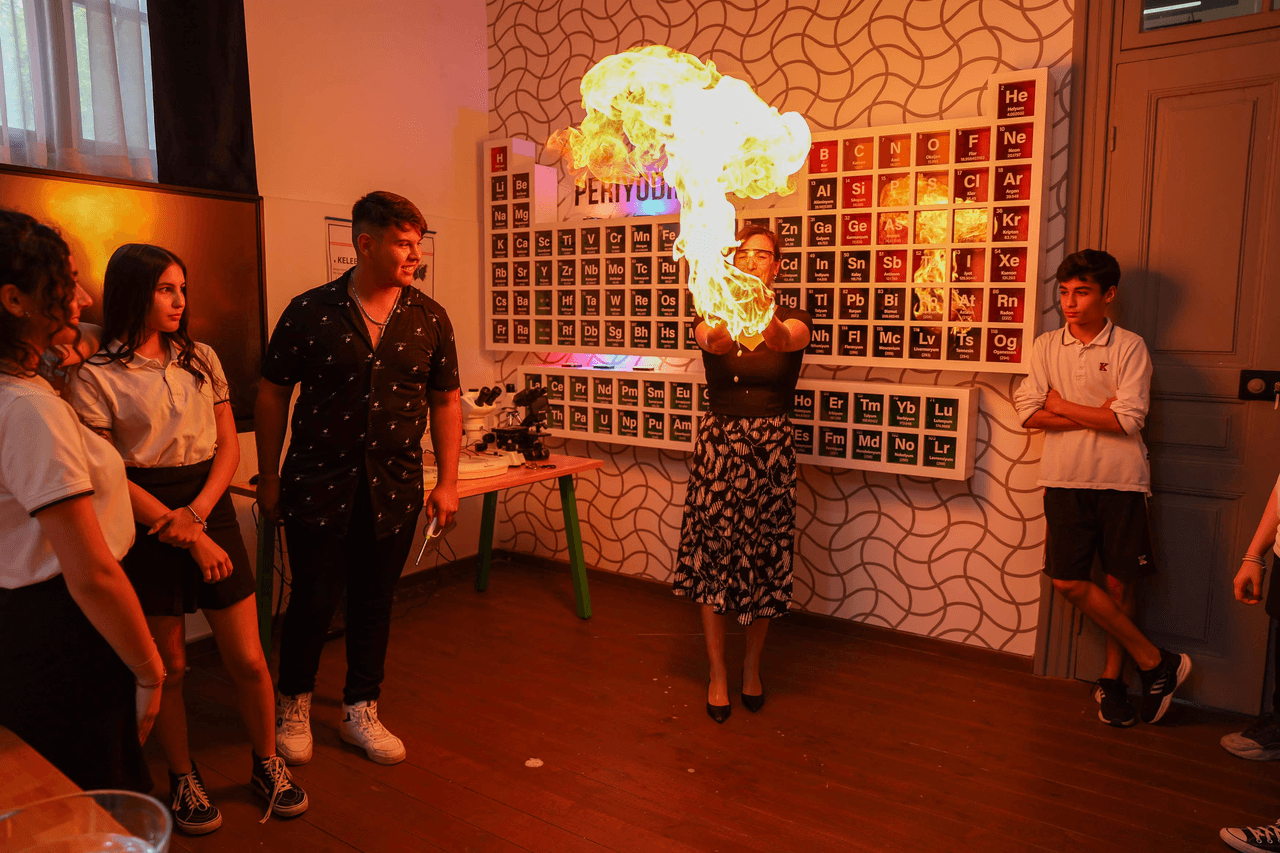
Informal Learning Process (Bilim Türkiye Archive)
Characteristics of informal learning:
Examples of informal learning include family interactions, peer conversations, media consumption, gaming experiences, and workplace-acquired skills.
The distinction between formal, nonformal, and informal learning is not merely an organizational classification but also a framework linked to different learning theories.
In this context, learning types are associated not only with environment or degree of planning but also with epistemological and pedagogical perspectives.
Literature emphasizes that learning types do not have rigid boundaries.【8】 Activities conducted outside school settings often exhibit both nonformal and informal characteristics.
For example:
Learning types should be viewed not as sharp categories but as existing along a continuum.
Formal education systems have long been regarded as the sole legitimate pathway to learning. However, with the development of lifelong learning policies, recognition of nonformal and informal learning has become a priority.
In this context, practices such as:
have prompted a policy-level reevaluation of learning types.
With the advancement of digital technologies, boundaries between learning types have become even more fluid.
This has led to the deterritorialization of learning and the emergence of hybrid learning models.
Out-of-school learning is not a type of learning but rather the context in which learning occurs.
In this context, learning occurring outside school can be:
This distinction is particularly important for the theoretical positioning of science centers, museums, and nature-based education practices.
Kolb’s experiential learning theory argues that learning occurs through the individual’s process of making sense of their experiences.【9】 According to this model, learning progresses through a four-stage cycle: concrete experience, reflective observation, abstract conceptualization, and active experimentation. This approach emphasizes that learning is not merely the transmission of information but the transformation of experience.

Experiential Learning Cycle (Generated by Artificial Intelligence)
The experiential learning model provides an explanatory framework for understanding nonformal and informal learning processes. In nonformal settings, learning is often deliberately designed around experience, while in informal learning, experience arises spontaneously and gains meaning through the individual’s reflective process. In formal learning environments, experiential activities (laboratories, fieldwork, project-based learning) are regarded as elements that enhance learning durability.
This classification expresses not only the context in which learning occurs but also the organization of the learning process and its level of social recognition. Formal learning encompasses structured processes tied to the official education system; nonformal learning refers to organized yet flexible learning activities; and informal learning denotes learning experiences that emerge spontaneously within daily life. Today, these three categories are not viewed as mutually exclusive structures but as complementary dimensions of a lifelong learning process.
Future learning ecosystems represent a “hybrid universe” in which boundaries between formal, nonformal, and informal learning domains become entirely permeable, shaped by technological transformation and evolving societal needs. In these ecosystems, learning becomes a continuous process integrated into the individual’s life flow, independent of time and space.
The foundational elements of this transformation are shaped by the following dynamics:
Formal, nonformal, and informal learning modes are no longer alternative venues but interconnected components of an integrated ecosystem supporting holistic individual development. Modern educational paradigms compel the integration of knowledge confined within school walls with the dynamism of life and the boundless resources of the digital world. Literature emphasizes that linking an “informal” discovery made in a museum or a “nonformal” skill acquired in a workshop to formal education outcomes constitutes a critical threshold for the democratization and personalization of learning.
Future educational paradigms are expected to fully eliminate sharp boundaries among these learning types and place “hybrid and flexible learning pathways” at the core. Particularly, AI-supported personalized learning processes and the documentation of micro-credentials are initiating an era in which informal experiences are regarded as valuable as formal diplomas. Within the lifelong learning vision, the fundamental criterion is no longer where learning occurs but how acquired competencies are transformed into the individual’s problem-solving capacity and social well-being.
Birgili, B., Bulut, M. A., Gülünay, O., Koçoğlu, M., & Baş, F. R. (2025). Technology-enhanced “GipSci” approach in developing contexts performs well at *interest* and *curiosity*, yet, needs reinforcing at *inquiry* level. *Research in Science & Technological Education*, 1–38. Accessed February 14, 2026. https://doi.org/10.1080/02635143.2025.2578303
Coombs, Philip H., and Manzoor Ahmed. 1974. Attacking Rural Poverty: How Nonformal Education Can Help. Baltimore: Johns Hopkins University Press.
Eraut, Michael. 2000. "Non‐formal Learning and Tacit Knowledge in Professional Work." *British Journal of Educational Psychology* 70 (1): 113–136. Accessed February 14, 2026. https://doi.org/10.1348/000709900158001.
European Commission. 2000. A Memorandum on Lifelong Learning. Brüksel: Commission of the European Communities.
Kolb, David A. 1984. Experiential Learning: Experience as the Source of Learning and Development. Englewood Cliffs, NJ: Prentice Hall.
Marsick, Victoria J., and Karen E. Watkins. 2001. "Informal and Incidental Learning." *New Directions for Adult and Continuing Education* 2001 (89): 25–34. Accessed February 14, 2026. https://doi.org/10.1002/ace.5.
OECD. 2007. *Recognising Non-formal and Informal Learning: Outcomes, Policies and Practices*. Paris: OECD Publishing. Accessed February 14, 2026. https://doi.org/10.1787/9789264033612-en.
UNESCO. 2012. *International Standard Classification of Education: ISCED 2011*. Montreal: UNESCO Institute for Statistics. Accessed February 14, 2026. https://uis.unesco.org/sites/default/files/documents/international-standard-classification-of-education-isced-2011-en.pdf.
[1]
UNESCO, International Standard Classification of Education: ISCED 2011 (Montreal: UNESCO Institute for Statistics, 2012), access date 14 February 2026, https://www.uis.unesco.org/sites/default/files/medias/fichiers/2025/08/EDS-3-ISCED-Final-WEB.pdf
[2]
Philip H. Coombs and Manzoor Ahmed, Attacking Rural Poverty: How Nonformal Education Can Help (Baltimore: Johns Hopkins University Press, 1974). access date 14 February 2026,https://archive.org/details/attackingruralpo0000coom
[3]
European Commission, A Memorandum on Lifelong Learning (Brussels: Commission of the European Communities, 2000), access date 14 February 2026, https://www.hsu-hh.de/wb/wp-content/uploads/sites/647/2017/10/Anthology-Memorandum_on_Lifelong_Learning-EU-2000.pdf
[4]
OECD, Recognising Non-Formal and Informal Learning: Outcomes, Policies and Practices (Paris: OECD Publishing, 2007), access date 14 February 2026, https://www.oecd.org/content/dam/oecd/en/publications/reports/2010/04/recognising-non-formal-and-informal-learning_g1ghaff6/9789264063853-en.pdf
[5]
Philip H. Coombs and Manzoor Ahmed, Attacking Rural Poverty: How Nonformal Education Can Help (Baltimore: Johns Hopkins University Press, 1974), access date 14 February 2026, https://documents1.worldbank.org/curated/en/656871468326130937/pdf/multi-page.pdf
[6]
Victoria J. Marsick and Karen E. Watkins, “Informal and Incidental Learning,” New Directions for Adult and Continuing Education 89 (2001): 25–34, access date 14 February 2026, https://onlinelibrary.wiley.com/doi/10.1002/ace.5
[7]
Michael Eraut, “Non-Formal Learning and Tacit Knowledge in Professional Work,” British Journal of Educational Psychology 70, no. 1 (2000): 113–136, access date 14 February 2026, https://bpspsychub.onlinelibrary.wiley.com/doi/10.1348/000709900158001
[8]
OECD, Recognising Non-Formal and Informal Learning: Outcomes, Policies and Practices (Paris: OECD Publishing, 2007), access date 14 February 2026, https://www.oecd.org/content/dam/oecd/en/publications/reports/2010/04/recognising-non-formal-and-informal-learning_g1ghaff6/9789264063853-en.pdf
[9]
David A. Kolb, Experiential Learning: Experience as the Source of Learning and Development, access date 14 February 2026, https://www.researchgate.net/publication/235701029_Experiential_Learning_Experience_As_The_Source_Of_Learning_And_Development


Types of Learning
Evaluation Format | Implicit Competence Certificate Diploma | ||||||||
|---|---|---|---|---|---|---|---|---|---|
Modern Trends | Digital Learning Micro-competencies | ||||||||
Application Area(s) | Daily Life Workplace Courses Schools | ||||||||
Theoretical Foundations | Lifelong Learning Constructivism | ||||||||
Conceptualization | Manzoor Ahmed (1974) Philip Coombs | ||||||||
Categories | Informal Nonformal Formal | ||||||||
Classification(s) | Educational Sciences Andragogy Pedagogy Humanities | ||||||||
Historical Development
Comparative Analysis
Formal Learning
Nonformal Learning
Informal Learning
Theoretical Foundations
Relationships Among Types
Educational Significance
Digital Context
Out-of-School Context
Experiential Learning
Future Learning Ecosystems