


This article was automatically translated from the original Turkish version.
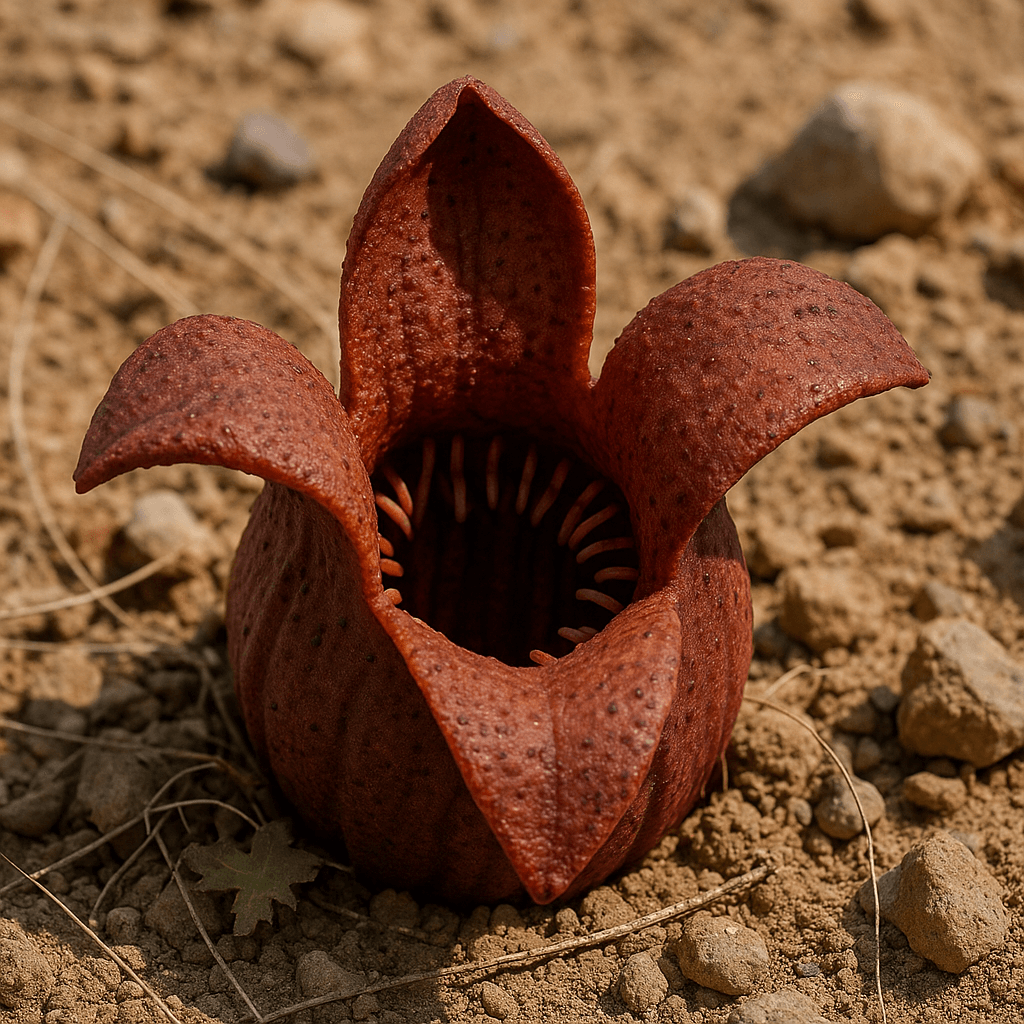
Underground Flower (Hydnora africana) is a parasitic plant species belonging to the family Balanophoraceae, native to the semi-arid and arid regions of South Africa. This species typically attaches itself to the roots of plants in the genus Euphorbia and is known for its unique structure that develops entirely underground. When its flowers emerge above ground, they form a fleshy structure that emits a foul odor, attracting carrion insects to facilitate pollination. The plant is incapable of photosynthesis and relies entirely on its host plant for nutrients.
Hydnora africana has adapted to harsh climatic conditions through its root-stem-like stem that spreads underground. In regions with intense temperature fluctuations, this subterranean lifestyle provides the plant with advantages against water and heat stress. The flowering period coincides with the activity of its pollinator insects, and the host plant’s roots play a crucial role in seed dispersal.
This species forms complex ecological relationships with endemic plants in its range. Its parasitic, rather than symbiotic, lifestyle influences the balance within the ecosystem. Additionally, H. africana, which is also used by local communities for medicinal and ritual purposes, holds regional cultural significance.

General View of the Flower Structure (Generated by Artificial Intelligence)
Kingdom: Plantae
Phylum: Tracheophyta
Class: Magnoliopsida
Order: Santalales
Family: Balanophoraceae
Genus: Hydnora
Species: Hydnora africana
Hydnora africana was first described by Carl Thunberg in 1775. The specific epithet “africana” refers to the plant’s African origin. Systematically, this species is a significant member of the Balanophoraceae family and is distinguished by its complete parasitic nature.
Hydnora africana has lost the ability to perform photosynthesis and develops underground with a root-stem-like structure. The stem is thick and fleshy, enabling it to attach firmly to the roots of its host plant. The leaves are entirely reduced, appearing only as small scales on the stem. These structures aid in attachment to host roots and in the transport of water and minerals.
The flower structure is highly specialized. Fleshy, thick tepals form a three-lobed structure that emerges above ground. The interior of the flower contains a trap-like mechanism that temporarily captures pollinator insects. Upon opening, the flower emits a characteristic foul odor that attracts carrion insects, which then transfer pollen for fertilization.
The flower structure is highly specialized. Fleshy, thick tepals form a three-lobed structure that emerges above ground. The interior of the flower contains a trap-like mechanism that temporarily captures pollinator insects. Upon opening, the flower emits a characteristic foul odor that attracts carrion insects, which then transfer pollen for fertilization.
Hydnora africana has evolved a reproductive strategy in which pollinator insects play a critical role. The odor released upon flower opening specifically attracts carrion insects. These insects enter the flower, carrying pollen, and become temporarily trapped, during which time pollination occurs.
Flowers are borne on short stalks attached to the underground stem. The fleshy, thick texture of the three-lobed tepals prevents insects from easily entering or exiting, thereby increasing pollen transfer efficiency and ensuring successful pollination.
The fruits that develop after fertilization are fleshy, and seeds are dispersed in environments near the host plant’s roots underground. This adaptation enables the plant to sustain its population in arid habitats.
Hydnora africana thrives in semi-arid and arid regions alongside host plants of the genus Euphorbia. These areas are typically characterized by low rainfall and intense temperature fluctuations. Its subterranean stem and reduced leaves provide an adaptation that minimizes water loss.
The plant can survive in nutrient-poor soils, but its growth is most successful in areas with dense concentrations of host roots. The water and nutrients obtained from the host roots enable the plant to survive even under conditions of drought and nutrient scarcity.
This species exerts indirect effects on local ecosystem biodiversity. Its parasitic lifestyle can alter the growth dynamics of host plants and influence local plant composition.
Due to its parasitic nature, Hydnora africana is extremely difficult to cultivate directly. Seed propagation efforts have been limited, as germination requires direct contact with suitable host roots.
In scientific studies, seed germination trials have been conducted in semi-natural environments by matching seeds with roots of Euphorbia species. These methods have achieved limited success in botanical gardens and research collections.
Maintaining environmental parameters such as temperature, humidity, and soil structure close to those of its natural habitat is essential for cultivation. However, commercial-scale production is not feasible and remains uncommon.
Although Hydnora africana is not used directly as an agricultural product, it is valued by local communities for medicinal and ritual purposes. The roots are traditionally chewed to treat digestive disorders. It has also been reported to be used for gum health.
These uses are not commercial but based on small-scale local practices. Nevertheless, the plant’s endemic and rare status enhances its importance in botanical gardens and academic research collections.
In the context of tourism and ecotourism, Hydnora africana can serve as an attractive feature of local nature tours when in bloom. However, conservation measures are critical due to threats such as habitat loss and overharvesting.
Hydnora africana can influence the dynamics of local plant communities through its subterranean parasitic structure. The stress it imposes on host plants may contribute to ecosystem re-equilibration from a biodiversity perspective. Additionally, its flowers are known to serve as temporary food sources and habitats for pollinator insects.
Some pharmacological studies have indicated that the roots of Hydnora africana may possess antibacterial and anti-inflammatory properties. These effects are associated with the presence of phytochemical compounds such as tannins and flavonoids. In traditional medicine, chewing the roots is common for treating digestive ailments such as diarrhea.
Local communities also use Hydnora africana for ritual purposes. The extraction and use of the plant hold symbolic meaning in certain cultures. Additionally, due to its rarity and subterranean growth habit, it is often associated with the myth of the “hidden plant.”

No Discussion Added Yet
Start discussion for "Underground Flower (Hydnora africana)" article
Taxonomic Position and Morphological Characteristics
Systematic Classification
Morphological Features
Flower Structure and Reproductive Biology
Ecological Requirements
Cultivation Techniques
Agricultural and Economic Value
Ecological and Cultural Significance
Ecosystem Services
Phytochemical Potential and Medicinal Use
Ethnobotanical Perspectives