


This article was automatically translated from the original Turkish version.
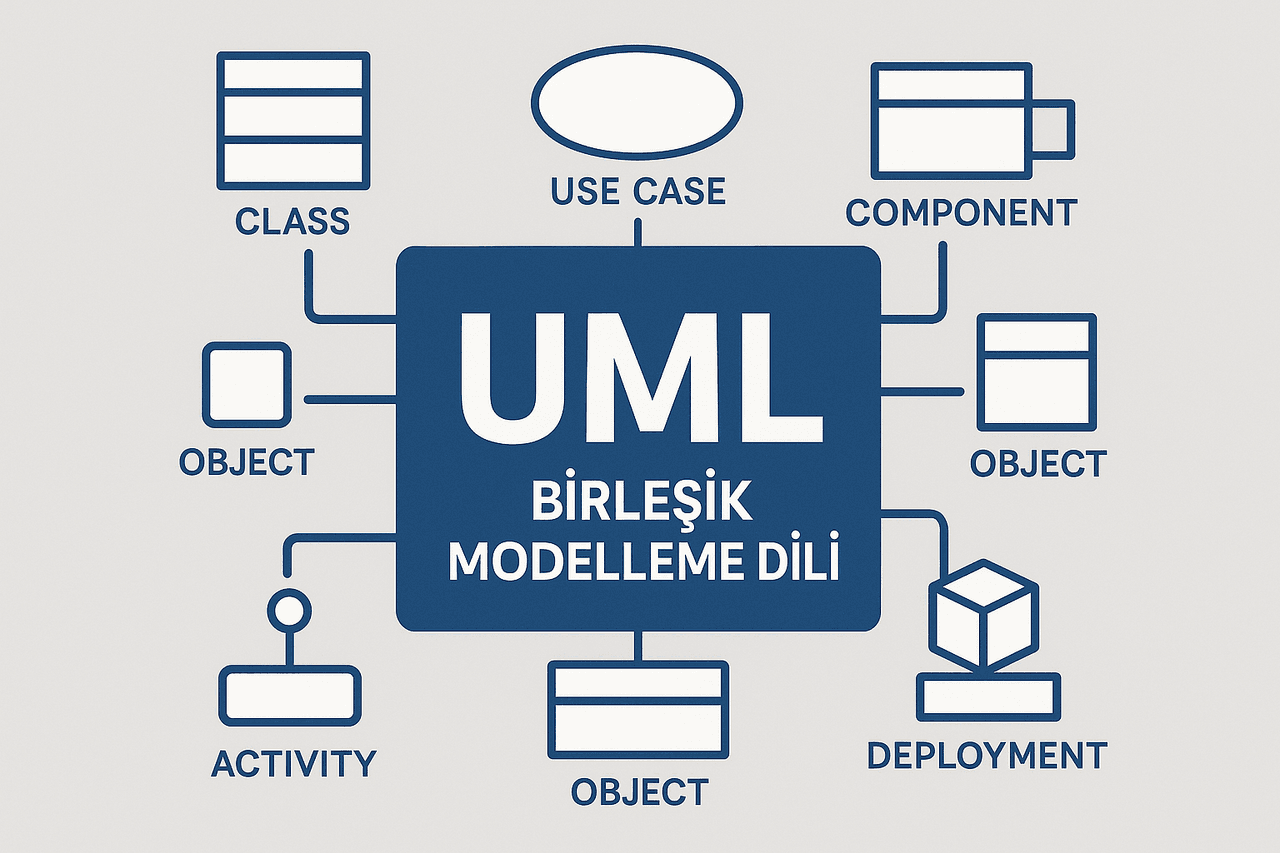
Generated by artificial intelligence.
Unified Modeling Language (UML)
Definition(s) | UML (Unified Modeling Language) is a non-programming modeling language developed to design and make complex software systems understandable to stakeholders using a standard visual language. document | ||||||||
|---|---|---|---|---|---|---|---|---|---|
Purpose(s) | Reusability Common Language Visual Thinking Method Independent | ||||||||
Diagram Types | Interaction Diagrams Behavioral Diagrams Structural Diagrams | ||||||||
Unified Modeling Language (UML) emerged from the need to create a standard, understandable, and shared visual modeling language in response to the increasing complexity and scale of software technologies and software projects over the years. UML is not a programming language but a modeling language. Its primary purpose is to visually represent the design structure and behavior of software systems in a standardized manner. Just as blueprints shape a building project in civil engineering, UML serves the same function for software projects.
UML is particularly grounded in object-oriented software development paradigms and enables stakeholders with different perspectives—such as analysts designers developers testers and managers—to understand systems using a common language. This facilitates the visual design documentation and development of complex software systems.
The origins of the Unified Modeling Language trace back to the late 1980s and early 1990s. At that time object-oriented programming (OOP) was rapidly gaining popularity but there was no common modeling standard to represent this approach. Pioneers in the field James Rumbaugh Grady Booch and Ivar Jacobson had each developed their own methods: Rumbaugh’s Object Modeling Technique (OMT) excelled in analysis Booch’s method in design and Jacobson’s Object-Oriented Software Engineering (OOSE) in use cases.
In 1994 these three key figures united under the Rational Software umbrella to merge their methods into a single framework. The resulting language was named the Unified Modeling Language. In 1997 the Object Management Group (OMG) adopted UML 1.0 as a standard. This standardization process was supported by the UML Partners consortium which included major companies such as IBM Microsoft HP and Oracle.
Over time certain shortcomings of UML—such as complex semantics scalability issues and incomplete standards—were discussed and in 2005 UML 2.0 was released. With UML 2.x versions the number of fundamental diagrams increased from nine to thirteen meta-modeling concepts were enhanced and the language was formalized as an international standard under ISO 19505-1/19505-2. This evolution of UML was shaped in response to the software industry’s need for a common visual language.
The purpose of Unified Modeling Language (UML) is to provide a standardized notation language that facilitates the visualization documentation construction and specification of increasingly complex systems in software engineering. UML is not a programming language but a universal modeling language compatible with diverse software development methodologies and languages.
The core philosophy of UML includes:
Meta-modeling plays a vital role in the theoretical foundation of UML. UML 2.x defines modeling concepts across four hierarchical levels:
This structure enables UML to be a self-defined rule-based and extensible language not only for systems but also for itself. This layered architecture is supported by complementary languages such as OCL (Object Constraint Language).
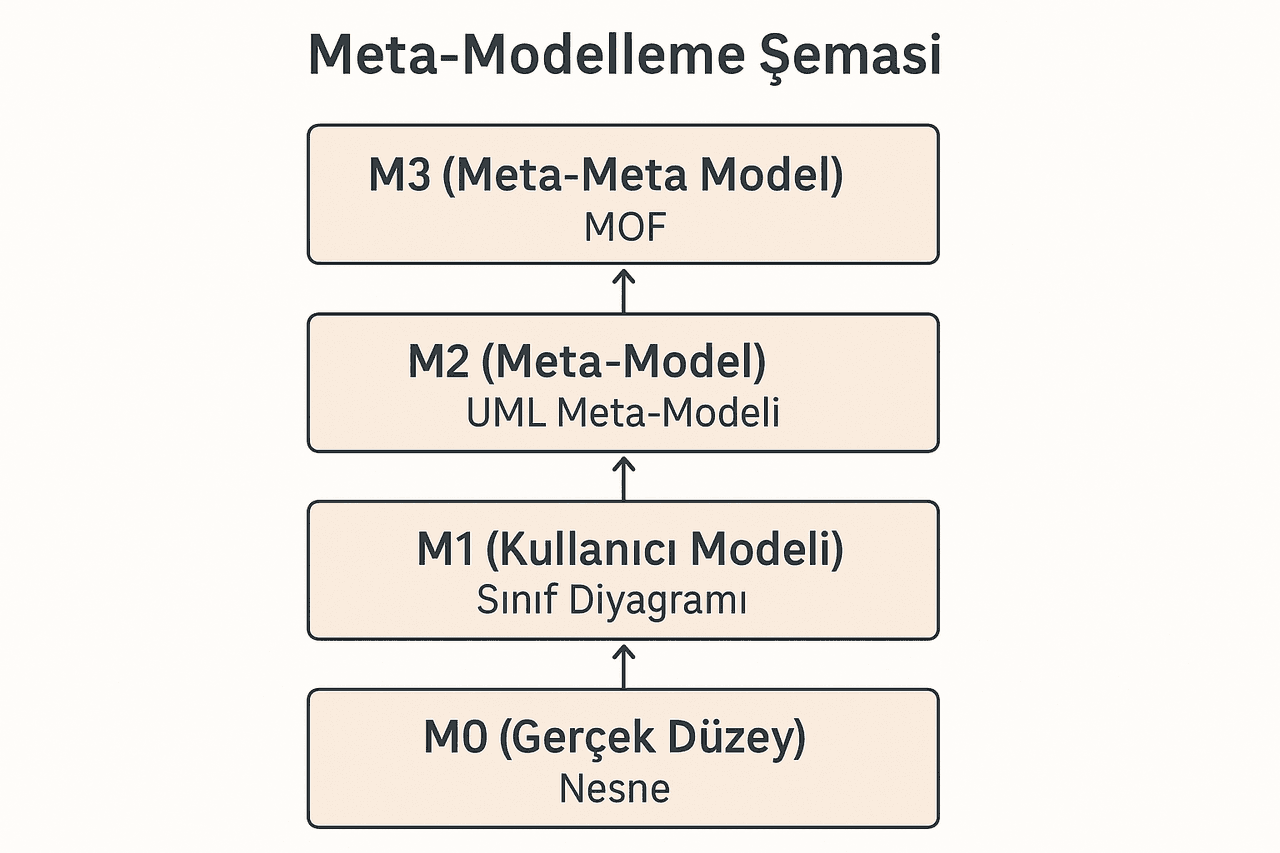
Meta-modeling Structure (Generated by artificial intelligence.)
Language units are the abstract building blocks of UML:
The philosophy of Unified Modeling Language is directly rooted in the object-oriented programming (OOP) paradigm. This approach is based on breaking down complex systems into manageable objects defining these objects in classes and organizing them through principles such as encapsulation inheritance abstraction and polymorphism.
UML expresses these concepts through concrete diagrams. For example:
UML 2.x categorizes diagrams into two main groups: Structural Diagrams and Behavior Diagrams. Behavior diagrams are further divided into the subcategory of Interaction Diagrams.
The class diagram is the fundamental diagram of UML. It shows the classes of an object-oriented system their attributes methods and relationships between classes such as association inheritance and composition. For example a “User” class may have attributes such as “Name” and “Surname” and operations such as “Login()”.
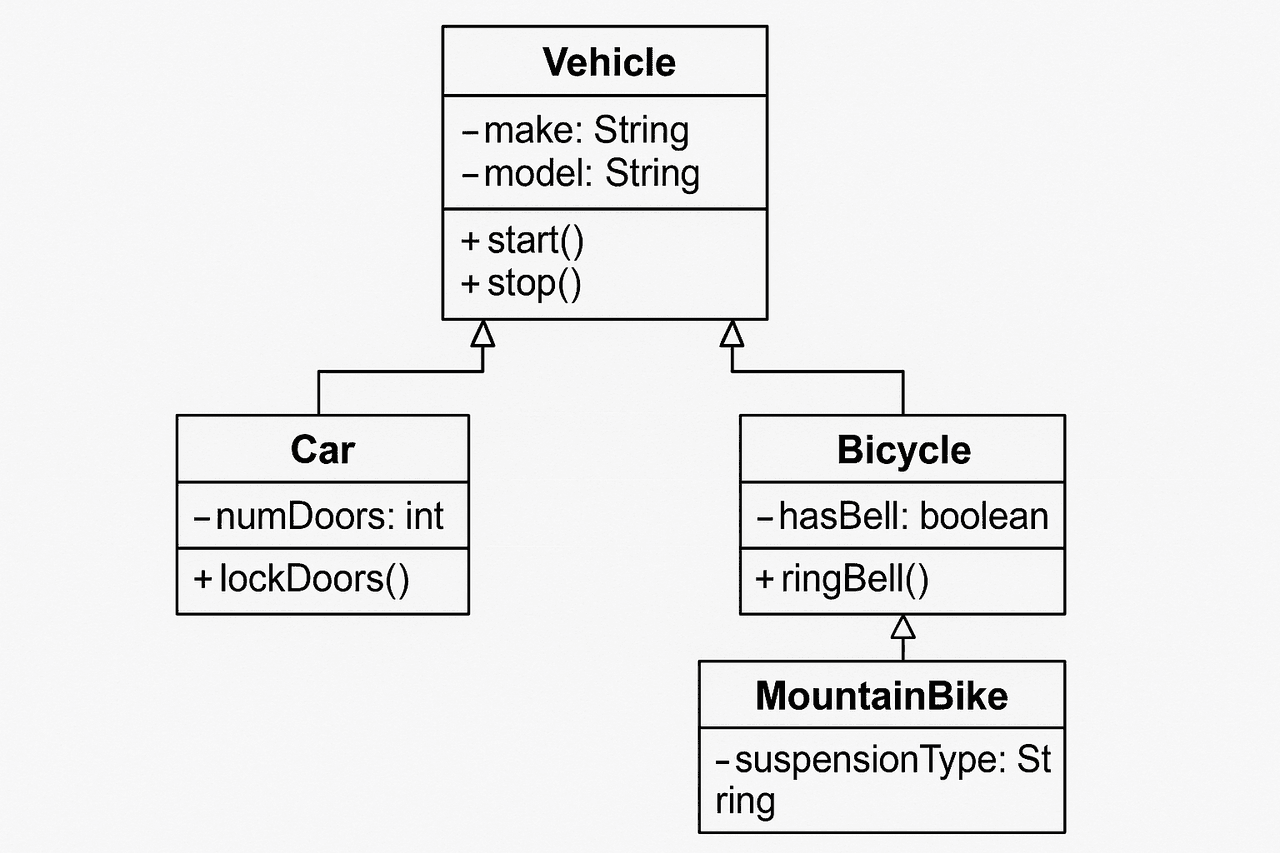
Example of a class diagram (Generated by artificial intelligence.)
An object diagram is a snapshot of a class diagram at runtime. It shows how instances of a class are related to each other and what values they hold at a specific moment.
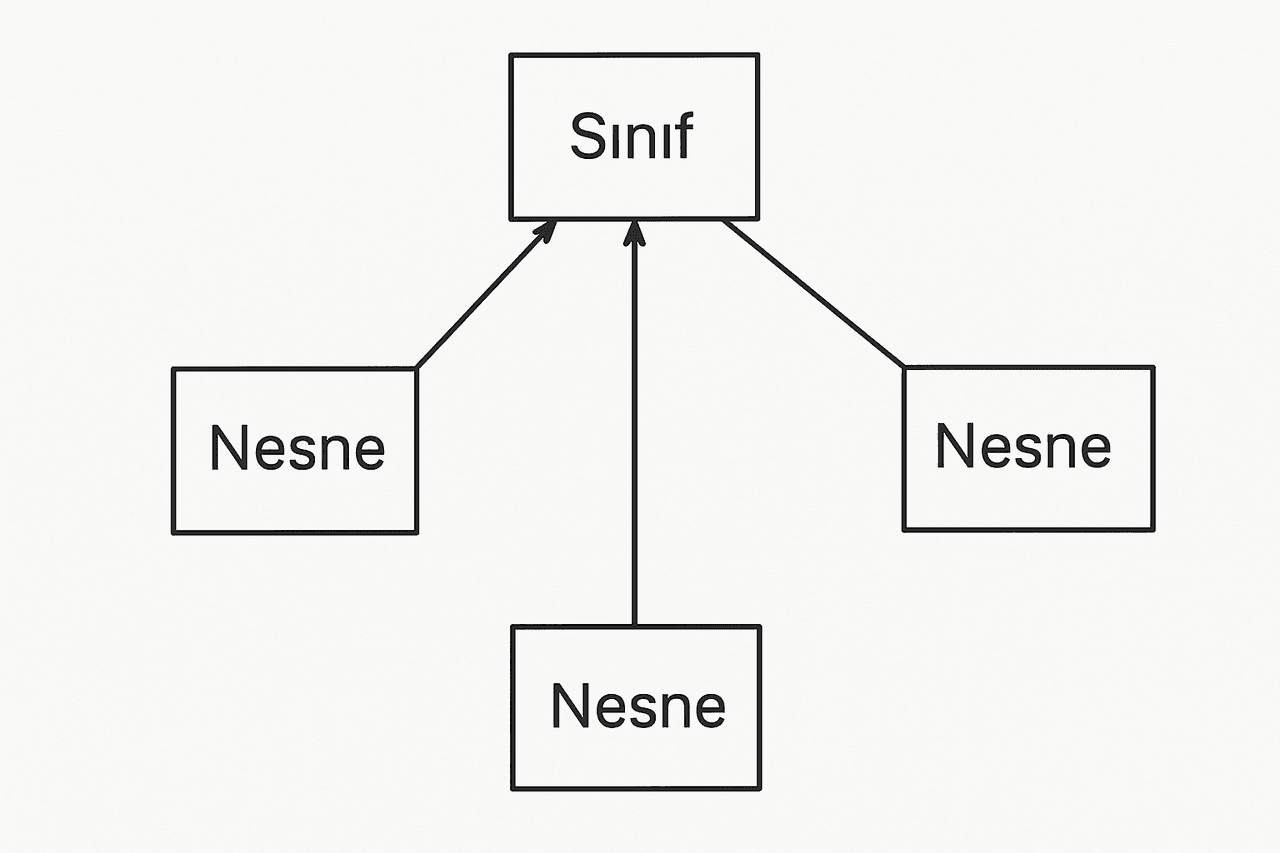
Example of an object diagram (Generated by artificial intelligence.)
Represents the logical structure of software components their dependencies and interface relationships. It is central to component-based development strategies in large projects.
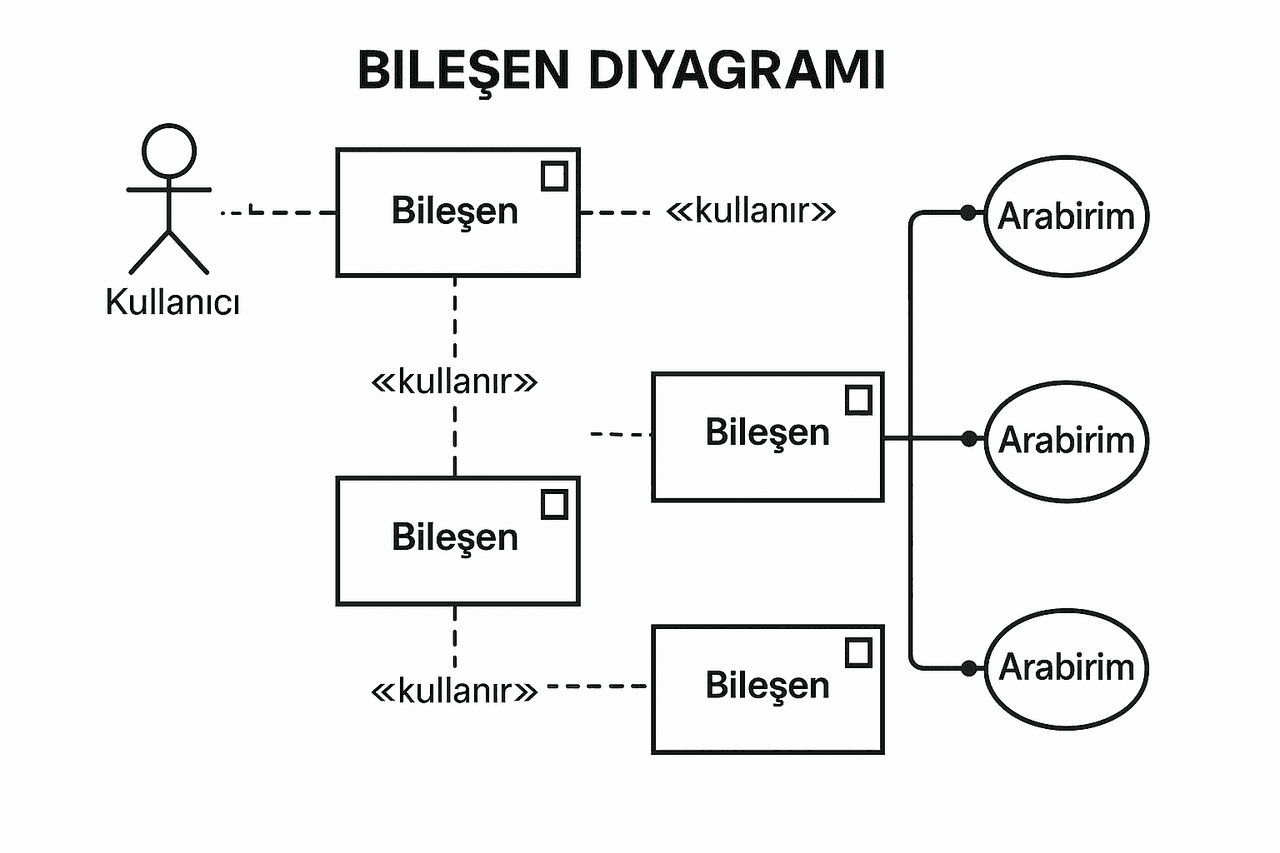
Example of a component diagram (Generated by artificial intelligence.)
Models in detail the internal structure parts ports and connections of a class.
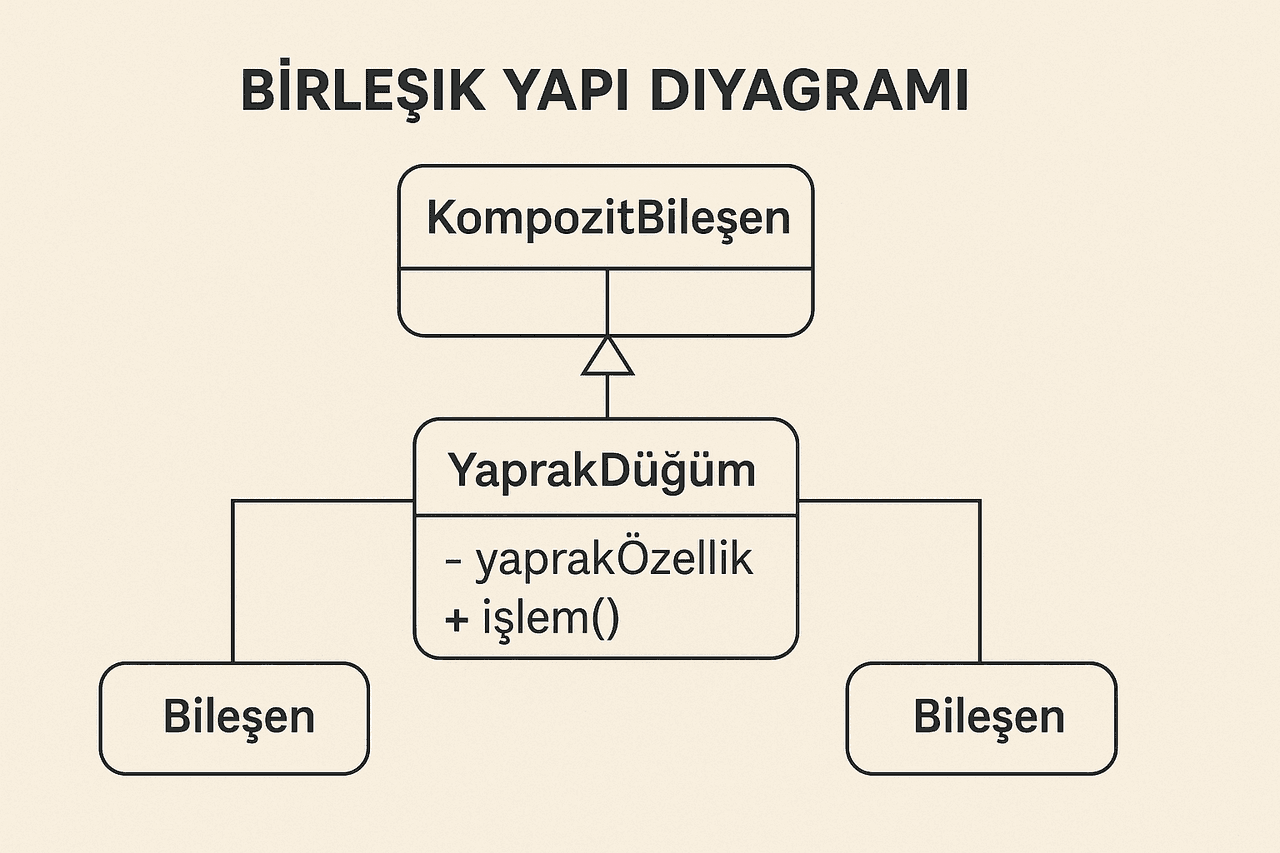
Example of a composite structure diagram (Generated by artificial intelligence.)
Organizes classes interfaces or components into packages enabling complex systems to be divided into manageable modules.
Shows how software components are distributed across hardware. Physical machines servers execution environments (nodes) and software artifacts running on these nodes are visualized.
Used to customize UML for a specific domain or platform. Model semantics can be adapted using extensions such as stereotypes.
High-level representation of a system’s interactions with users (actors) and its core functionality. In an ATM example scenarios such as “Withdraw Cash” and “Deposit Money” are presented through this diagram.
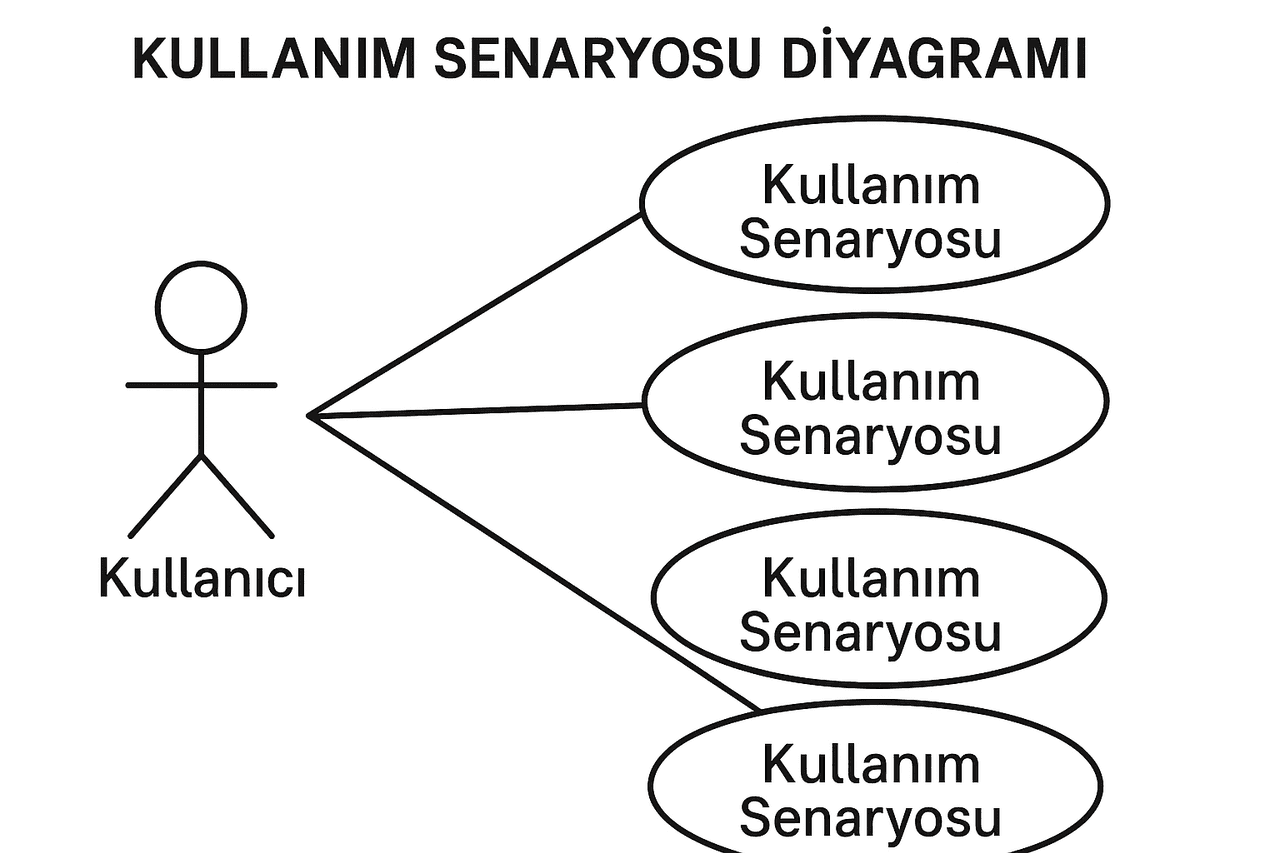
Example of a use case diagram (Generated by artificial intelligence.)
Visualizes business processes workflows decision points and parallel operations. It is widely used in business process analysis.
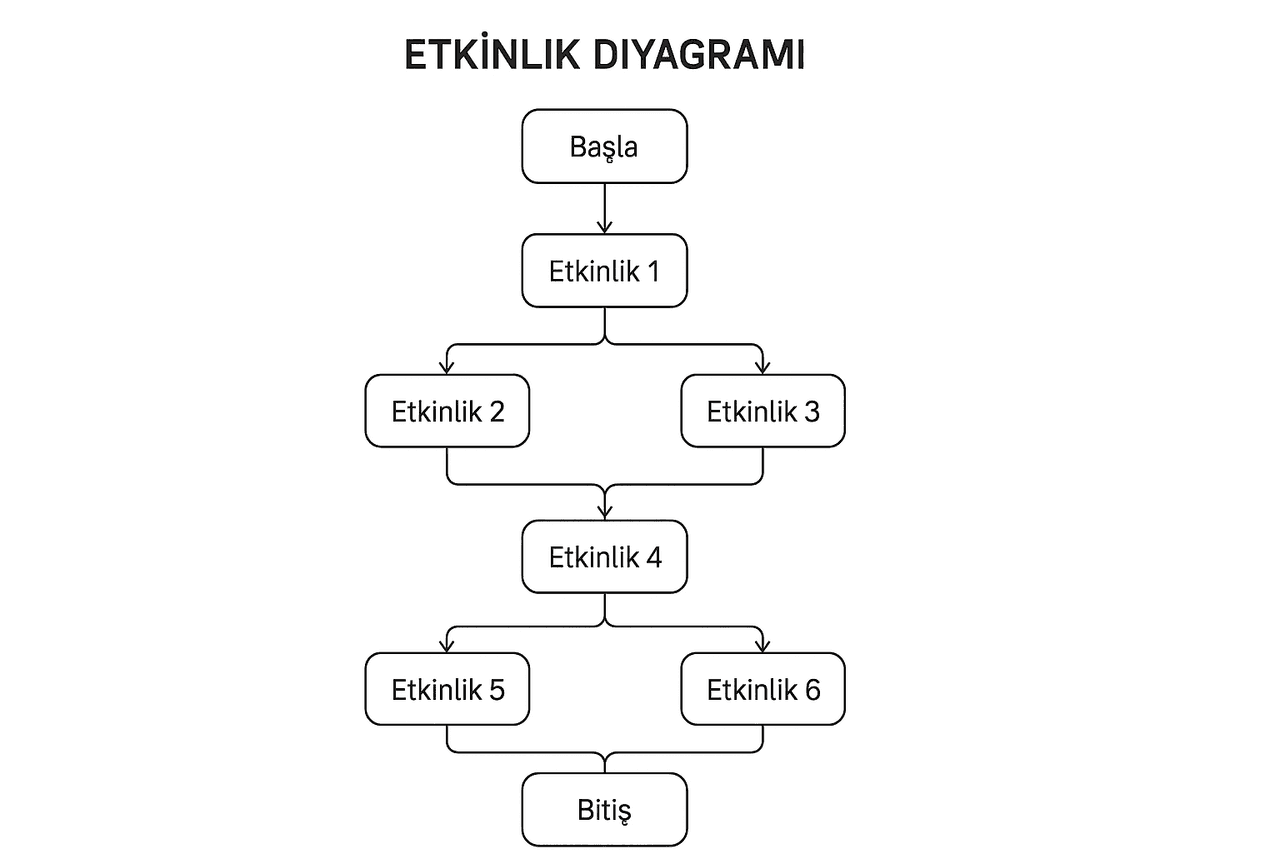
Example of an activity diagram (Generated by artificial intelligence.)
Used to model the states a single object can pass through during its lifecycle and the transitions between these states. For example a loan application may pass through states such as “Application Received” “Preliminarily Approved” and “Rejected”.
Shows how messages between objects occur in chronological order. It is used to document the step-by-step progression of an interaction.
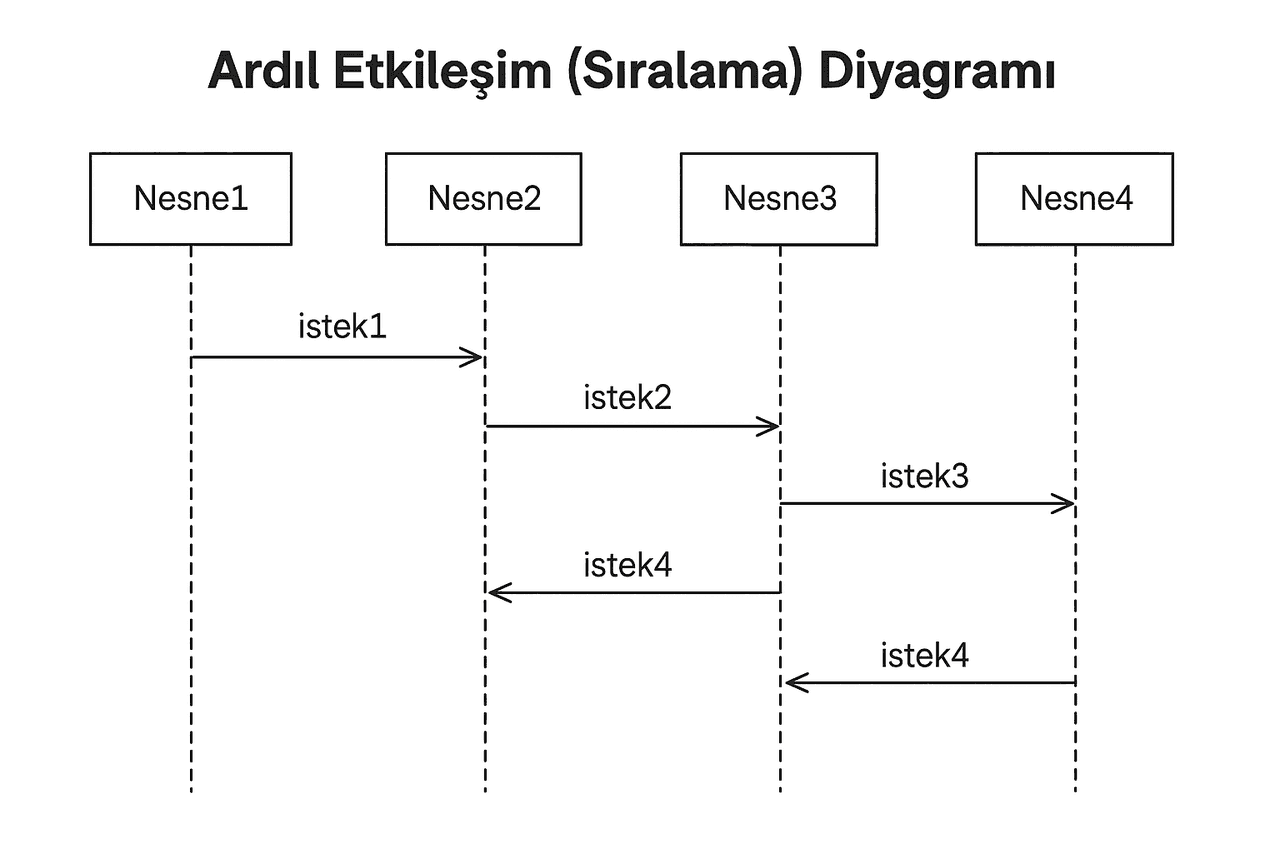
Example of a sequence diagram (Generated by artificial intelligence.)
Focuses on the flow of messages and the connections between objects. Similar to a sequence diagram but uses numbering instead of a time axis.
Shows state changes of objects within specific time intervals in real-time systems. For example the color change cycle of an LED light.
Represents complex interactions at a higher level using a general flow. It depicts interaction diagrams as nodes.
Unified Modeling Language does not contradict Agile development principles. On the contrary simplified and purpose-driven diagrams:
In Agile development:
Bell, Donald. "An Introduction to the Unified Modeling Language". IBM. Accessed July 8, 2025. Accessed Adresi.
Booch, Grady, Ivar Jacobson, and James Rumbaugh. "The unified modeling language." Unix Review 14, no. 13 (1996): 5. Accessed Adresi.
Geeksforgeeks. "Unified Modeling Language (UML) Diagrams". 2025. Accessed July 8, 2025. Accessed Adresi.
Jacobson, Ivar, Grady Booch, and James Rumbaugh. "The unified modeling language." University Video Communications (1996). Accessed Adresi.
Quatrani, Terry, and U. M. L. Evangelist. "Introduction to the Unified Modeling Language." A Technical Discussion of UML 6, no. 11 (2003): 03. Accessed Adresi.
Visual Paradigm. "What is Unified Modeling Language (UML)?" Accessed July 8, 2025. Accessed Adresi.
İstanbul Teknik Üniversitesi Bilgi İşlem Daire Başkanlığı. "Birleşik Modelleme Dili (UML)." Accessed July 8, 2025. Accessed Adresi.

Generated by artificial intelligence.
Unified Modeling Language (UML)
Definition(s) | UML (Unified Modeling Language) is a non-programming modeling language developed to design and make complex software systems understandable to stakeholders using a standard visual language. document | ||||||||
|---|---|---|---|---|---|---|---|---|---|
Purpose(s) | Reusability Common Language Visual Thinking Method Independent | ||||||||
Diagram Types | Interaction Diagrams Behavioral Diagrams Structural Diagrams | ||||||||
No Discussion Added Yet
Start discussion for "Unified Modeling Language (UML)" article
Historical Development of Unified Modeling Language
Purpose and Core Philosophy of Unified Modeling Language
Meta-modeling and Language Units
Object-Oriented Concepts in Unified Modeling Language
Types of Unified Modeling Language Diagrams
Structural Diagrams
Class Diagram
Object Diagram
Component Diagram
Composite Structure Diagram
Package Diagram
Deployment Diagram
Profile Diagram
Behavior Diagrams
Use Case Diagram
Activity Diagram
State Machine Diagram
Interaction Diagrams
Sequence Diagram
Communication Diagram
Timing Diagram
Interaction Overview Diagram
Benefits of Unified Modeling Language
Challenges in Unified Modeling Language
Unified Modeling Language and Agile Development