

This article was automatically translated from the original Turkish version.
+2 More
Location | Norway Vestland (former Sogn og Fjordane) on the eastern coast of Lustrafjorden Ornes | ||||||||
|---|---|---|---|---|---|---|---|---|---|
Construction Date(s) | the 1130s | ||||||||
Architectural Style(s) | Basilica-style stave church Urnes Style decorations Romanesque influences | ||||||||
UNESCO Status | 1979 World Heritage List | ||||||||
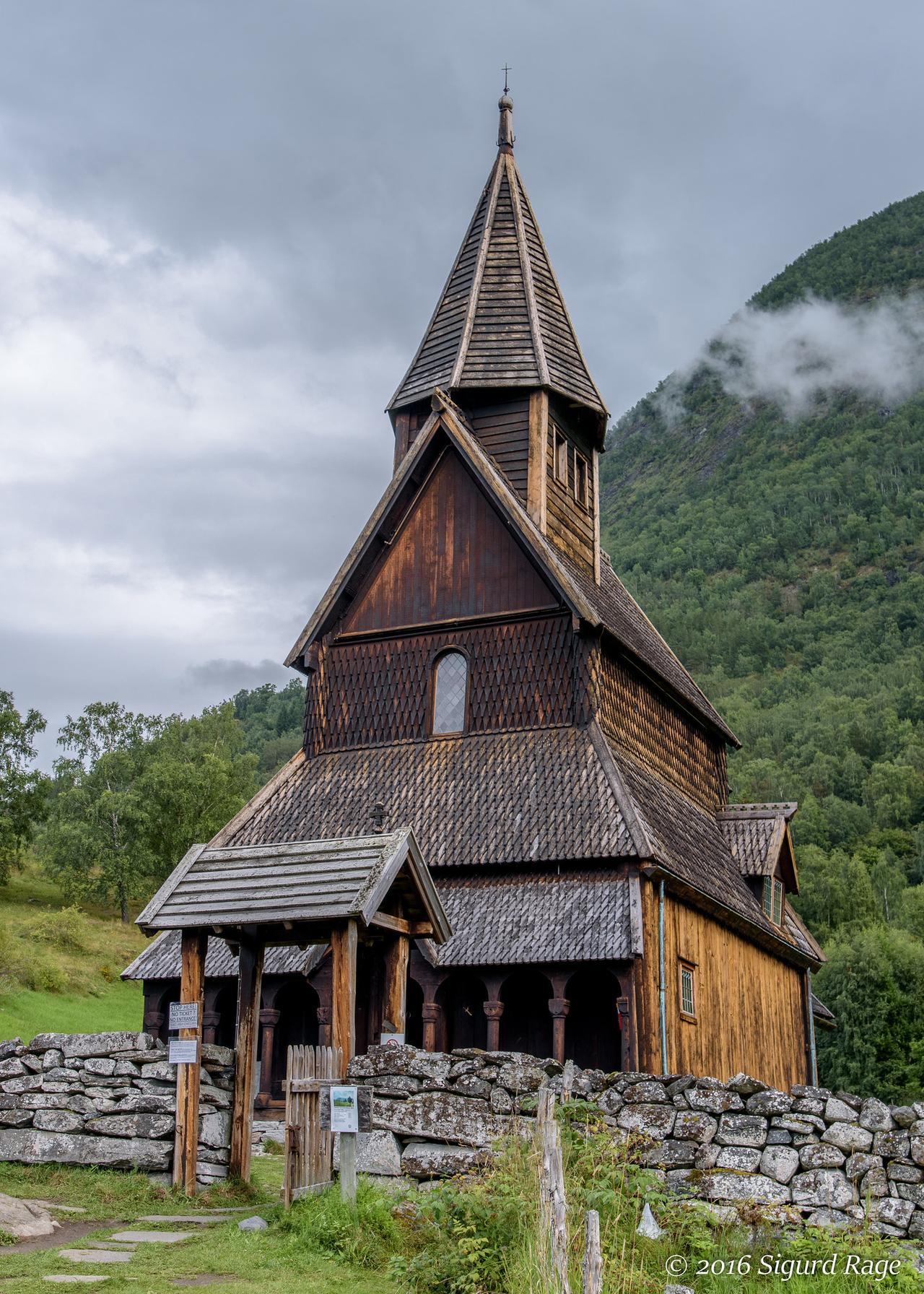
Urnes Stavkirke (Urnes Wooden Church) is a medieval wooden church located on the shores of Lustrafjorden in the village of Ornes, within the municipality of Luster in the Sogn og Fjordane region of western Norway. It was inscribed on the UNESCO World Heritage List in 1979 and is the only stavkirke (wooden stave church) on the list. Dating from the 1130s, the church is a cultural monument representing the fusion of Viking art and Christian medieval architecture. Among the 28 surviving Norwegian stavkirke, it is the oldest and most richly decorated.

Urnes Stavkirke (grosun)
Archaeological excavations and structural analyses indicate that the current Urnes Stavkirke is the fourth church built on the same site. The first church is believed to have been constructed in the early 1000s, coinciding with the initial spread of Christianity in the region. Excavations in the 1950s uncovered post holes and graves in the ground, confirming the existence of earlier churches.
The standing structure was built using timber felled between 1129 and 1132 according to dendrochronological analysis. It is thought to have been constructed as a private place of worship for a wealthy local family, reflecting the artistic tastes of the aristocracy. The church’s construction combines local carpentry traditions with influences from Romanesque architecture in Europe.
Following the Reformation in 1537, the church underwent modifications to align with Protestant traditions. In 1601, the choir was extended, and in the late 17th century, a new altar and pulpit were added. In 1881, the congregation was merged with that of Solvorn, and the building largely ceased to function as a place of worship. That same year, Fortidsminneforeningen (Norwegian Society for the Preservation of Ancient Monuments) took ownership and placed the church under modern conservation practices, a status it has maintained to the present day.

Urnes Stavkirke (Signe Karin)
Urnes Stavkirke follows a basilica plan, with a raised central nave flanked by side aisles. Fourteen wooden staves, supported by beams resting on a stone foundation, carry the roof through a complex jointing system. This technique is regarded as one of the most sophisticated examples of medieval wooden architecture. The steeply pitched roof was developed to accommodate Norway’s rainy climate.
The carvings on the north door represent a distinctive style known as the Urnes Style, associated with Viking art. This style features stylized animal figures, interwoven serpent-like creatures, and vegetal motifs. The carvings are dated to 1070–1080 and were likely transferred from an earlier church. The Urnes Style is not unique to this church; similar motifs appear on stone monuments and runic inscriptions in Sweden and the British Isles.
The interior layout of the church clearly reflects Romanesque architectural influence. Figures of centaurs, dragons, griffins, and deer on the column capitals are adaptations of motifs commonly found in medieval stone churches across Europe. This demonstrates that Urnes Stavkirke is not merely a product of local tradition but also a result of broader cultural exchanges across Europe.

Decorations on the North Door of Urnes Stavkirke (Astrid Westvang)
One of the church’s most striking features is the Calvary group located at the entrance to the choir. Dating to approximately 1150, this wooden sculpture depicts Christ on the cross flanked by the Virgin Mary and John the Baptist. It is considered one of the rare surviving examples of medieval wooden sculpture in Europe.
Some of the church’s original liturgical furnishings have survived to the present day. Enamelled bronze candlesticks from Limoges, an iron ship-shaped candlestick from the medieval period, an episcopal chair known as a “biskopstol,” and various icons are preserved. These artifacts reflect the international trade networks of the time: the Limoges candlesticks originated in France, while ultramarine pigment was obtained via the Silk Road.
The wall paintings dated to 1601 depict apostles, floral ornaments, and motifs influenced by the Baroque style. These paintings are typical examples of church decoration in Norway after the Reformation.
Urnes Stavkirke underwent extensive restoration in the late 19th and early 20th centuries. During interventions in the 1900s, later additions were removed, the roof was re-covered, and deteriorated facades were repaired.
Between 2001 and 2015, under the Stavkirke Conservation Program led by the Norwegian Directorate for Cultural Heritage, the church’s foundations were restructured, subsidence issues were addressed, and interior artworks were preserved. Particularly meticulous conservation work on the Calvary group ensured the preservation of its original form.
The church is equipped with an advanced fire suppression system to mitigate fire risk. Visitor numbers are also restricted to limit the pressure of mass tourism.

Urnes Stavkirke (karaian)
Urnes Stavkirke is a unique structure that unites the artistic sensibilities of the Viking Age with the theological symbols of Christian medieval Europe. UNESCO designated it a World Heritage Site based on three primary criteria:
Through these characteristics, Urnes Stavkirke holds a central position both in Norway’s national identity and in the world’s cultural heritage.
Urnes Stavkirke is a multi-layered monument that has endured for nearly nine centuries, integrating cultural, religious, and artistic traces from different eras. With its architectural structure, Urnes Style carvings, preserved liturgical furnishings, and universally recognized value as designated by UNESCO, it is regarded not only as Norway’s heritage but as the shared heritage of the entire world.
Today, Urnes Stavkirke is not an active parish church; however, limited religious ceremonies are still held during the summer months. Due to its UNESCO World Heritage status, it is under strict protection by both the Norwegian government and Fortidsminneforeningen (Norwegian Society for the Preservation of Ancient Monuments). Climate change, fire risk, and intensive tourism pressure are among the main factors increasing the building’s vulnerability.
Anker, Leif and Stephan Tschudi-Madsen. “Urnes stavkirke.” *Store norske leksikon*. Accessed October 3, 2025. https://snl.no/Urnes_stavkirke
Anne. "How to visit UNESCO-listed Urnes Stave Church." *Heritage Wanderlust*. Accessed October 3, 2025. https://heritagewanderlust.com/visit-urnes-stave-church/
Astrid Westvang. “Urnes Stave Church (detail).” Flickr. Accessed October 3, 2025. https://www.flickr.com/photos/astrid/3885912379
Fjord Norway. "UNESCO Urnes Stave Church." Accessed October 3, 2025. https://www.fjordnorway.com/en/attractions/unesco-urnes-stave-church
Fortidsminneforeningen. "Urnes Stave Church." Accessed October 3, 2025. https://fortidsminneforeningen.no/en/museum/urnes-stave-church/
Fox, Felicity. “Urnes Stave Church.” Building Conservation. Accessed October 3, 2025. https://www.buildingconservation.com/articles/urnes-stave-church/urnes-stave-church.html
Karin, Signe. “Eidsborg stave church.” Flickr. Accessed October 3, 2025. https://www.flickr.com/photos/signe_karin/7712986794/
Rage, Sigurd. “Urnes Stavkirke.” Flickr. Accessed October 3, 2025. https://www.flickr.com/photos/sigurdr/28082746784
Skjolden. “Urnes Stave Church.” Accessed October 3, 2025. https://skjolden.com/en/urnes-stave-church/
Stavechurch.com. "Urnes Stave Church." Accessed October 3, 2025. https://www.stavechurch.com/urnes-stave-church/?lang=en
UNESCO World Heritage Centre. “Urnes Stave Church.” Accessed October 3, 2025. https://whc.unesco.org/en/list/58/
Visit Norway. "Urnes Stave Church." Accessed October 3, 2025. https://www.visitnorway.com/listings/urnes-stave-church/5326/
grosun. "Urnes stave church." Flickr. Accessed October 3, 2025. https://www.flickr.com/photos/grosun/2740351018
karaian. “Urnes stave church.” Flickr. Accessed October 3, 2025. https://www.flickr.com/photos/karaian/3280059802

Location | Norway Vestland (former Sogn og Fjordane) on the eastern coast of Lustrafjorden Ornes | ||||||||
|---|---|---|---|---|---|---|---|---|---|
Construction Date(s) | the 1130s | ||||||||
Architectural Style(s) | Basilica-style stave church Urnes Style decorations Romanesque influences | ||||||||
UNESCO Status | 1979 World Heritage List | ||||||||
Historical Background
Previous Churches
Construction in the 12th Century
The Middle Ages and Beyond
Architectural Structure
Plan and Structural System
Urnes Style
Romanesque Influences
Interior and Artistic Works
Carvings and Sculptures
Liturgical Objects
Wall Paintings
Conservation Efforts
Historical Restorations
Modern Conservation Program
Current Conservation Measures
Cultural and Universal Significance
Current Status