

 Recently Added:
This article was automatically translated from the original Turkish version.
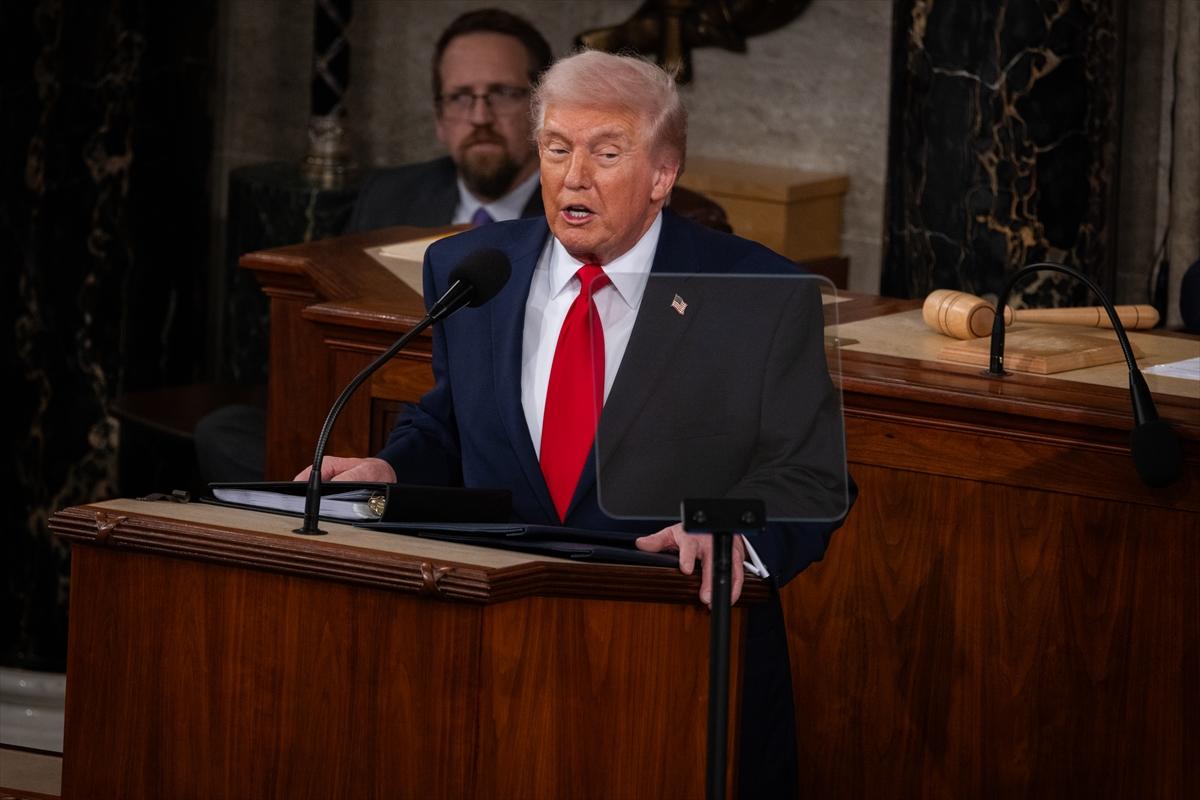
The State of the Union Address of 2026 was delivered on February 24 2026 by United States President Donald Trump before a joint session of Congress. The speech marked Trump’s first comprehensive State of the Union address from the congressional podium during his second term. Lasting approximately 108 minutes it became the longest State of the Union address in modern American political history.
The address was held under high security measures with attendance from members of the House of Representatives and the Senate. During the session the president assessed the performance of his administration’s first term and comprehensively addressed issues including the economy immigration public safety foreign policy and trade. The tone of the speech carried a strong character of political mobilization and direct appeal to the party base.
Throughout the address Republican members frequently applauded while Democratic members remained silent in parts and at times voiced protests and verbal objections. This dynamic underscored that the address was not merely an administrative briefing but also a highly partisan political platform.
The economy formed the largest segment of the address. President Trump stated that the American economy had regained momentum inflation rates had declined and energy prices had fallen. He highlighted increased production of oil and natural gas and emphasized that the goal of energy independence had been strengthened.
Trump noted rising stock market indices and low unemployment rates. He underscored the revival of the manufacturing sector the attraction of industrial investment back into the country and the return of American production. He announced that new tax reforms and investment incentives would continue.
Policies aimed at reducing healthcare expenditures and lowering drug prices were also addressed. The president stated that cost control mechanisms within the federal healthcare system had been strengthened and argued that the tax burden on the middle class and above should be eased.
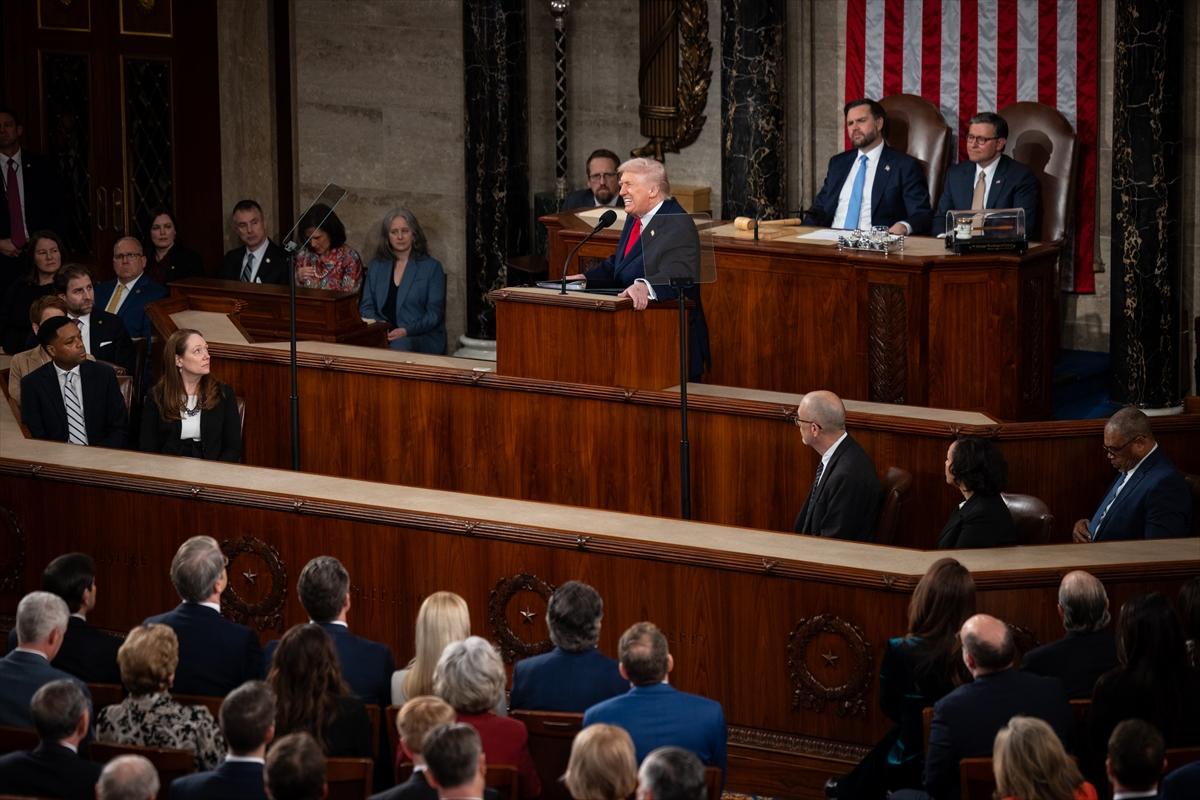
Trump’s State of the Union Address. February 24 2026 (Anadolu Ajansı)
Immigration and border security were among the most forceful and intensively emphasized topics of the address. Trump asserted that irregular crossings at the southern border posed a threat to national security and announced that federal security forces were now operating more effectively along the border.
The president cited examples of immigrant-related crimes to argue for enhanced border control. He called on Congress to enact stricter immigration laws and stressed the need to expand funding for border wall projects and border patrols. He also indicated that some asylum applications would be resolved through expedited procedures.
Regarding domestic security the administration announced increased resource allocation to federal law enforcement agencies and the continuation of stringent policies to maintain public order in cities. The president emphasized that public safety was the government’s top priority.
Trump devoted a substantial portion of the speech to foreign trade policy. He stated that reciprocity would be the guiding principle in trade relations with China and certain European countries. He announced the imposition of new tariffs to reduce trade deficits he claimed were harming the United States.
The president indicated that import tariffs could be raised to protect American industry and that policies promoting domestic production would be expanded. He specified that safeguarding the automotive steel and technology sectors held strategic importance.
The speech also linked trade policy to national security. It was stated that critical supply chains must be established within the United States and that dependence on foreign sources for semiconductors defense technologies and energy infrastructure must be eliminated.
In the foreign policy section the address addressed Iran the Middle East and global security. Trump expressed concerns regarding Iran’s nuclear activities and stated that diplomacy and deterrence would be pursued in tandem.
He also stated that relations with U.S. allies would be redefined and that a foreign policy centered on national interests would be pursued. The president emphasized that America’s interests would take precedence in international agreements.
Regarding the war in Ukraine and global conflicts Trump stated that wars must be brought to an end and argued that the United States must avoid unnecessary financial burdens. However no detailed military plans or new strategic doctrines were announced in this section.
Special emphasis was placed on the United States Armed Forces during the address. The president stated that the defense budget would remain strong and that modernization of the military would continue. Investment in new defense technologies was also announced.
The speech included plans to expand defense industry capacity strengthen domestic production and improve military personnel benefits. The president announced that support programs for veterans would be expanded.
It was stated that military power plays a central role in both foreign policy and deterrence strategy. However no new military operations were directly announced.
Throughout the address Republican members frequently stood to applaud while Democratic members remained silent in many sections or expressed protest-like reactions. The segments on immigration and trade policy were the moments of most intense partisan tension.
Democratic Party representatives argued after the speech that economic data had been selectively presented and claimed that social policies had been weakened. The Republican wing evaluated the address as a strong demonstration of leadership.
BBC News. “Trump hails economy and threatens Iran in longest-ever State of the Union.” Accessed February 25, 2026. https://www.bbc.com/news/live/ce3g0epn6gdt
BBC Türkçe. "Trump'tan Kongre'de rekor konuşma ve İran'a mesaj: 'Tercihim diplomasi'." Accessed February 25, 2026. https://www.bbc.com/turkce/articles/clyx1lex85yo
Deutsche Welle. “Trump Birliğin Durumu konuşmasında hangi mesajları verdi?” DW. Accessed February 25, 2026. https://www.dw.com/tr/trump-birliğin-durumu-konuşmasında-hangi-mesajları-verdi/a-76112667
Euronews Türkçe. "Trump'tan Kongre'de en uzun konuşma: İran'ı uyardı, göçmen politikalarını ve vergileri savundu." Euronews. Accessed February 25, 2026. https://tr.euronews.com/2026/02/25/trump-en-uzun-ulusa-seslenis-konusmasinda-gocmenlere-yonelik-baskilari-ve-gumruk-vergileri
Reuters. “Takeaways from Trump’s State of the Union address to Congress.” Accessed February 25, 2026. https://www.reuters.com/legal/government/takeaways-trumps-state-union-address-congress-2026-02-25/
Reuters. “Trump delivers longest State of Union speech in history - as it happened.” Accessed February 25, 2026. https://www.reuters.com/world/state-union-live-updates-trump-address-congress-2026-02-24
The Guardian. “Trump delivers longest-ever State of the Union address – as it happened.” The Guardian. Accessed February 25, 2026. https://www.theguardian.com/us-news/live/2026/feb/24/trump-state-of-the-union-address-congress-watch-updates

U.S. President Donald Trump, in a 108-minute State of the Union address delivered to Congress on February 24, 2026, highlighted economic immigration and trade policies. Trump stated that border security would be strengthened new customs duties could be implemented and defense spending would be increased. The speech was marked by partisan tensions in the congressional chamber.
No Discussion Added Yet
Start discussion for "U.S. President Trump's State of the Union Address to Congress" article
February 25, 2026
Economic Policies and Fiscal Priorities
February 25, 2026
Immigration Policy and Domestic Security
February 25, 2026
Trade Policy and Tariffs
February 25, 2026
Foreign Policy and International Relations
February 25, 2026
Military Emphasis and Defense Policies
February 25, 2026
Congressional Reactions and Political Atmosphere