This article was automatically translated from the original Turkish version.
Location | Muğla Türkiye Fethiye | ||||||||
|---|---|---|---|---|---|---|---|---|---|
Geological Structure | Karstic limestone formations, Mesozoic-Cretaceous period rocks | ||||||||
Climate(s) | Mediterranean climate | ||||||||
Vegetation | Mediterranean shrubland species (olive, myrtle, strawberry tree, bay laurel, sandalwood) | ||||||||
Important Fauna | Charaxes jasius, Papilio machaon and other butterfly species, reptiles, raptors | ||||||||
Tourism Type | Ecotourism, nature walking, camping, birdwatching | ||||||||
Butterfly Valley is a significant natural area located within the boundaries of Fethiye district in Muğla Province in southwestern Türkiye, renowned for its unique geographical structure and rich biological diversity. The valley has acquired its name, “Butterfly Valley,” due to the numerous butterfly species it harbors. This valley presents the appearance of a narrow canyon, surrounded by high and steep cliffs, opening toward the sea. Formed naturally over centuries, the valley hosts not only endemic and rare plant species but also approximately 100 different butterfly species. In particular, the tiger moth (Euplagia quadripunctaria) is one of the valley’s symbolic species and is observed in dense populations during specific periods. In addition to being an important center for biodiversity, Butterfly Valley is also the subject of scientific research due to its natural beauty and protected status. The conservation of the valley is of great importance for maintaining ecological balance and ensuring the transmission of the region’s natural heritage to future generations.

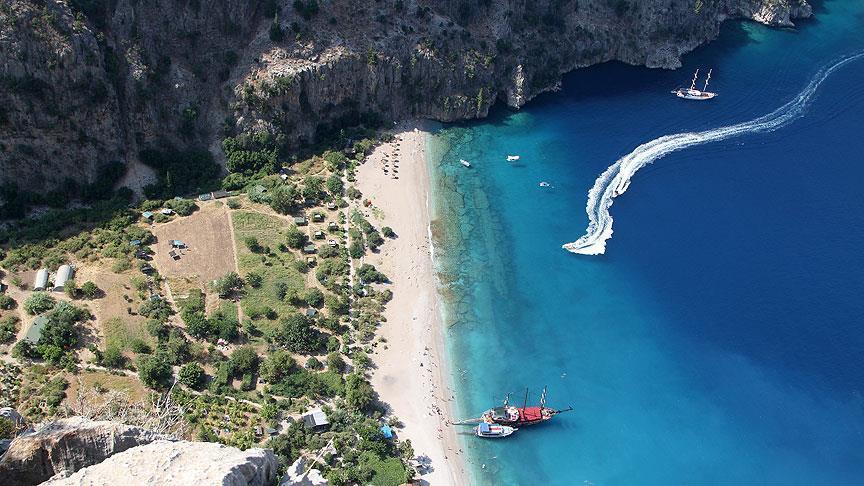
Butterfly Valley View from the Sea (Pexels)
Butterfly Valley is situated at the foot of Babadağ, an extension of the Western Taurus Mountains, in an area dominated by limestone terrain. The valley’s formation is explained by a combination of karstic processes and tectonic movements characteristic of the Mediterranean region over geological time. The erosion of limestone by external agents such as rain and wind has resulted in the formation of deep, narrow canyons. The valley’s overall morphology is characterized by steep north- and south-facing slopes reaching depths of approximately 350 to 400 meters. The valley floor has been shaped by a stream fed by Babadağ, which flows along the valley and empties into the sea. The stream’s flow varies throughout the year and makes a significant contribution to the valley’s ecosystem. While the valley’s entrance opens to the sea via a small sandy beach, its inner sections contain waterfalls and small pools.
The valley’s geological structure consists of Permian-Triassic limestone, dolomite, and locally marbleized limestone. These rock types, due to their solubility and susceptibility to erosion, have provided favorable conditions for the formation of karstic features such as caves, sinkholes, and dolines. The steep and rugged cliffs surrounding the valley also serve as habitats for alpine plant species and certain bird species. The valley’s microclimate is mild due to its protection from winds by surrounding high mountains and its proximity to the sea. This condition is a crucial factor supporting the diversity of plant and animal life within the valley. Soil composition varies: alluvial near the stream bed and rocky and calcareous on the slopes, influencing the distribution of vegetation. The valley’s geomorphological formation has created an ideal environment for the development of biological diversity in the region. The geological and geomorphological details of the valley are examined in greater depth in studies by Mehmet Karaca and Levent Köse on the geomorphological characteristics of the Fethiye-Ölüdeniz Special Environmental Protection Area. These studies provide scientific evidence for how the valley acquired its current form through tectonic activity and erosion processes.
Butterfly Valley holds significant ecological importance due to its rich biodiversity. Its most well-known feature is its butterfly species, after which it is named. Research conducted throughout the valley has revealed the presence of nearly 100 different butterfly species. Among these, the tiger moth (Euplagia quadripunctaria), an endemic species of Anatolia, stands out. Tiger moths are typically observed in dense populations at the end of July and beginning of September. These butterflies seek the valley’s cooler and more humid areas, particularly along stream banks and near waterfalls, to escape the heat and rest. The larvae of this species feed primarily on herbaceous plants and shrubs, while adult moths feed on nectar. The presence of this species in the valley is an important indicator of its ecological health. Research by Ahmet Sari and Mehmet Ali Yıldırım has provided detailed analyses of the valley’s macrolepidoptera fauna and comprehensive data on the diversity of butterfly species in the region, scientifically confirming the valley’s role as a primary habitat for butterflies.
In addition to butterfly species, Butterfly Valley supports a rich vegetation cover. The valley’s microclimate allows not only for the typical Mediterranean maquis vegetation but also for the survival of certain endemic and rare species. Along the valley floor, influenced by water sources, moisture-loving plants such as oriental plane tree (Platanus orientalis), oriental sweetgum (Liquidambar orientalis), and oleander (Nerium oleander) thrive, while on the slopes, more drought-resistant species such as strawberry tree (Arbutus andrachne), strawberry tree (Arbutus unedo), and olive tree (Olea europaea) are found. Furthermore, certain areas of the valley have been identified as habitats for endemic plant species unique to this region and of significant importance for scientific research. These plant species contribute to the functioning of the ecosystem by serving as food sources for butterflies and other organisms.
The valley’s fauna is not limited to butterflies. Various bird species, particularly raptors, use the valley’s steep slopes and cliffs as nesting sites. The valley is also home to a variety of reptiles and amphibians. In particular, aquatic insects and larvae in the stream bed further enhance the valley’s ecological diversity. Butterfly Valley is an important area recognized for its biodiversity and holds national and international protected status. The area has been designated as a Class I Natural Site, subject to strict restrictions on construction and human activities. Maintaining the valley’s ecological balance is vital for the sustainability of species diversity and the continuity of natural processes.
Butterfly Valley has been placed under protection due to its unique natural beauty and biological diversity. In 1995, the Republic of Türkiye Ministry of Environment and Urbanization designated the valley as a Class I Natural Site. This status represents the highest level of protection, aiming to preserve the valley’s natural structure and ecosystem without degradation. Conservation of the area is of critical importance for safeguarding the habitats of endemic and rare species living in the valley, particularly the tiger moth. In accordance with its protected status, new construction, mining, agricultural activities, and other human activities that could negatively impact the environment are prohibited. The Republic of Türkiye Ministry of Environment, Urbanization and Climate Change’s “Regulation on Special Environmental Protection Areas” establishes the legal framework for conservation principles and restrictions in such areas.
The valley’s sustainability is ensured through the preservation of ecological balance and the controlled implementation of ecotourism activities. Opening the valley to visitors not only contributes economically to the region but also has the potential to raise awareness about the natural environment. However, uncontrolled tourism, particularly high visitor density, can damage the valley’s fragile ecosystem. Therefore, it is necessary to promote activities in and around the valley that adhere to eco-tourism principles. Specific trails and rules have been established to allow visitors to explore the natural environment with minimal impact. For example, visitors are required to avoid making noise in areas where butterflies rest, refrain from littering, and not damage the vegetation. These are fundamental principles that visitors must follow. Articles by Emine Güler on conservation efforts in Türkiye’s important natural areas examine the impacts and benefits of sustainable tourism practices on such sensitive ecosystems.
Scientific research and monitoring activities play a major role in conservation efforts. Studies conducted by universities and research institutions in the valley provide valuable data on butterfly population trends, vegetation conditions, water quality, and other ecological parameters. This information is used to determine conservation strategies and evaluate the effectiveness of existing measures. For instance, fluctuations in tiger moth populations can offer important insights into the overall ecological health of the valley. Additionally, increasing environmental awareness among local communities and involving them in conservation efforts is critical for sustainability. The understanding by local residents that the protection of the valley is essential for their own economic and social well-being is a primary condition for the success of conservation initiatives. The long-term preservation of Butterfly Valley will be possible through science-based management plans, effective monitoring mechanisms, and the participation of all stakeholders. This integrated approach will serve as the foundation for transmitting the valley’s natural and biological richness to future generations.
"Kelebekler Vadisi." Accessed July 3, 2025. https://www.aa.com.tr/tr/yasam/kelebekler-vadisine-terlikle-degil-ekipmanla-gelin/892678
"Kelebekler Vadisi." Accessed July 3, 2025. https://www.pexels.com/tr-tr/fotograf/32504056/
"Kelebekler Vadisi." CNN Türk Seyahat. "Muğla Fethiye Kelebekler Vadisi: Cennetten Bir Köşe! Nasıl Gidilir, Nereler Gezilmeli?" Accessed July 3, 2025. https://www.cnnturk.com/seyahat/galeri/mugla-fethiye-kelebekler-vadisi-cennetten-bir-kose-nasil-gidilir-nereler-gezilmeli-2120138
"Kelebekler Vadisi."Muğla İl Directorate of Culture and Tourism. Accessed July 3, 2025.
Aydın, Cansu. "Fethiye Kelebekler Vadisi." TÜBİTAK Bilim Genç. Accessed July 3, 2025. https://bilimgenc.tubitak.gov.tr/makale/fethiye-kelebekler-vadisi

Location | Muğla Türkiye Fethiye | ||||||||
|---|---|---|---|---|---|---|---|---|---|
Geological Structure | Karstic limestone formations, Mesozoic-Cretaceous period rocks | ||||||||
Climate(s) | Mediterranean climate | ||||||||
Vegetation | Mediterranean shrubland species (olive, myrtle, strawberry tree, bay laurel, sandalwood) | ||||||||
Important Fauna | Charaxes jasius, Papilio machaon and other butterfly species, reptiles, raptors | ||||||||
Tourism Type | Ecotourism, nature walking, camping, birdwatching | ||||||||
No Discussion Added Yet
Start discussion for "Valley of Butterflies" article
Geographical Features and Formation
Biodiversity and Ecological Importance
Conservation and Sustainability