This article was automatically translated from the original Turkish version.
+1 More
Registration Date | 23 November 2017 | ||||||||
|---|---|---|---|---|---|---|---|---|---|
Applicant/Registrant(s) | Van Chamber of Commerce and Industry | ||||||||
Geographical Boundary | Van Province | ||||||||
Product / Product Group(s) | Handicraft products other than carpets kilims and textiles | ||||||||
Geographical Indication Type(s) | Place of origin | ||||||||
Registration Number | 242 | ||||||||
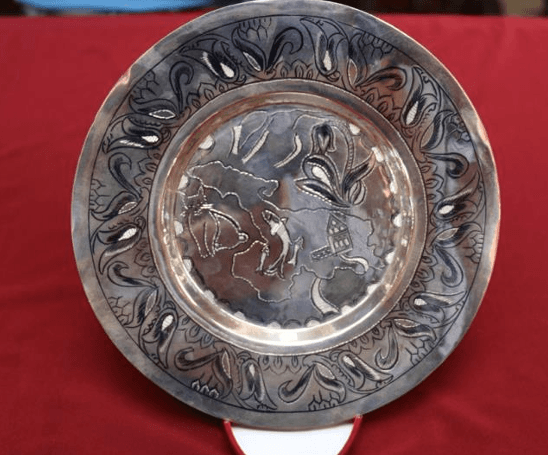
Van Savatlı Gümüş İşlemesi is a traditional craft that involves applying a mixture known as savat onto a silver surface. Savat is a black compound made by combining lead, silver, copper, and sulfur; it derives its name from the Arabic word “esvad” (black), which over time evolved into “savat.” The savat technique has been used on a variety of items including cigarette holders, tobacco trays, horse saddles, prayer beads, and jewelry.
Archaeological findings indicate that the savat technique has been in use since the Chalcolithic Age. Between 1350 and 900 BCE, it was applied by the Urartian and Hurrian civilizations. It is believed to have been introduced to Anatolia through Turkic groups from the Caspian region. During the Ottoman period, savat craftsmanship enjoyed a golden age lasting approximately 150 years, particularly in the decoration of weapons and valuable objects. In the provinces of Van and Diyarbakır, artisans were granted the authority to stamp silver of 900 fineness with the imperial cipher (tughra); before World War I, around 400 savat masters and apprentices were active in Van.

Van Savatlı Gümüş İşlemesi (Turkish Patent and Trademark Office)
Van Savatlı Gümüş İşlemesi is applied to handicraft items other than carpets, kilims, and textiles. When applying savat, silver of less than 900 fineness is not used; the ideal fineness is 950. The savat material is applied onto the silver surface using fine-tipped steel styluses to create intricate motifs and patterns.
Van Savatlı Gümüş İşlemesi consists of four stages:
Main tools used include melting crucibles, steel-tipped styluses, pliers, tweezers, hammers, anvils, files, milling bits, clamps, polishing motors, and wire brushes.
Van Savatlı Gümüş İşlemesi was registered for protection under Law No. 6769 on Industrial Property on 23 November 2017, effective from 28 July 2017 (Registration No: 242, Application No: C2017/071). Production is monitored by a commission composed of representatives from the Van Chamber of Commerce and Industry, Van Yüzüncü Yıl University Vocational School, the Provincial Directorate of Culture and Tourism, and the Directorate of Public Education. Inspections are carried out during production, marketing, and sales stages; artisans’ documentation, materials used, and production methods are verified.
Van Savatlı Gümüş İşlemesi is produced exclusively within the boundaries of Van Province and may only be marked with the “Van” stamp. Today, production continues in four workshops in Van and is also in demand on international markets.
Ministry of Culture and Tourism. "Van Savat Silver Crafting." Kültür Portalı. Accessed August 16, 2025. https://www.kulturportali.gov.tr/turkiye/van/kulturatlasi/savat-gumus-slemeclg
Turk Patent and Trademark Office. "Van Savatlı Gümüş İşlemesi – Coğrafi İşaret Detay." Turk Patent and Trademark Office. Accessed August 16, 2025. https://ci.turkpatent.gov.tr/cografi-isaretler/detay/38300
Türk Patent ve Marka Kurumu. "Van Savatlı Gümüş İşlemesi – Coğrafi İşaret Dosyası." PDF. Accessed August 16, 2025. https://ci.turkpatent.gov.tr/Files/GeographicalSigns/b61585f5-0145-42e2-aafe-418b5dceb570.pdf

Registration Date | 23 November 2017 | ||||||||
|---|---|---|---|---|---|---|---|---|---|
Applicant/Registrant(s) | Van Chamber of Commerce and Industry | ||||||||
Geographical Boundary | Van Province | ||||||||
Product / Product Group(s) | Handicraft products other than carpets kilims and textiles | ||||||||
Geographical Indication Type(s) | Place of origin | ||||||||
Registration Number | 242 | ||||||||
No Discussion Added Yet
Start discussion for "Van Savatlı Silverwork" article
Products and Distinctive Features
Used Motifs
Production Method
Monitoring and Protection
Geographical Boundary and Usage