
This article was automatically translated from the original Turkish version.
Veil Nebula (NGC 6960), is a large and diffuse supernova remnant located within the Cygnus constellation. It is estimated that the supernova explosion occurred approximately 8,000 years ago. Its visibility, due to its bright filamentary structures and extensive coverage of the sky, makes it particularly significant for astronomers. First discovered in 1784 by William Herschel, the Veil Nebula was later included in 19th-century expanded sky catalogs. Modern observations have been conducted using the Hubble Space Telescope, Spitzer, Chandra, and numerous ground-based observatories.
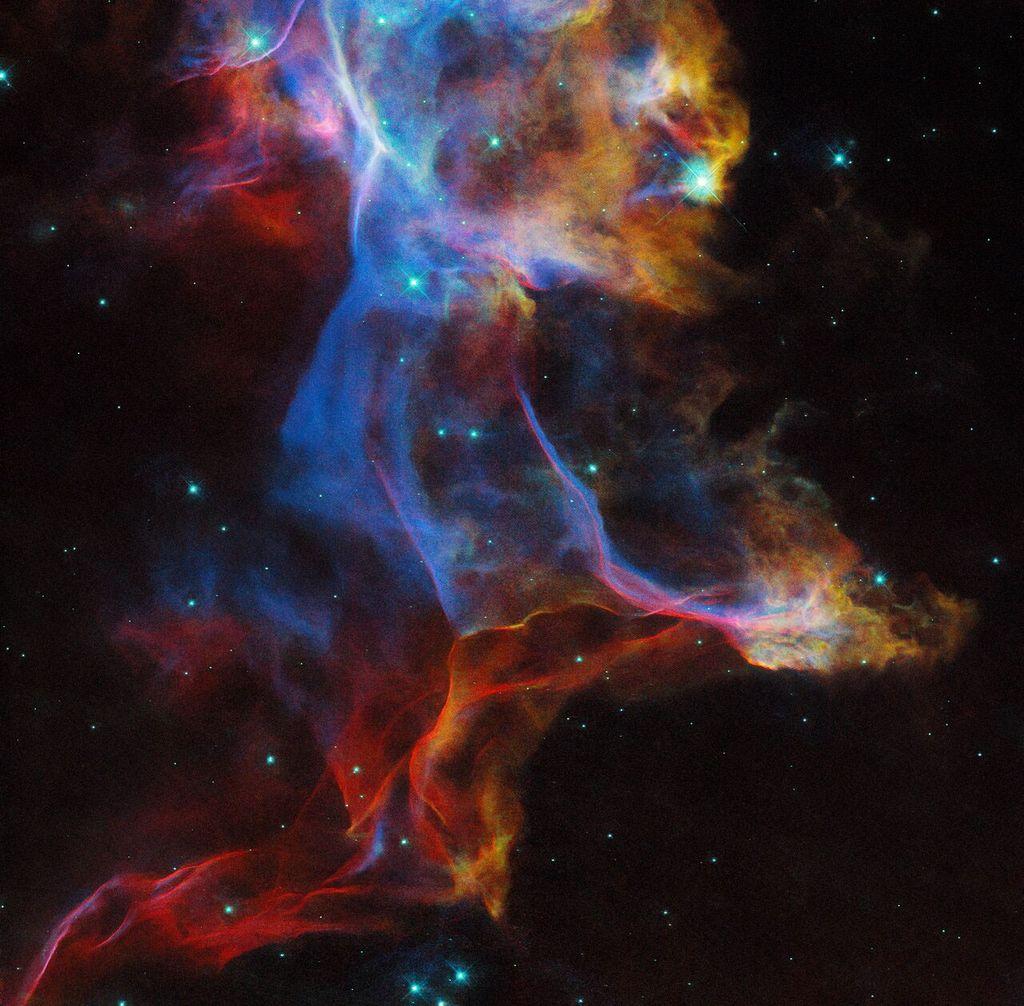
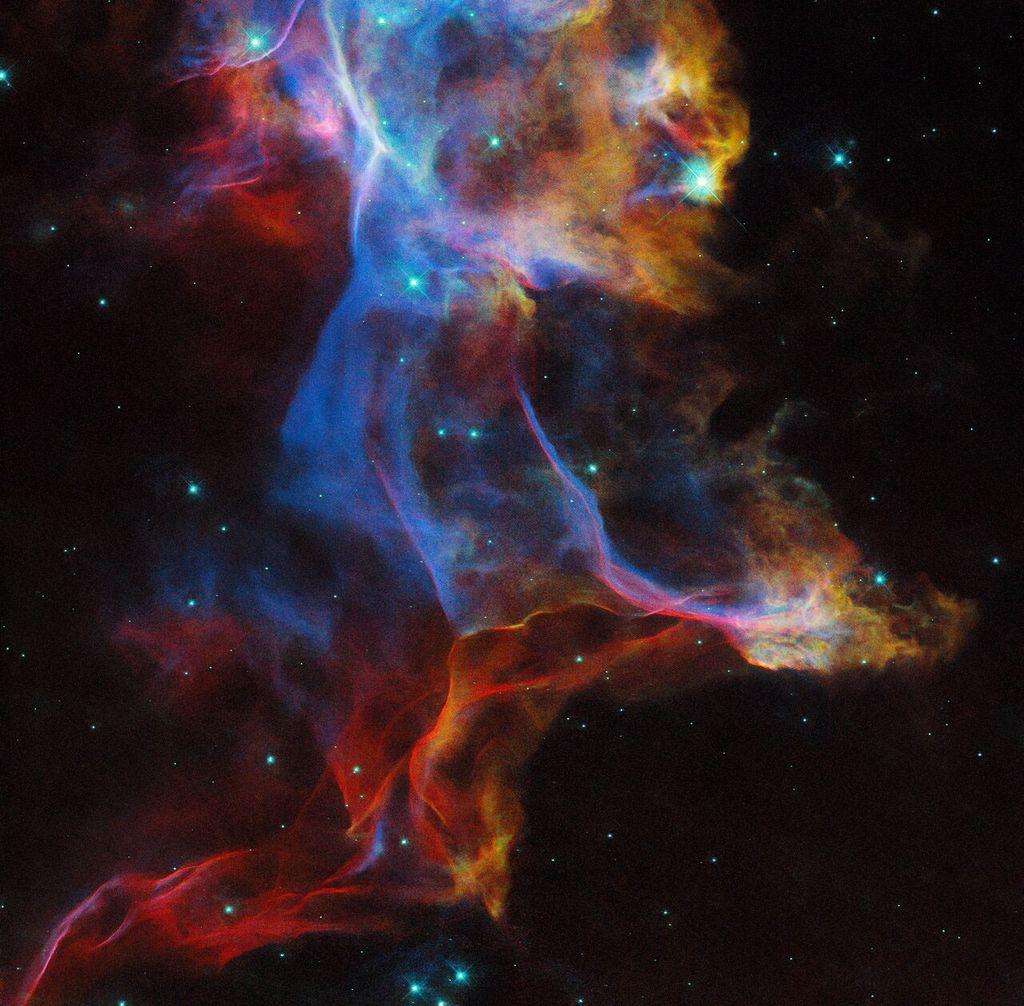
Veil Nebula (NASA)
Known as the Veil Nebula, NGC 6960 (also called the Western Fragment or Witch’s Broom Nebula) is part of a larger structure that includes NGC 6992 and NGC 6995 (the Eastern Fragment) and IC 1340, each identified by different catalog designations, all located within the Cygnus constellation. This nebula, situated approximately 2,400 light years from Earth, is a type of supernova remnant (SNR). Spanning a vast area of about 110 light years in diameter, it has an apparent magnitude of around 7.0, making it a popular deep-sky target observable with amateur telescopes.
The Veil Nebula formed as a result of the interaction between an expanding supernova shock wave and the interstellar medium. It is believed to have originated from the supernova explosion of a massive star with a mass approximately 20 times that of the Sun at the end of its life cycle. The shock waves left behind after the explosion collided with surrounding gas and dust, creating ionized gas filaments.
The Veil Nebula consists of several distinct cataloged components:
Formation of the Veil Nebula. (ESA YouTube)
The Veil Nebula is a supernova remnant composed of gas and dust left over from a supernova explosion. Located approximately 2,400 light years away, the nebula extends across a region about 110 light years in diameter. The explosion is estimated to have occurred between 8,000 and 10,000 years ago, and the remnant continues to expand today at a rate of approximately 1,500 kilometers per second. With an apparent magnitude of around +7.0, the Veil Nebula is observable in detail not only in optical light but also in X-ray, ultraviolet, and radio wavelengths. Prominent elements detected within the nebula include oxygen, hydrogen, and sulfur.
The Veil Nebula is the remnant of a supernova explosion thought to have occurred between 8,000 and 10,000 years ago. This vast nebula is currently expanding at a rate of about 1,500 kilometers per second and covers an area of approximately 3 degrees across the sky, equivalent to about sixty times the diameter of the full Moon. The gas within the nebula prominently features ionized forms of hydrogen (H), oxygen (O), and sulfur (S). In optical wavelengths, the Veil Nebula shines brightly through strong emission lines of hydrogen-alpha (H-alpha), oxygen ([O III]), and sulfur ([S II]), making it a prominent object of study for both professional astronomers and amateur observers.
Due to its low surface brightness, the Veil Nebula cannot be seen with the naked eye; however, under dark sky conditions it can be observed in detail using binoculars with wide fields of view or telescopes equipped with narrowband filters. Observations using [O III] filters particularly highlight the bright greenish emission lines of ionized oxygen.
The Veil Nebula serves as an important example for studying the interaction between supernova shock waves and the interstellar medium. Many astrophysical processes, such as how post-supernova shocks affect molecular gas, how chemical elements are dispersed, and how the interstellar medium is reshaped, are investigated through this nebula. Additionally, high-energy X-ray and ultraviolet observations have provided valuable insights into the evolution of supernova remnants.
"Hubblecast 07: Uncovering the Veil Nebula." ESA/Hubble. Accessed July 16, 2025. https://www.youtube.com/watch?v=EB7EK9d6juM.
NASA. "Compass and Scale Image of Veil Nebula." *NASA Science.* Accessed July 16, 2025. https://science.nasa.gov/asset/hubble/compass-and-scale-image-of-veil-nebula/.
NASA. "Hubble Captures New View of Colorful Veil Nebula." *NASA Science.* Accessed July 16, 2025. https://science.nasa.gov/missions/hubble/hubble-captures-new-view-of-colorful-veil/.
NASA. "Veil Nebula." *NASA Science.* Accessed July 16, 2025. https://science.nasa.gov/image-detail/hs-2015-29-a-xlarge_web/.
NASA. "Veil Nebula." *NASA Science.* Accessed July 16, 2025. https://science.nasa.gov/image-detail/veil-nebula/.

No Discussion Added Yet
Start discussion for "Veil Nebula (NGC 6960)" article
General Information
Formation and Structure
Technical Characteristics
Physical Characteristics
Observability and Scientific Significance