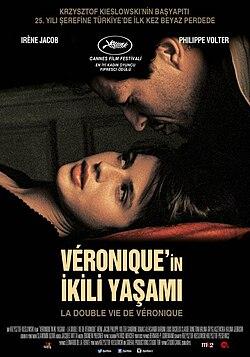
This article was automatically translated from the original Turkish version.
Original Title | The Double Life of Véronique | ||||||||
|---|---|---|---|---|---|---|---|---|---|
Type(s) | A modern narrative with drama and romantic elements mystery | ||||||||
Country / Languages | France–Poland co-production; in French and Polish | ||||||||
Year / Duration | 1991; approximately 95–98 minutes (depending on version) | ||||||||
Director(s) | Krzysztof Kieślowski | ||||||||
Screenplay(s) | Krzysztof Kieślowski Krzysztof Piesiewicz | ||||||||
Music(s) | Zbigniew Preisner | ||||||||
Main Cast | Irène Jacob (Weronika / Véronique), Philippe Volter (Alexandre Fabbri), Władysław Kowalski (Baba), Aleksander Bardini (Chief of Choir), Halina Gryglaszewska (Aunt), Sandrine Dumas (Close Friend) | ||||||||
Notable Achievements | Three main awards at Cannes 1991; multiple nominations and wins at critics' associations and national/international award platforms in 1992; continued presence in classic film programs during the 2000s and 2020s | ||||||||
The Double Life of Véronique is a feature-length film that explores the mysterious connection between two young women living in different countries, whose lives parallel each other in uncanny ways. The film treats themes such as personal identity, intuition, and sensory experience through a minimalist dramatic structure. Rather than offering explicit explanations, the narrative opens space for suggestion and emotional continuity. The visual world is composed with tones and textures that reflect the characters’ inner states. Music functions as a motif that connects the characters to their respective worlds. The rhythm establishes a quiet intensity rather than high tension. The result is structured not as a single plotline but as an experiential journey.
The film engages with the concepts of partnership and twinship without limiting them to biological or social conditions. The two life paths are tested through the interplay of chance and choice. Although time progresses linearly, the emotional resonance between scenes creates a “mirror” effect across segments. Objects, spaces, and musical phrases become signs that imply invisible bonds. Dialogue is restrained, and meaningful silences are deliberately preserved. This choice prevents interpretations from being reduced to a single conclusion. The film constructs an experiential field that grows through subtle gestures and fleeting glances.
The story unfolds in parallel trajectories following a gifted young musician in Poland and another young woman in France. Each life touches the other through a single scene, encounter, or object, evoking an ambiguous sense of kinship. The characters’ decisive moments emerge through small, everyday details. Intuitive responses prove more determinative than planned actions. The narrative advances not through causality but through a web of associations, producing a pattern composed of transitions between emotions rather than a chain of events. This pattern closes without being tied to an absolute explanation.
The structure bridges two geographies, placing their cultural textures side by side. Music serves in both lives as both profession and existential language. The camera renders solitude within crowds and the echo of presence within collective spaces. Close-ups of objects recur as motifs to trace the imprint of a moment or an intuition. At times, the rhythm of daily life slows, and the character’s inner observation becomes the center of the scene. These delays enhance the emotional depth of the narrative. Ultimately, the film proposes a balance between chance and fate.
The visual design distinguishes the two life paths through warm and cool tonal transitions while establishing a shared emotional atmosphere. Lighting creates a soft stillness in interior spaces and an unexpected clarity in exterior ones. Framing favors close-ups of faces and hands, externalizing inner movements. Editing avoids rapid rhythms; intra-scene continuity is prioritized. Music and ambient sound produce a palpable “inner world.” This sonic fabric expands the narrative’s zones of ambiguity. The film employs its technical tools not for show but for the transmission of feeling and intuition.
Location choices convey the everyday textures of both countries without resorting to tourist clichés. Concert halls, classrooms, streets, and interiors function as grounds that reflect the characters’ psychologies. Fluctuations in the color palette along yellow-green-brown hues signal transitions between calm and unease. Camera movement is restrained; static frames and short pans allow the viewer to remain within the scene. Narrative bridges are reinforced by musical motifs, strengthening emotional continuity. Overall, all technical choices reinforce the twin motif on a formal level, achieving a consistent alignment between form and content.

Irène Jacob as Véronique (MUBI)
Irène Jacob portrays both Weronika and Véronique, distinguishing the two lives through differences in body language, gaze, and tempo. Her discipline in musical scenes merges with the delicacy of the characters’ inner worlds. The meaning carried in silence lies at the heart of her performance. The characters’ hesitation and passion in moments of decision are revealed through subtle gestures. The two roles are built on a balance of different yet kinship-like emotional tones. This interpretation aligns with the film’s intuition-based narrative. The actress’s presence anchors the entire storytelling.
Philippe Volter (Alexandre Fabbri) enters the narrative as a figure who approaches artistic creation through play and experimentation. The character serves as a counterweight that challenges the protagonist’s emotional and intellectual boundaries. Władysław Kowalski (Father) conveys familial tenderness and anxiety with a simple, restrained line. Aleksander Bardini (Choir Master / Teacher) embodies an authority built on discipline, technique, and emotional equilibrium. Halina Gryglaszewska (Aunt) is the voice of everyday solidarity and close-knit community. Supporting roles such as Sandrine Dumas (Close Friend) provide small but potent echoes between the two life paths. Ensemble acting is balanced to make visible the emotional line established by the lead.
Critics note that the film constructs its twin motif not only at the character level but also at the formal level. Color, light, and music are identified as carriers that support the conceptual content. Narrative gaps invite the viewer’s intuition and generate experience rather than explanation. Minimalist dialogue, combined with close-ups of faces and hands, intensifies emotional density. Repeated objects and spaces signal the invisible connection between the two lives. This approach resists closing the text to a single interpretation. The film offers an open “field of reading” receptive to suggestion.
Furthermore, dual tensions such as fate versus chance and choice versus intuition are woven through resonances between scenes. Thematic continuity in the use of music strengthens emotional synchronicity. The deliberate restraint in camera scale and movement allows scenes to attain a calm yet intense quality. The editing rhythm generates cumulative effect rather than dramatic crescendos. The characters’ decisive moments are revealed not through explanatory dialogue but through body language and silence. This coherence reinforces the idea that the film produces a timeless sensitivity. Ultimately, the production stands as a lasting reference point in modern cinema.
In its premiere year, the film was honored with the Best Actress Award at a major festival; the same year, it also won both the FIPRESCI Prize and the Ecumenical Jury Prize. This early recognition accelerated the film’s international circulation and opened doors to selections across different continents. The following year, it achieved strong visibility in foreign language categories among critics’ associations and national award institutions. Its success in music was noted separately by both critics’ groups and national cinema bodies. A nomination in the Best Foreign Film category at North American independent film awards demonstrated its impact on distribution networks. Nominations in acting and music categories were recorded at European national awards. Re-screenings in classic programs and special festival sections years later confirmed the work’s enduring significance.
The festival circuit can be summarized as follows: prominent program appearances in 1991; consecutive screenings in prestigious venues across continents within the same year; nomination and award balance established in 1992 among critics’ associations and national award platforms; and continued presence in classic and retrospective sections during the 2000s and 2020s.
1991 – Cannes Film Festival: Best Actress – Winner; FIPRESCI Prize – Winner; Ecumenical Jury Prize – Winner.
1991 – Toronto / Telluride / New York Film Festival: Program.
1991 – Chicago Film Festival: Program.
1991 – Warsaw Film Festival: Audience Award – Winner.
1992 – National Society of Film Critics: Best Foreign Language Film – Winner.
1992 – Chicago Film Critics Association: Best Foreign Language Film – Nominee.
1992 – Independent Spirit Awards: Best Foreign Film – Nominee.
1992 – Golden Globes: Best Foreign Language Film – Nominee.
1992 – César Awards: Best Actress – Nominee; Best Music – Nominee.
1991/2007/2021 – Various program notes: 2007 Locarno program appearance; 2021 Cannes Classics Official Selection.
Beyazperde. "The Double Life of Veronique." Accessed October 11, 2025. https://www.beyazperde.com/filmler/film-97414/
IMDb. "The Double Life of Veronique – Awards." Accessed October 11, 2025. https://www.imdb.com/title/tt0101765/awards/?ref_=tt_ov_at_op_awd
IMDb. "The Double Life of Veronique – Filming Locations." Accessed October 11, 2025. https://www.imdb.com/title/tt0101765/locations/?ref_=tt_ov_at_dt_flmg
IMDb. "The Double Life of Veronique – Full Cast & Crew." Accessed October 11, 2025. https://www.imdb.com/title/tt0101765/fullcredits/?ref_=tt_ov_at_pop_cst
IMDb. "The Double Life of Veronique – Media Index." Accessed October 11, 2025. https://www.imdb.com/title/tt0101765/mediaindex/?ref_=tt_ov_at_pop_ph
IMDb. "The Double Life of Veronique – Plot Summary." Accessed October 11, 2025. https://www.imdb.com/title/tt0101765/plotsummary/?ref_=tt_ov_at_pl_pl
IMDb. "The Double Life of Veronique – Release Info." Accessed October 11, 2025. https://www.imdb.com/title/tt0101765/releaseinfo/?ref_=tt_ov_at_dt_rdat
IMDb. "The Double Life of Veronique." Accessed October 11, 2025. https://www.imdb.com/title/tt0101765/
MUBI. "The Double Life of Veronique." Accessed October 11, 2025. https://mubi.com/tr/tr/films/the-double-life-of-veronique
Yanat Bağcı, Yelda, and Öznur Akyılmaz. “Bir Auteur Olarak Kieślowski ve Veronique’in İkili Yaşamı Filmi.” *Elektronik Sosyal Bilimler Dergisi* 21, no. 82 (April 2022). Accessed October 11, 2025. https://dergipark.org.tr/tr/download/article-file/2190155

Original Title | The Double Life of Véronique | ||||||||
|---|---|---|---|---|---|---|---|---|---|
Type(s) | A modern narrative with drama and romantic elements mystery | ||||||||
Country / Languages | France–Poland co-production; in French and Polish | ||||||||
Year / Duration | 1991; approximately 95–98 minutes (depending on version) | ||||||||
Director(s) | Krzysztof Kieślowski | ||||||||
Screenplay(s) | Krzysztof Kieślowski Krzysztof Piesiewicz | ||||||||
Music(s) | Zbigniew Preisner | ||||||||
Main Cast | Irène Jacob (Weronika / Véronique), Philippe Volter (Alexandre Fabbri), Władysław Kowalski (Baba), Aleksander Bardini (Chief of Choir), Halina Gryglaszewska (Aunt), Sandrine Dumas (Close Friend) | ||||||||
Notable Achievements | Three main awards at Cannes 1991; multiple nominations and wins at critics' associations and national/international award platforms in 1992; continued presence in classic film programs during the 2000s and 2020s | ||||||||
No Discussion Added Yet
Start discussion for "Véronique's Double Life (Film)" article
Subject and Narrative Structure
Production and Technical Features
Cast and Characters
Critical Evaluation
Awards and Festivals