


This article was automatically translated from the original Turkish version.
+1 More
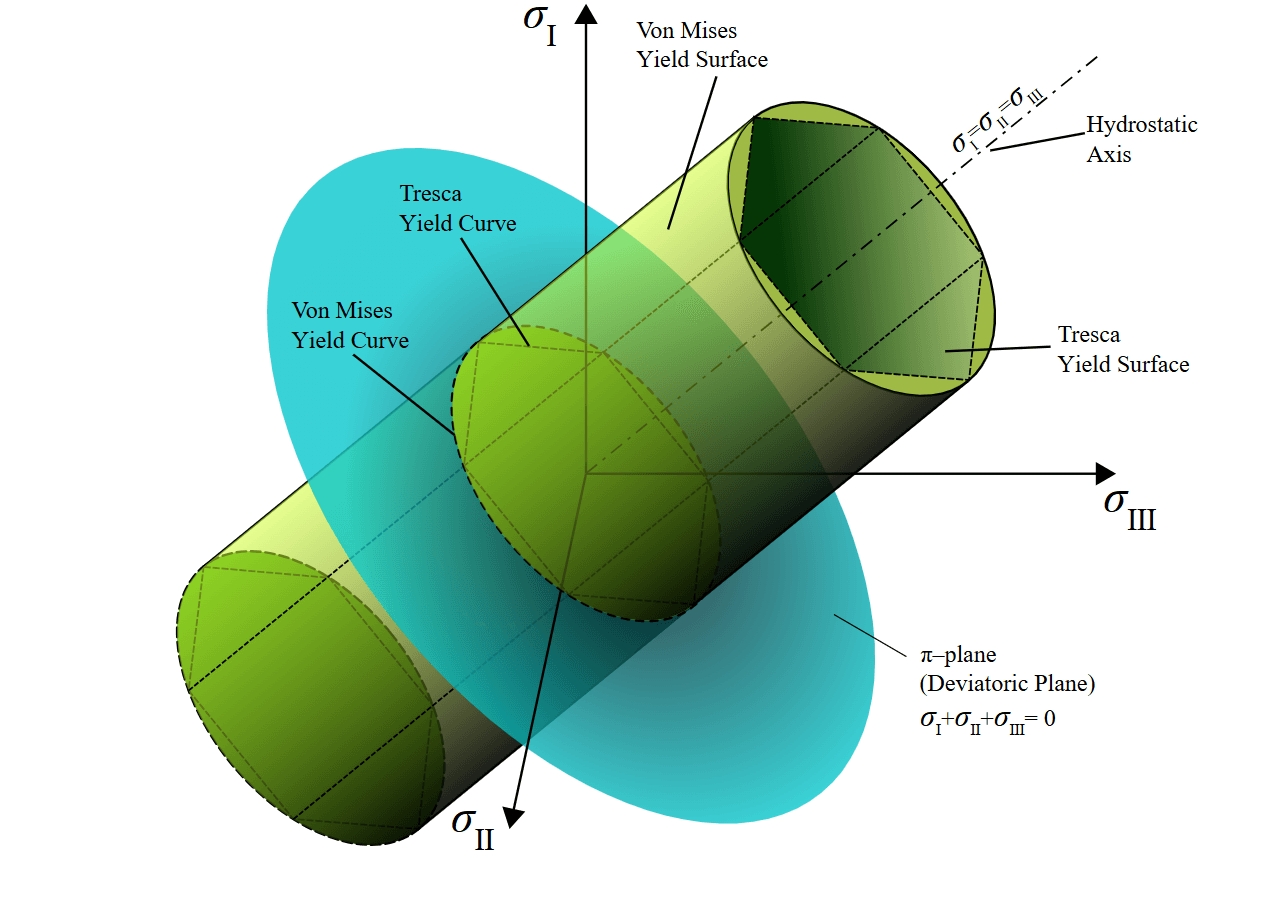
Representation of Material Yield Limits in Three-Dimensional Stress Space
Emergence | 1904 | ||||||||
|---|---|---|---|---|---|---|---|---|---|
Important Researchers | Maximilian Huber, Richard von Mises, Heinrich Hencky | ||||||||
Application Area(s) | Materials Science Strength Tests Engineering Analyses Mechanical Design | ||||||||
Von Mises stress is a stress criterion used to determine whether a material will yield or not. It is particularly widely used for metals and ductile materials (materials that exhibit the same properties in all directions). The von Mises theory is based on the concept of distortion energy and is also commonly referred to as the "distortion energy theory" or "maximum distortion energy theory".
The concept of von Mises stress was first proposed by Maksymilian Huber in 1904. However, it attracted significant attention when Richard von Mises independently reintroduced it in 1913 in a more comprehensive form. Both researchers provided only a mathematical equation; it was Heinrich Hencky who developed the concept of "von Mises stress" with a meaningful physical interpretation.
Von Mises argues that to determine whether a material has yielded, one must consider only the deviatoric stresses (not the total stresses, which include hydrostatic and deviatoric components).

【1】

This stress changes only the volume of the material. Plastic deformation

Beer, Ferdinand P., E. Russell Johnston Jr., John T. Dewolf, and David F. Mazurek. Cisimlerin Mukavemeti. 6. basımdan çeviri. Çev. Ayşe Soyuçok ve Özgün Soyuçok. İstanbul: Literatür Yayıncılık, 2019.
Madier, Dominique. Practical Finite Element Analysis for Mechanical Engineers. 2021.
[1]
"How to Write a Bibliography in Chicago Style." YouTube video, 10:05. Uploaded by Scribbr, August 24, 2020. https://www.youtube.com/watch?v=xkbQnBAOFEg.

Representation of Material Yield Limits in Three-Dimensional Stress Space
Emergence | 1904 | ||||||||
|---|---|---|---|---|---|---|---|---|---|
Important Researchers | Maximilian Huber, Richard von Mises, Heinrich Hencky | ||||||||
Application Area(s) | Materials Science Strength Tests Engineering Analyses Mechanical Design | ||||||||
No Discussion Added Yet
Start discussion for "Von Mises Stress (Distortion Energy Theory)" article
Development of the Theory
Core Concepts