

This article was automatically translated from the original Turkish version.
Architect(s) | Pierre J. H. Cuypers | ||||||||
|---|---|---|---|---|---|---|---|---|---|
Construction Date(s) | 19th century | ||||||||
Exterior Architecture | Neo-Gothic | ||||||||
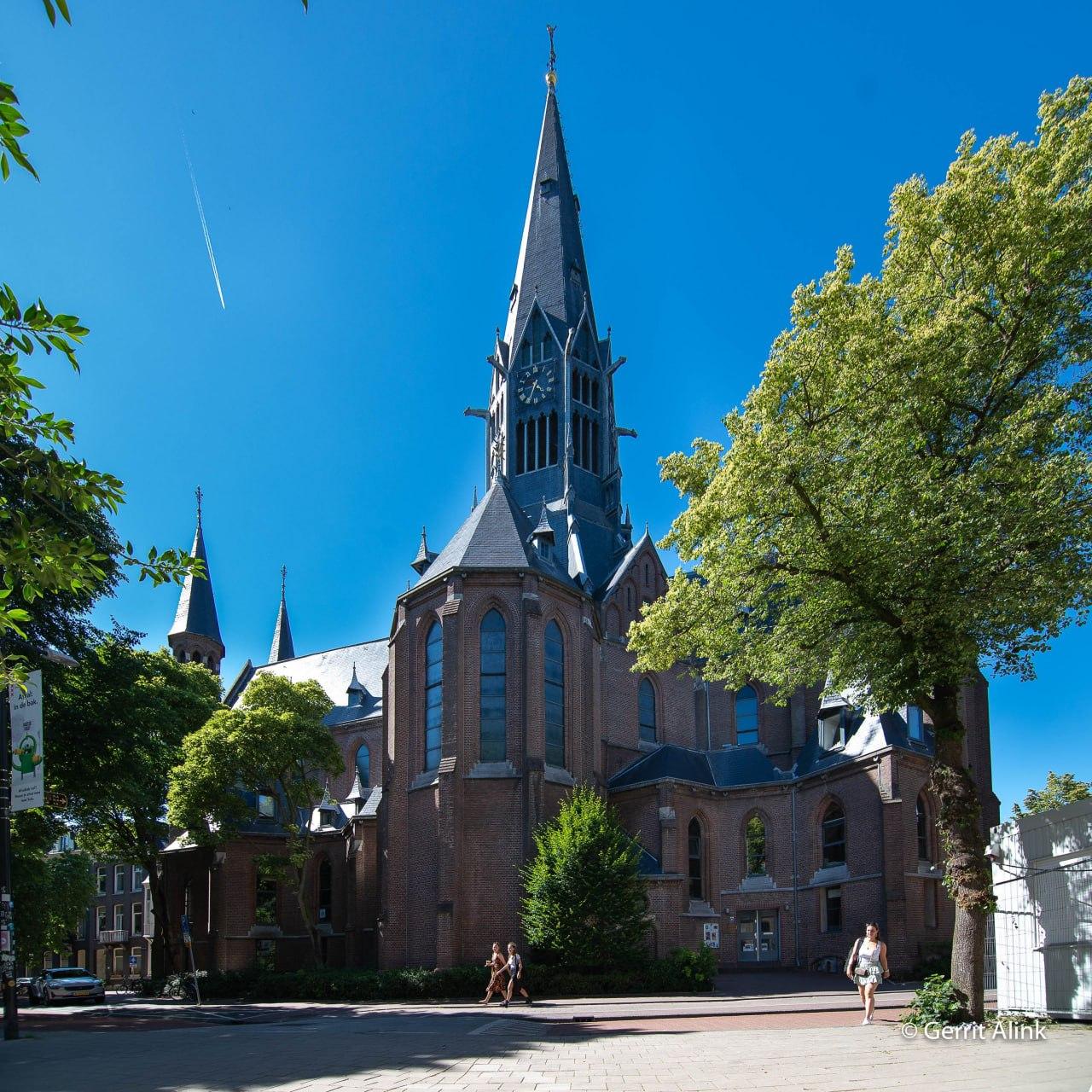
Vondelkerk is a historic church building located in the vicinity of Vondelpark in the city of Amsterdam, Netherlands. Constructed in the second half of the 19th century, it was originally designed as a Roman Catholic church. Today, it no longer serves a religious function and has been repurposed for cultural and public uses.
The construction of Vondelkerk emerged in response to the growing spatial needs of the Catholic community in Amsterdam during the 19th century. The building was planned in alignment with the city’s urban expansion and constructed to serve as a place of worship.
The architectural design of the building was carried out by Pierre J. H. Cuypers, a leading figure in 19th-century Dutch church architecture. The design drew upon the prevailing neo-Gothic style of the period.
Following its completion, Vondelkerk served the Roman Catholic community for many years. During this period, the building hosted regular religious services as well as congregational meetings and religious ceremonies.
In the later decades of the 20th century, demographic and social changes in Amsterdam led to a decline in regular religious use of the church. This trend limited the sustainability of its original function.
Religious activities at Vondelkerk ceased entirely in the last quarter of the 20th century. The termination of its use as a place of worship was carried out in accordance with relevant religious and administrative decisions.
With the end of its religious function, Vondelkerk was removed from its status as a place of worship and reclassified as a heritage building requiring preservation. At this stage, new proposals for its future use began to be explored.
Vondelkerk exhibits characteristic features of the neo-Gothic architectural style. Its façade emphasizes pointed arches, vertical accents, and symmetrical proportions. The architectural language aligns with the broader aesthetic principles of 19th-century European church design.
The interior is organized around a high-ceilinged central nave. The spacious volume and open plan made the building suitable for both worship and public uses. The use of light and spatial proportions supported the perceptual coherence of the interior.
The building’s structural system and materials reflect the technical capabilities of its construction era. Original architectural details were identified as elements to be preserved during subsequent interventions.
Vondelkerk has been recognized as a structure requiring preservation due to its historical and architectural value. This status has led to conservation policies aimed at safeguarding its original features.
The building was taken over by Stadsherstel Amsterdam, an organization active in the preservation and adaptive reuse of historic structures. The interventions carried out during this period aimed to preserve the building’s architectural integrity while adapting it to new functional requirements.
Vondelkerk has been redefined as a multi-purpose public building open to non-religious uses. This approach sought to reintegrate the building into cultural and social life.
During the adaptive reuse process, interior modifications were carried out in a manner that did not compromise the building’s historical character. Original architectural elements were preserved, and the space was modified to accommodate a variety of activities.
Today, Vondelkerk functions as a venue for concerts, exhibitions, and various artistic events. Its acoustic and spatial qualities provide an appropriate environment for such activities.
The building is also used for meetings, private events, and other organizational activities. This mode of use contributes to the continuation of its public function.
The building is considered one of Amsterdam’s historic religious architectural examples and is regarded as part of the city’s cultural heritage.
Historical information regarding Vondelkerk is documented in archival records held by institutions affiliated with the Amsterdam Municipality. These archives provide documentary evidence on the building’s construction, periods of use, and changes in status.
On January 1, 2026, during New Year’s celebrations, a fire broke out in Vondelkerk. The fire caused damage to the interior sections of the building, and following the incident, the structure was temporarily closed to the public for safety reasons. Authorities have initiated an investigation to determine the cause of the fire.
Amsterdam Municipality Archives (Stadsarchief Amsterdam). "Vondelkerk." Amsterdam.nl. Accessed January 1, 2026.
NTV. "154 yıllık kilisede yangın: Yeni yıl kutlamaları alevlerle bitti." NTV, January 1, 2026. Accessed January 1, 2026. https://www.ntv.com.tr/dunya/154-yillik-kilisede-yangin-yeni-yil-kutlamalari-alevlerle-bitti-1705598
Stadsherstel Amsterdam. "Vondelkerk – Eventlocatie." Stadsherstel Amsterdam. Accessed January 1, 2026.


Architect(s) | Pierre J. H. Cuypers | ||||||||
|---|---|---|---|---|---|---|---|---|---|
Construction Date(s) | 19th century | ||||||||
Exterior Architecture | Neo-Gothic | ||||||||
Historical Background
Religious Function Period
Use as a Church
End of Religious Function
Architectural Features
Architectural Style
Interior Layout
Structural Elements
Conservation and Restoration Process
Cultural Heritage Status
Stadsherstel Amsterdam Period
Adaptive Reuse
Current Uses
Place within the Urban Fabric
January 1 Fire