

+1 More

Vyshyvanka
Type(s) | Traditional folk garment | ||||||||
|---|---|---|---|---|---|---|---|---|---|
Origin(s) | Ukraine | ||||||||
First Known Use | Pre-Christian era | ||||||||
Material(s) | Wool Cotton Hemp Linen | ||||||||
Technique | Hand embroidery | ||||||||
The term vyshyvanka refers to a traditional Ukrainian embroidered shirt, notable for its distinctive ornamentation and its symbolic role in Ukrainian culture. It is derived from the Ukrainian verb vyshyvaty (to embroider) and functions both as a garment and a cultural artifact. While the term commonly denotes the embroidered shirt itself, it may also refer more broadly to Ukrainian traditional embroidery as a practice and medium of cultural expression.

Embroided map of Ukraine (Kyiv Independent)
Vyshyvankas are characterized by geometric, floral, and zoomorphic motifs rendered through hand embroidery, typically on linen or hemp fabric. Color schemes and patterns vary by region and historical period, serving as a form of local identification. Historically, the vyshyvanka was worn by both men and women and was associated with everyday use, festive occasions, and ritual practices.
The origins of vyshyvanka embroidery can be traced back to pre-Christian times, with archaeological finds and ethnographic records indicating the presence of embroidery on clothing in ancient Ukrainian territories. Over time, embroidery evolved into a highly developed symbolic system, functioning as both decoration and protective amulet. During the 19th and early 20th centuries, as Ukrainian national consciousness grew, vyshyvanka embroidery became increasingly tied to identity politics and cultural resistance, especially under regimes seeking to suppress Ukrainian cultural expressions.

A young couple in traditional Ukrainian clothing in Volyn Oblast, Ukraine (
Vyshyvankas differ significantly across Ukrainian regions in terms of embroidery technique, ornamental motifs, color preferences, and garment construction. For example:
These regional differences not only reflect aesthetic preferences but also indicate variations in historical development, trade routes, and intercultural contact.
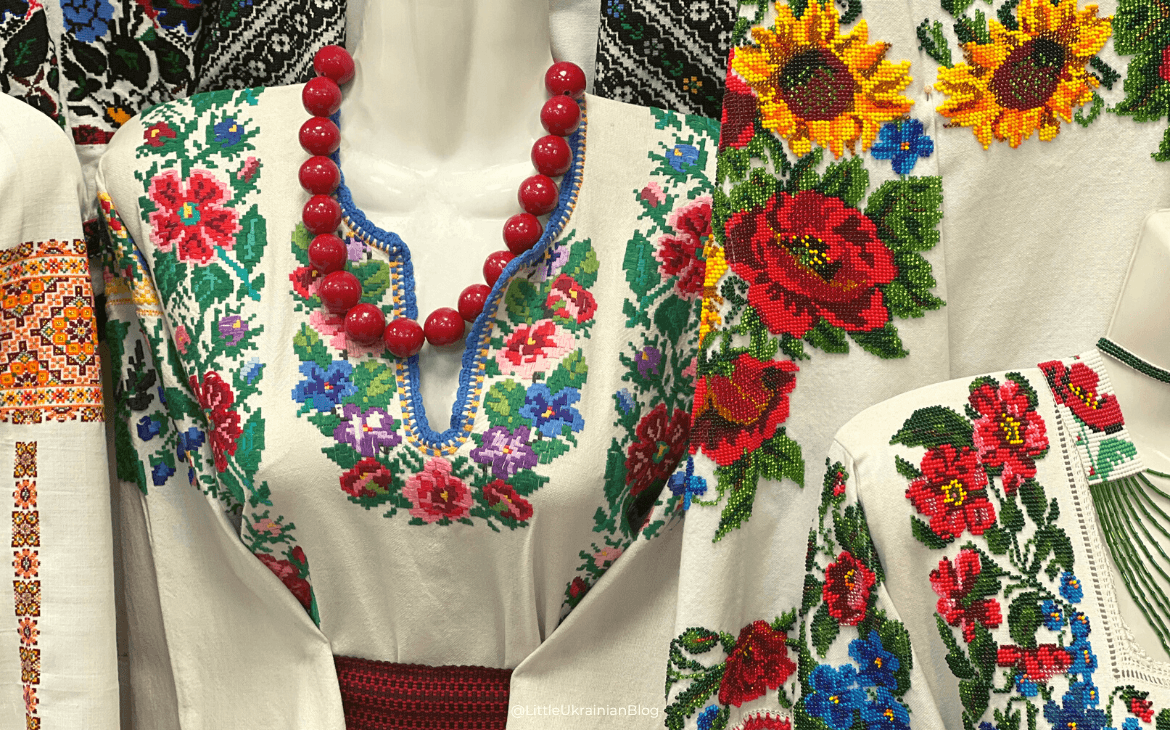
The ornamental language of vyshyvanka is deeply symbolic. Common motifs such as the berehynia (female protector), the tree of life, eight-pointed stars, and rhombuses are interpreted as symbols of fertility, continuity, cosmic order, and protection. Embroidery was believed to possess apotropaic qualities, warding off evil and bringing good fortune. Placement of embroidery was deliberate—necklines, cuffs, and hems were embroidered as symbolic “boundaries” of the human body to protect the wearer.

Vyshyvanka (Little Ukrainianblog)
Vyshyvankas also served social and communicative functions. They indicated the wearer’s age, marital status, social standing, and regional identity. In some areas, specific patterns were used for mourning or nuptial attire. Women's shirts often bore more intricate and symbolically charged designs, particularly in rites of passage and family ceremonies.
Traditional vyshyvanka embroidery was executed using natural materials—linen or hemp fabric, and threads dyed with vegetal pigments. Techniques included cross-stitch, satin stitch, openwork, hemstitching, and white embroidery. The choice of technique often depended on regional traditions, the purpose of the garment, and available resources.

Vyshyvanka (Little Ukrainianblog)
Embroidery was typically taught from mother to daughter and often commenced at a young age. Creating a personal vyshyvanka was part of a girl’s dowry and a measure of her diligence and skill. The making of these garments was intimately tied to seasonal cycles, religious calendars, and communal labor practices.
In contemporary Ukraine, the vyshyvanka has transcended its original function as a folk costume and emerged as a symbol of national identity and resilience. Since Ukraine’s independence in 1991, and particularly during periods of political unrest, such as the 2014 Revolution of Dignity and the full-scale Russian invasion in 2022, the vyshyvanka has become a prominent symbol of cultural affirmation and civic unity.

Vyshyvanka Bayraktar (Ukrinform)
Vyshyvanka Day, an unofficial holiday initiated in 2006 and observed on the third Thursday of May, has gained national and international popularity. On this day, Ukrainians wear embroidered shirts to demonstrate pride in their heritage. The global Ukrainian diaspora has also adopted vyshyvanka practices, reinforcing cultural ties and solidarity abroad.
Numerous museums, private collectors, and ethnographers have contributed to preserving and cataloguing vyshyvankas. Projects include the documentation of regional styles, reproduction of historic patterns, and publication of embroidery manuals. Significant scholarly work has been conducted on the semiotics of embroidery, its ritual functions, and its role in the construction of Ukrainian cultural memory.
Institutional efforts, such as those by the National Center of Folk Culture “Ivan Honchar Museum,” as well as individual researchers and collectors, have made important contributions to the safeguarding of vyshyvanka heritage. Despite challenges related to modernization and mass production, interest in authentic techniques and regional specificity continues among both artisans and researchers.
"41.pdf." Dspace.pnpu.edu.ua. Accessed 2025. https://web.archive.org/web/20190708140615/http://dspace.pnpu.edu.ua/bitstream/123456789/7384/1/41.pdf
"Etnokulturna Spadshchyna." Internet Archive. Accessed 2025. https://archive.org/details/etnokulturi/page/n89/mode/2up?view=theater
"File.pdf." Diasporiana. Accessed 2025. https://web.archive.org/web/20210522140018/https://diasporiana.org.ua/wp-content/uploads/books/11927/file.pdf
"Lvivski Maistryni Vygotovliaiut Vyshyvanky iz Vizerunkom Bayraktar." Accessed 2025. Львівські майстрині виготовляють вишиванки із візерунком Bayraktar
"Slovnyk Symvoliv Ukrainskoi Kultury." Internet Archive. Accessed 2025. https://archive.org/details/slovnyksymvoliv/page/n113/mode/2up?view=theater
"The Vyshyvanka." Little Ukrainian Blog. Accessed 2025. The Vyshyvanka - Little Ukrainian Blog
"Ukraine Heritage Spotlight: Vyshyvanka – Ukrainian Embroidered Activism." European Heritage Hub. Accessed 2025. https://www.europeanheritagehub.eu/document/ukraine-heritage-spotlight-vyshyvanka-ukrainian-embroidered-activism/
"Ukrainska Narodna Vbrannia." NB Ukraine Library. Accessed 2025. http://irbis-nbuv.gov.ua/cgi-bin/ua/elib.exe?Z21ID=&I21DBN=UKRLIB&P21DBN=UKRLIB&S21STN=1&S21REF=10&S21FMT=online_book&C21COM=S&S21CNR=20&S21P01=0&S21P02=0&S21P03=FF=&S21STR=ukr0000215
"Vyshyvana Istoriia: Kilka Tsikavykh Faktiv pro Vyshyvanku." Meridian Kpnu. Accessed 2025. https://meridian.kpnu.edu.ua/2021/05/20/vyshyvana-istoriia-kilka-tsikavykh-faktiv-pro-vyshyvanku/
"Vyshyvanka: Traditional Ukrainian Embroidered Shirt." The Kyiv Independent. Accessed 2025. https://kyivindependent.com/vyshyvanka-traditional-ukrainian-embroidered-shirt/
"Vyshyvanka: Ukrainian Tradition Preserved Through Centuries." The Kyiv Independent. Accessed 2025. https://kyivindependent.com/vyshyvanka-ukrainian-tradition-preserved-through-centuries/
Antonovych, Ye. A., R. V. Zakharchuk-Chuhai, and M. Ye. Stankevych. Dekoratyvno-prykladne mystetstvo. Lviv: Svit, 1993
Lozynskyi, Taras. Bukovynski Zhinochi Sorochky: Kataloh Pryvatnykh ta Muzeinykh Tvoriv. Accessed 2025. https://shron1.chtyvo.org.ua/Lozynskyi_Taras/Bukovynski_zhinochi_sorochky_kataloh_pryvatnykh_ta_muzeinykh_tvoriv.pdf?
Pavliuk, S. P., ed. Ukrainske narodoznavstvo: Navchalnyi posibnyk. 3rd ed., revised. Kyiv: Znannia, 2006

Vyshyvanka
Type(s) | Traditional folk garment | ||||||||
|---|---|---|---|---|---|---|---|---|---|
Origin(s) | Ukraine | ||||||||
First Known Use | Pre-Christian era | ||||||||
Material(s) | Wool Cotton Hemp Linen | ||||||||
Technique | Hand embroidery | ||||||||
No Discussion Added Yet
Start discussion for "Vyshyvanka (Ukrainian Embroidered Shirt)" article
Historical Context
Regional Variations
Symbolism and Function
Techniques and Materials
Modern Relevance
Preservation and Documentation
This article was created with the support of artificial intelligence.