


This article was automatically translated from the original Turkish version.
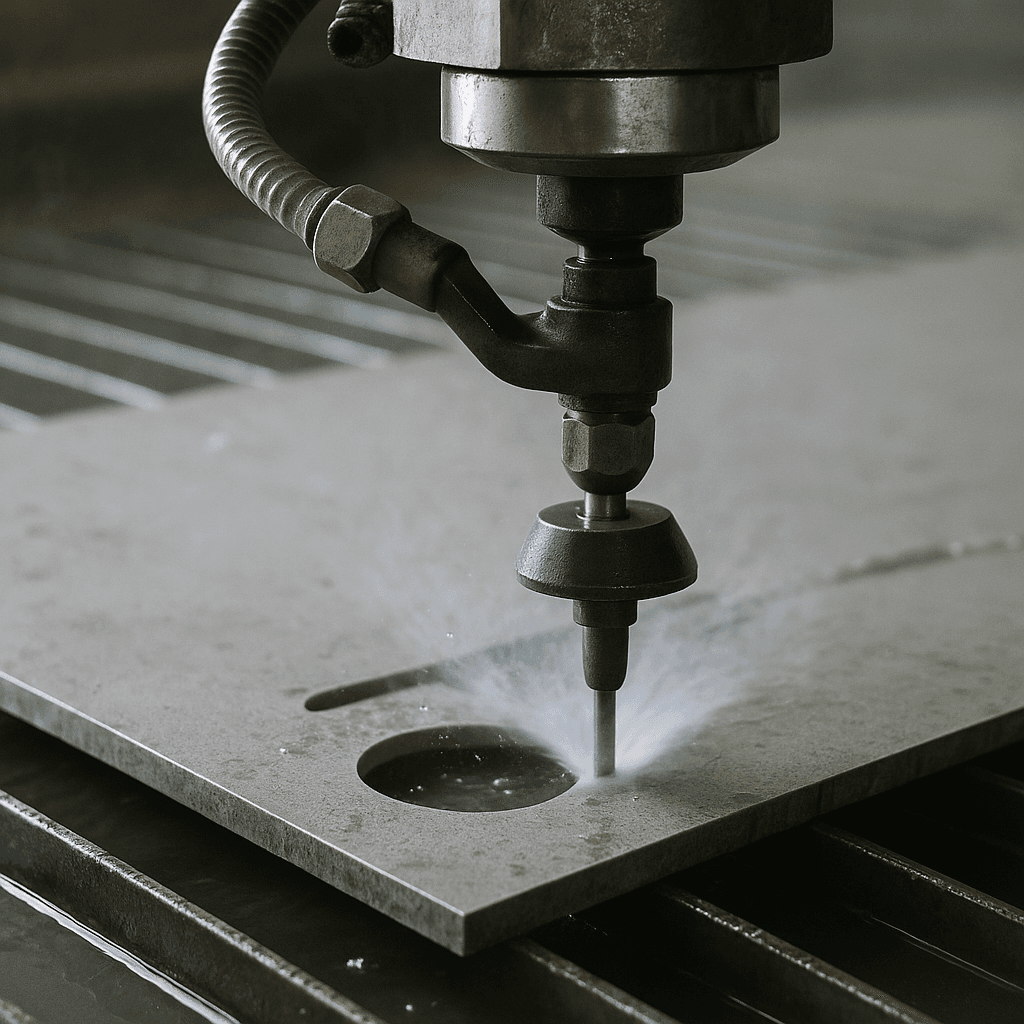
Pure Water Jet
Technology | Waterjet cutting systems (Waterjet Cutting, Abrasive Waterjet Cutting) | ||||||||
|---|---|---|---|---|---|---|---|---|---|
Work Pressure | 3000–4000 bar | ||||||||
Cutting Speed | 100–2000 mm/min (variable depending on material and nozzle diameter) | ||||||||
Jet Speed | 700–900 m/s | ||||||||
Nozzle Material | Sapphire, Diamond, Ceramic | ||||||||
Application Area(s) | Automotive Construction Food Glass-ceramic Electronics Defense Aerospace | ||||||||
Advantage(s) | Non-contact process Low cost Precision cutting Eco-friendly design Thermal neutrality | ||||||||
Water jet cutting is a modern, non-contact cutting technology based on the principle of material removal through erosion, achieved by directing a high-velocity jet of liquid water through a narrow nozzle under extremely high pressure.
Industrially, it is widely used for various operations such as cutting, drilling, milling, and surface hardening. This method is preferred in production environments where high precision and heat-free processing are critical, serving as an alternative to conventional chip-removal manufacturing processes.

Pure Water Jet (Generated by Artificial Intelligence)
The pure water jet method is a system that uses water alone without any abrasive particles. It is particularly suited for precise cutting of soft and porous materials such as sponge, paper, textiles, gaskets, plastics, cardboard, thin rubber, and diapers.
During the cutting process, water is typically forced through a sapphire nozzle to reach pressures of approximately 3000–4000 bar. If water contact with the material is problematic—for example, with hydrophilic plastics—alternative cutting fluids such as vegetable oil or alcohol may be used.
Abrasive water jet enables the processing of hard materials that are difficult to machine using conventional methods, such as steel, titanium, ceramics, glass, granite, and carbon fiber. In this method, abrasives such as garnet, boron carbide (B₄C), silicon carbide (SiC), or aluminum oxide (Al₂O₃) are mixed into the water stream. These abrasive particles are accelerated by the high kinetic energy of the water jet, creating micro-cracks on the material surface and removing chips.
The operation of water jet systems is based on a two-stage energy conversion: generation of potential energy and its transformation into kinetic energy. Using specially designed piston or intensifier pumps, water is compressed to pressures of up to 4000 bar. This high-pressure water is then forced through a nozzle with a diameter of 0.1–0.6 mm, made of sapphire, ceramic, or diamond, achieving velocities of 700–900 m/s—2.5 to 3 times the speed of sound.
In AWJ systems, water and abrasive material first pass through separate channels and meet in a mixing chamber. Here, approximately 0.3% of the kinetic energy is transferred to the abrasive particles. This complex momentum transfer enables the generation of high-energy abrasive particles, facilitating the cutting process.

Metal Part Cutting Using Abrasive Water Jet (pexels)

Components of a Pure Water Jet System (Generated by Artificial Intelligence)
Although water jet technology offers numerous advantages, it also presents certain technical and economic limitations, particularly in terms of system cost, maintenance requirements, and processing constraints:
Water jet technology offers a strong alternative to conventional cutting methods through its high precision, eco-friendly nature, and versatile application capabilities. Pure water jets excel in low-cost cutting of soft and delicate materials, while abrasive water jets provide a unique solution for processing hard, layered, and complex materials. Thanks to its non-contact nature, tool wear is eliminated, and the desired geometry and surface quality are achieved through controlled use of high-pressure water and abrasives. Water jet systems, which integrate easily with industrial automation, are seeing growing adoption across numerous sectors including automotive, aerospace, defense, glass-ceramics, electronics, and food. Considering all these features, water jet cutting technology will continue to be an indispensable manufacturing method in the future.
Akkurt, Adnan. “Su Jeti ile Kesme Sistemleri ve Uygulama Alanlarının Değerlendirilmesi.” Politeknik Dergisi 7, no. 2 (2004): 129–139. https://dergipark.org.tr/tr/download/article-file/384388.
Armağan, Mustafa, and A. Armağan Arıcı. “Aşındırıcılı Su Jetinde Eğimli Kesimin İncelenmesi.” *Afyon Kocatepe Üniversitesi Fen ve Mühendislik Bilimleri Dergisi* 19 (2019): 480–489. https://fenbildergi.aku.edu.tr/wp-content/uploads/2019/09/025904-480-489.pdf.
Ay, İbrahim. "Aşındırıcılı Su Jeti." Master's thesis, Marmara Üniversitesi, 2007. Accessed May 17, 2025. https://www.ibrahimay.net/wp-content/uploads/2014/01/ibrahim_ay_asindiricili_sujeti.pdf.
Demirer, Ahmet. *Su Jeti ile Kesme Tekniği*. PDF presentation, November 16, 2022. Accessed May 17, 2025. https://acikkaynak.bilecik.edu.tr/server/api/core/bitstreams/43375f6b-c83c-47d0-ba8e-492f1157b188/content.
Demirer, Ahmet. *Su Jeti ile Kesme Tekniği*. Presentation, 2022. Accessed May 17, 2025. https://dokumanapi.bys.subu.edu.tr/File/2022/11/16/a8cef3cd-aa92-40ce-95e4-65f0e2222cde.pdf.
Mendi, Faruk, and Mustafa Kemal Külekçi. “İmalatta Su Jeti Uygulamalarının Değerlendirilmesi.” Pamukkale Üniversitesi Mühendislik Bilimleri Dergisi 5, no. 2–3 (1999): 1067–1075. https://dergipark.org.tr/tr/download/article-file/191462.
Yazıcıoğlu, Osman, and Senai Yalçınkaya. “Aşındırıcılı Su Jeti Uygulamaları ve Üretimde Yoğun Kullanıma Sahip Malzemelerin Delinmesi.” ResearchGate. Accessed May 17, 2025. https://www.researchgate.net/publication/237679920_ASINDIRICILI_SU_JETI_UYGULAMALARI_VE_URETIMDE_YOGUN_KULLANIMA_SAHIP_MALZEMELERIN_DELINMESI.
Yazıcıoğlu, Osman, and Senai Yalçınkaya. “Endüstride Aşındırıcılı Su Jeti Tasarımları.” Marmara Üniversitesi Teknik Eğitim Fakültesi, 2006. Accessed May 17, 2025. https://www.mmo.org.tr/sites/default/files/188905e74c28e48_ek.pdf.

Pure Water Jet
Technology | Waterjet cutting systems (Waterjet Cutting, Abrasive Waterjet Cutting) | ||||||||
|---|---|---|---|---|---|---|---|---|---|
Work Pressure | 3000–4000 bar | ||||||||
Cutting Speed | 100–2000 mm/min (variable depending on material and nozzle diameter) | ||||||||
Jet Speed | 700–900 m/s | ||||||||
Nozzle Material | Sapphire, Diamond, Ceramic | ||||||||
Application Area(s) | Automotive Construction Food Glass-ceramic Electronics Defense Aerospace | ||||||||
Advantage(s) | Non-contact process Low cost Precision cutting Eco-friendly design Thermal neutrality | ||||||||
Types of Water Jets
1. Pure Water Jet (Pure Water Jet - PJ)
2. Abrasive Water Jet (Abrasive Water Jet - AWJ)
Working Principle
Materials That Can Be Cut
Materials Cut by Pure Water Jet:
Materials Cut by Abrasive Water Jet:
System Components
Advantages
Disadvantages
Application Areas