


This article was automatically translated from the original Turkish version.
+1 More
The wavelet transform is a fundamental tool in signal processing, time-frequency analysis, and data science, generating powerful insights across diverse domains. Developed to overcome the limitations of the traditional Fourier transform in frequency-only analysis, the wavelet transform enables the simultaneous examination of signals in both time and frequency domains. This capability provides a significant advantage, particularly when analyzing signals with irregular, transient, or localized features. For instance, detecting an abrupt burst in an audio signal or sharp edges in an image can be performed far more easily and effectively using wavelet transforms.
The development of the wavelet transform was shaped by mathematicians and engineers in the late 20th century seeking innovative solutions to complex problems. Introduced in the 1980s by Jean Morlet during petroleum research, this concept was later formalized into a mathematical framework through the contributions of Yves Meyer, Ingrid Daubechies, and Stéphane Mallat (Mallat, n.d.). Unlike the Fourier transform, the wavelet transform does not use a fixed window size; instead, it analyzes signals using scalable and shiftable wavelet-like functions. This flexibility has made the wavelet transform indispensable in a wide range of applications including signal compression, noise reduction, image processing, and even machine learning.
The term wavelet, meaning "small wave" in French, refers to a mathematical function that oscillates over a limited duration. Unlike traditional sine and cosine waves, wavelets are designed to have a zero mean value and are concentrated within a specific time interval. This property makes them ideal for analyzing local features. For example, the simple Haar wavelet can take the form of a square wave and is commonly used to detect abrupt changes.
The foundation of the wavelet transform lies in scaling and shifting a mother wavelet function. Scaling alters the width or frequency of the wavelet, while shifting adjusts its position along the time axis. These two operations allow the signal to be analyzed at different resolutions and time intervals. Mathematically, a wavelet function is expressed as:
As the scale decreases, the wavelet narrows and captures high-frequency components; as the scale increases, it broadens and analyzes low-frequency components.
The wavelet transform is divided into two main categories: the Continuous Wavelet Transform (CWT) and the Discrete Wavelet Transform (DWT). The continuous transform is used when scale and shift parameters vary continuously and is suitable for theoretical analysis. The discrete transform, however, is more common in practical applications, where scale and shift parameters are typically chosen as powers of two (dyadic grid).
The Continuous Wavelet Transform is an integral transform that measures how well a signal matches with wavelets. Mathematically, it is defined as:
The wavelet transform is widely used in signal processing for noise reduction and data compression. For example, the JPEG2000 image compression standard is based on the DWT and reduces file size without quality loss. In audio signals, it is preferred for isolating transient noises.
In image processing, the wavelet transform is employed for edge detection, texture analysis, and compression. Thanks to its multi-resolution property, both the overall structure and fine details of an image can be analyzed simultaneously.
In data science, the wavelet transform serves as a powerful tool for feature extraction. It is frequently used in applications such as anomaly detection in time series data or analysis of financial datasets.
Wavelets are also effective in seismic analysis, biomedical signal processing (e.g., EEG and EKG), and fault detection. For example, abrupt changes in seismic signals can be easily identified using wavelets.
The greatest advantage of the wavelet transform is its flexibility in time-frequency analysis. Unlike the Fourier transform, it can focus on local features and decompose information across multiple scales. Additionally, it enhances efficiency in applications such as compression and noise reduction.
However, applying the wavelet transform can be complex. Selecting the appropriate wavelet type and managing computational cost may pose challenges in some cases. Moreover, the continuous transform is generally not preferred in practical applications due to its tendency to generate excessive data.
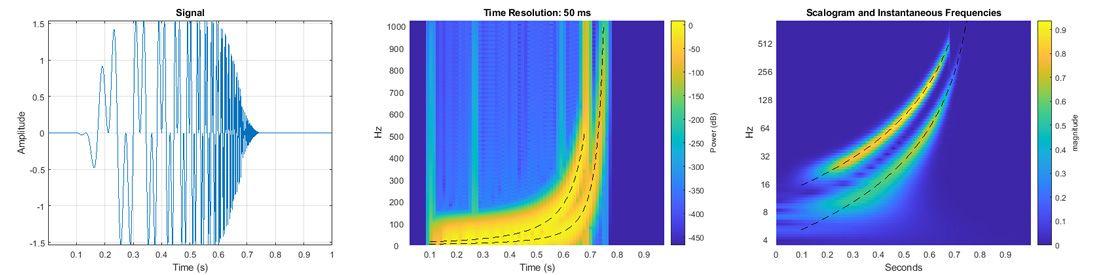
From left to right: Analysis of a two-component hyperbolic chirp signal varying over time in MATLAB. While the Short-Time Fourier Transform fails to clearly distinguish instantaneous frequencies, the Continuous Wavelet Transform accurately captures them. (Credit: mathworks.com)

Visualization of the Wavelet Transform in one-dimensional, two-dimensional, and three-dimensional spaces. (Credit: ataspinar.com)
Output:
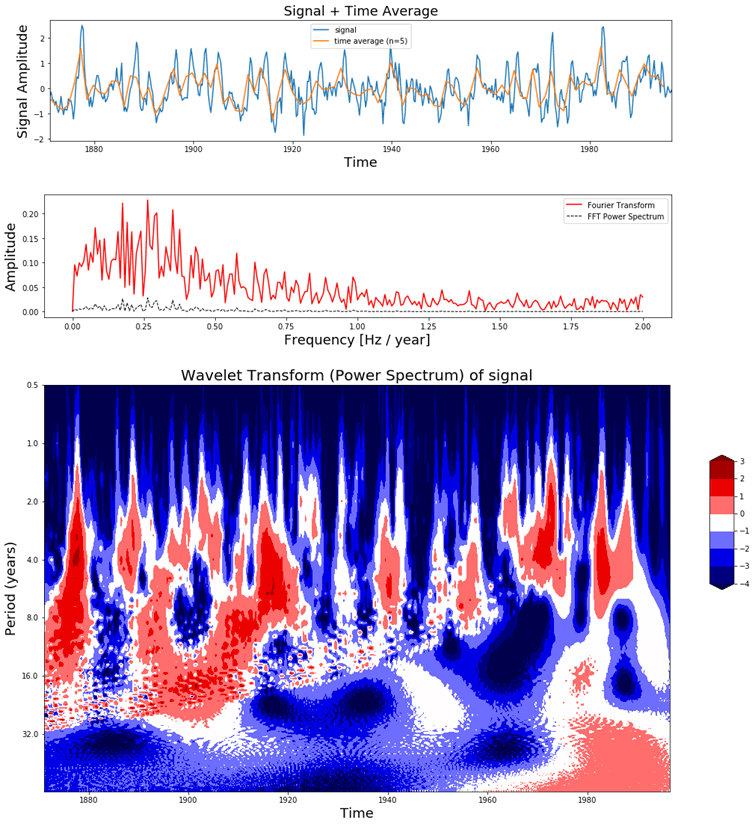
(Credit: ataspinar.com)
Cetin, A.E. "Introduction to Wavelet Transform." Ryerson University.
MathWorks. "What Are Wavelet Transforms?"
Sadowsky, J. "The Contnuoıs Wavelet Transform: A Tool For Signal Investigation And Understanding". Accessed Adresi.
Signal Analysis: Wavelets, Filter Banks, Time-Frequency Transforms and Applications. (1999). "Wavelet Tranform. Chapter 8. Accessed Adresi.
Talebi, S. (2022). "Fourier vs. Wavelet Transform: What's the Difference?". Accessed Adresi.
Taspinar, Ahmet. (2018). "A guide for using the Wavelet Transform in Machine Learning". Accessed Adresi.

No Discussion Added Yet
Start discussion for "Wavelet Transform (Dalgacık Dönüşümü)" article
Core Concepts of the Wavelet Transform
Wavelet
Scaling and Shifting Concepts
Continuous and Discrete Wavelet Transforms
Mathematical Foundations
Continuous Wavelet Transform (CWT)
Applications of the Wavelet Transform
Signal Processing and Compression
Image Analysis and Processing
Data Science and Machine Learning
Other Engineering and Scientific Applications
Advantages and Limitations
Advantages of the Wavelet Transform
Challenges and Constraints
Visualizing State Space Using the Wavelet Transform