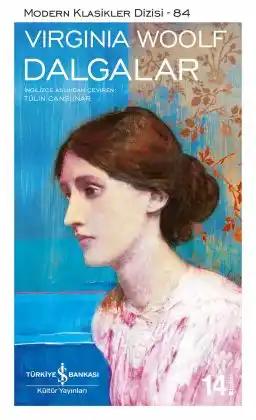
The Waves (original title: The Waves) is an experimental novel written by the English modernist author Virginia Woolf and first published in 1931. Recognized as one of Woolf’s most poetic and formally innovative works, the novel conveys the lives of six friends from childhood to old age primarily through interior monologues (soliloquies).
The Waves does not follow a traditional narrative structure. Instead, it presents in lyrical language the thoughts, emotions, and perceptions of six main characters—Bernard, Neville, Louis, Susan, Jinny, and Rhoda—as they unfold across a temporal span encompassing their childhood, school years, adulthood, and old age.
Each section consists of monologues reflecting the inner voices of the characters. Between these monologues are nine interludes written in italics, depicting a single day from sunrise to sunset over a coastal landscape. These interludes symbolize both the rhythmic cycles of nature—the movement of the sea and the waves—and the life stages of the characters.
The characters occasionally come together around Percival, a central but physically absent friend. Percival’s departure for India and subsequent death mark pivotal turning points in the group’s shared experience. The novel explores their individual quests for identity, their complex relationships with one another, the passage of time, and the search for meaning in existence.
- Bernard: The group’s storyteller and voice of expression. He constantly seeks to make sense of life through narratives and language, yet struggles with the inadequacy of words to capture reality. In the final section, he attempts to synthesize the lives of the other characters into a unified whole.
- Neville: A poet who seeks order and perfection. He is defined by his intense love and admiration for Percival. He is drawn to classical literature and male relationships.
- Louis: An ambitious businessman who feels alienated due to his Australian origins. He yearns to root himself in history and tradition, seeking stability and continuity.
- Susan: A character deeply connected to nature and rural life. She desires motherhood and a life tied to the land, avoiding the artificiality of the city.
- Jinny: A character focused on physical existence, fleeting pleasures, and social interaction. She loves dancing, parties, and romantic relationships, living intensely in the moment.
- Rhoda: The most introverted and fragile member of the group. She perceives herself as identity-less and “faceless.” Escaping the harshness of reality, she retreats into her imagination and ultimately commits suicide. She embodies the most intense exploration of the self.
- Percival: A figure who never appears physically in the novel but plays a central role in the lives of the six characters. To the others, he represents an ideal, a symbol of unity, and an object of admiration. His early death in India leaves a profound impact on the group.
- The Self and Identity: The central theme of the novel is the nature of individual identity. Woolf argues that the self is not a fixed or unified structure but rather fragmented, fluid, and in constant interaction with other selves. The six characters are presented both as distinct individuals and as different facets of a single consciousness.
- Time, the Cycle of Life, and Death: The movement of the sun and waves in the interludes symbolizes the cyclical progression of human life from childhood to old age and death. The passage of time and the sense of transience echo throughout the characters’ monologues. The deaths of Percival and Rhoda concretize this theme.
- Language, Narrative, and Reality: Through the character of Bernard especially, the capacity of language to express experience and capture reality is questioned. The dual nature of stories and expressions—as both unifying and limiting—is emphasized.
- Unity and Separation: The characters experience a fleeting sense of unity and wholeness when they come together, particularly around the figure of Percival. However, as life progresses, they individualize and drift apart (“We suffered terribly as we became separate bodies”).
- Nature and Civilization: The image of the wave represents nature’s constant motion, power, and sometimes indifference. This natural rhythm contrasts with the mechanicality and chaos of modern urban life, especially in London.
- Binary Oppositions: The novel is structured around fundamental binary oppositions such as order and chaos, life and death, individuality and collectivity, light and darkness, from a structuralist perspective.
Style and Narrative Features
The Waves is Woolf’s most experimental novel and clearly departs from traditional narrative structures.
- Interior Monologue (Soliloquy): The majority of the narrative consists of lyrical monologues that directly convey the inner voices of the six characters. These monologues reflect their immediate perceptions, memories, and thoughts.
- Poetic Language: Woolf employs a highly poetic, image-laden, and rhythmic language that blurs the boundaries between prose and poetry.
- Rhythmic Structure: The novel possesses a distinct rhythm, evident both in the interlude descriptions of waves and in the flow of the monologues. Woolf stated that this rhythm constitutes the novel’s structure.
- Symbolism: Symbols such as the waves (the flow of time, the rhythm of life, individual and collective consciousness), the sun (the cycle of life), and the ring or circle (unity, repetition, wholeness) provide structural and thematic cohesion to the novel.
- Interludes: Written in italics, these sections describe natural landscapes—the seashore, the movement of the sun, the waves—in an objective tone distinct from the main narrative. These interludes form the novel’s overarching structure and establish a symbolic parallel with the characters’ life stages.