


This article was automatically translated from the original Turkish version.
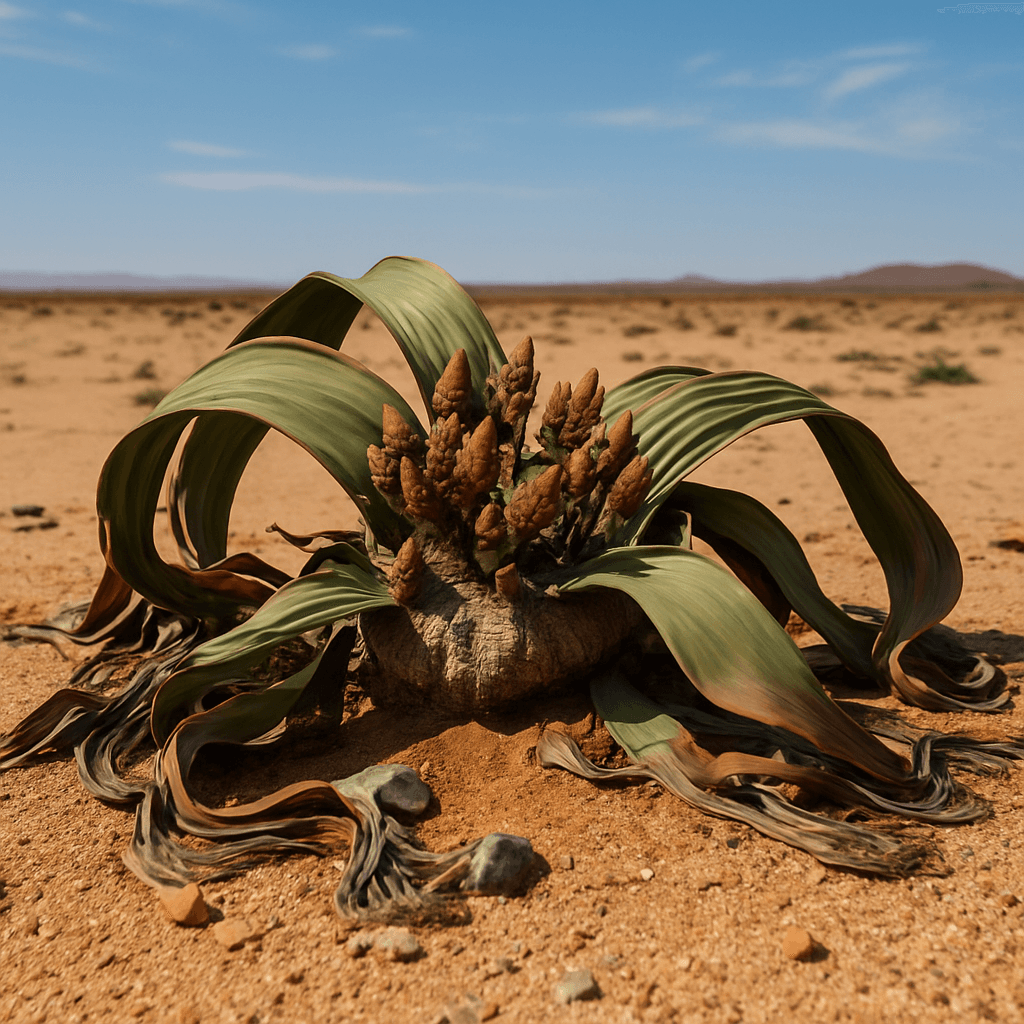
Welwitschia mirabilis
World | Plantae | ||||||||
|---|---|---|---|---|---|---|---|---|---|
Geographical Location(s) | Namib Desert | ||||||||
Family | Welwitschiaceae | ||||||||
Latin | Welwitschia mirabilis | ||||||||
Genus | Welwitschia | ||||||||
Matter | desert plant, long-lived | ||||||||
Welwitschia mirabilis (Welwitschia) is a plant native to the arid regions of Namibia and Angola, characterized by having only two leaves. These leaves grow continuously throughout the plant’s life and gradually wear down over time, becoming frayed into ribbon-like strips. The plant’s central structure is woody, from which the leaves emerge. Some specimens have been known to live for more than 1,500 years.
This species has adapted to extreme arid conditions. It survives in areas where annual rainfall is less than 100 mm and typically obtains its moisture from morning fog. Its deep root system enables it to access underground water sources.
W. mirabilis is found exclusively in the Namib Desert and is therefore an endemic species. Its habitat characteristics and adaptations make it an important subject in botanical research.
Welwitschia mirabilis is the only living species within the division Gnetophyta.
This plant is distinguished by its possession of only two leaves. The leaves grow continuously throughout the plant’s life and gradually fray into ribbon-like structures. The stem is woody, with the leaves emerging from this central structure. The overall height of the plant rarely exceeds 1.5 meters, but the leaf length can reach several meters.
W. mirabilis is a dioecious species, with male and female reproductive organs developing on separate individuals. The reproductive structures are cone-like. Pollination is carried out by flies and certain bees. Seed maturation takes approximately nine months, and seeds are dispersed by wind.

Male and Female Reproductive Structures of Welwitschia mirabilis (Generated by Artificial Intelligence)
Welwitschia mirabilis is a plant adapted to extreme arid and hot climatic conditions. It is found primarily in the arid regions of Namibia and Angola, where annual rainfall is below 100 mm. This low precipitation has shaped its survival strategies. It obtains moisture from morning fog, maintaining its water balance through this adaptation.
The plant generally prefers well-drained sandy or gravelly soils. This soil structure allows air circulation around the roots and prevents water accumulation. The roots of W. mirabilis can extend deep into the ground to reach underground water sources, enabling the plant to survive even under severe drought stress.
In terms of ecological requirements, W. mirabilis thrives in open, sunlit areas. Growth performance is poor in shaded environments. Additionally, the extreme temperature fluctuations in its natural habitat contribute significantly to its adaptive capacity.
Welwitschia mirabilis is typically propagated from seeds. Due to their sensitivity to fungal infections before germination, seeds must be germinated in sterile conditions. Moisture and temperature must be carefully controlled during germination. Germination rates decline significantly if optimal temperature conditions are not maintained.
The plant’s development is extremely slow, and it may take decades to reach full maturity. Therefore, cultivation in controlled environments such as botanical gardens and scientific collections is recommended. Controlled care and suitable climatic conditions in these settings improve germination success and long-term plant health.
Due to habitat destruction, cultivating W. mirabilis is considered an essential component of conservation strategies. This approach helps preserve both the population and genetic diversity of the species.
Welwitschia mirabilis has no direct agricultural or economic value. However, due to its morphologically intriguing structure and long lifespan, it holds a special place in botanical gardens and collections. Its longevity and unique form make it significant to botany enthusiasts and researchers. The plant also has tourism value. In Namibia and Angola, observing W. mirabilis in its natural habitat provides visitors with an engaging experience, contributing indirectly to the regional economy. Furthermore, its cultivation and conservation are regarded as important tools for sustainable ecosystem management and biodiversity preservation. As a result, it has become an indispensable component of botanical research and conservation projects.
Welwitschia mirabilis provides various ecosystem services. The underside of its leaves offers shade and shelter for small animals, particularly during hot and dry periods. This contributes to the formation of microhabitats and indirectly supports the conservation of local biodiversity.
Additionally, the plant’s broad leaves can function as surfaces for moisture collection. The humidity absorbed from morning fog not only supports the plant’s life cycle but also influences soil moisture and environmental balance.
In arid ecosystems, such plants often serve as habitats for organisms at lower trophic levels. Thus, W. mirabilis is a key element in maintaining ecological balance in desert ecosystems.
Welwitschia mirabilis has been used in traditional medicine by some local communities to alleviate digestive issues. Certain compounds in its leaves and roots are believed to enhance nutrient absorption by stimulating digestive enzymes. It also has mild diuretic properties that may support detoxification processes.
Scientific research on the phytochemical composition of this plant is currently limited. However, due to its potential medicinal applications, further research in this area is recommended. In this regard, W. mirabilis is among the plants expected to attract increasing interest in both botanical and pharmacological studies.
Warning: The content presented here is intended solely for general encyclopedic informational purposes. This information must not be used for diagnosis, treatment, or medical advice. Always consult a physician or qualified healthcare professional before making any health-related decisions. Neither the author nor KÜRE Encyclopedia assumes any responsibility for consequences arising from the use of this information for diagnostic or therapeutic purposes.
Welwitschia mirabilis holds cultural and practical significance for local communities. The Herero people, in particular, consume the central part of the female plant, either cooked or raw. This traditional use highlights not only the plant’s nutritional value but also its role as part of the cultural heritage.
The plant is known in the Herero language as "onyanga," meaning "desert onion." This name reflects its usage and importance among local populations.
Additionally, W. mirabilis features in local legends and rituals. The local population believes that the plant’s long lifespan symbolizes resilience and continuity.
I Have Plants. "Cultivating Welwitschia Mirabilis – Facts & Myths." Accessed May 24, 2025. https://ihaveplants.com/plant-directory/cultivating-welwitschia-mirabilis-facts-myths/.
Netmeds. "Welwitschia Mirabilis: Health Benefits, Uses, Dosage, Side Effects & Precautions." Netmeds. Accessed May 24, 2025. https://www.netmeds.com/health-library/post/welwitschia-mirabilis-health-benefits-uses-dosage-side-effects-precautions-and-more.
PlantZAfrica. "Welwitschia Mirabilis." *PlantZAfrica*. Accessed May 24, 2025. https://pza.sanbi.org/welwitschia-mirabilis.
Plants of the World Online. "Welwitschia Mirabilis." Royal Botanic Gardens. Accessed May 24, 2025. https://powo.science.kew.org/taxon/urn:lsid:ipni.org:names:383591-1/general-information.
UC Davis Botanical Conservatory. "Welwitschia Mirabilis." UC Davis Botanical Conservatory. Accessed May 24, 2025. https://conservatory.ucdavis.edu/collections/notable/welwitschia.

Welwitschia mirabilis
World | Plantae | ||||||||
|---|---|---|---|---|---|---|---|---|---|
Geographical Location(s) | Namib Desert | ||||||||
Family | Welwitschiaceae | ||||||||
Latin | Welwitschia mirabilis | ||||||||
Genus | Welwitschia | ||||||||
Matter | desert plant, long-lived | ||||||||
No Discussion Added Yet
Start discussion for "Welwitschia mirabilis" article
Taxonomic Position and Morphological Features
Systematic Classification
Morphological Features
Floral Structure and Reproductive Biology
Growth Conditions and Agricultural Significance
Ecological Requirements
Cultivation Techniques
Agricultural and Economic Value
Ecological and Cultural Significance
Ecosystem Services
Phytochemical Potential and Medicinal Use
Ethnobotanical Perspectives